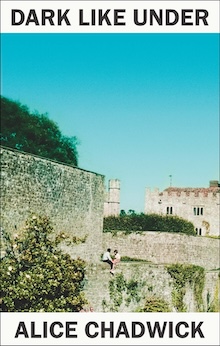
Biblioasis, June 2025
Adolescence is pervaded by a sense of waiting, its long days and longer nights blanketed in the lethargy of teenage time. In her debut novel, Alice Chadwick captures this sensation vividly and compassionately with a story set on a single sultry day near the end of the school year.
Two events erupt in the book’s early pages, rattling a posh school in an unnamed English town: the betrayal of the charismatic Tin by her boyfriend, Jonah, and her best friend, Robin, and the sudden death of a beloved teacher. The aftermath of both is explored through Chadwick’s third-person perspective that drifts through the town, chapter by chapter alighting on one character after another from the book’s large cast of teenagers and their teachers.
At the centre are Tin and Robin. Tin is enigmatic, aloof, always in movement, and has the ability to remove “all trace of herself from herself.” Robin is less confident, seen “moving in the provisional way she has”: “I’m not someone you should look too closely at, Robin’s slide and retreat says. I am someone not entirely ready to be here.” Tin, Robin, and their classmates, families, and teachers are variously burdened by malaise, loss, neglect, violence, poverty, and disease.
To convey the time period, Chadwick inserts an abundance of distinctively 1980s cultural references throughout the text: Bananarama, Tina Turner, Princess Di, yuppies, shoulder pads, Rubik’s Cube, and one maligned spiral perm. The constellation of highbrow and lowbrow cultural references and brand names weave a web, defining and confining the characters with the era’s markers of globalized capitalism, juxtaposing absurd intrusions from advertisements with the political, economic, and social turbulence of the time, alongside the lofty content of their school lessons.
Chadwick does well with the mostly teenaged characters, capturing their restlessness and their concerns, mundane and profound. As viewed by the French teacher, the students “rattle down the corridor and break through the door, smirking, throwing and hushing their voices. Spots, growth spurts, moustaches even, or the shadow of them, flesh burgeoning. A multi-headed monster.” Tin rails against “this small place.” She wants to get “to where she isn’t known. To where the constraints of all the things that have happened here—to her, to all of them—entirely lift away.”
The students spend art class sketching stones with charcoal and chalk, at once a mindful and mindless task. The art teacher describes one of the student’s drawings: “A single shaky pebble, an outpouring of shadow. Another triumph of inaccuracy, Miss Sharpe sees. What is weighty and indisputable rendered evasive; what is fine and insubstantial laid down heavy like a brick.” The art lesson gestures towards the novel’s themes when Miss Sharpe later shows the class a drawing by Hans Holbein: “This is what it is to see another human being. The alertness, the sensitivity required.”
Chadwick’s own alertness and sensitivity to her characters is highly visual, perhaps due to her work as an illustrator. While the sheer number of characters occasionally feels like too many for a single book, the problem is mitigated by Chadwick’s fresh and interesting descriptions, such as this account of a teacher’s pants: “[H]is corduroy trousers are rubbed in the wrong direction. In lots of wrong directions. A field of grass, pushed every which way by the wind, all down the front of his legs.” In similar fashion, the reader is provided with details about the sawdust in a teacher’s beard, the dandruff on an unnamed shopkeeper’s shoulders, and the history of a minor character’s middle name.
Chadwick’s prose is rich and poetic, containing surprising images and gorgeous complexities. Some passages transform into pure poetic arrangements under Chadwick’s innovations with form and sound. The glimpses of the working class are particularly, if inexplicably, prone toward pure sound poetry in their speech, unpunctuated word chains conveying no meaning to the other characters. A farmhand: “Ditch up channel stop.” The school custodian: “Rubber down stay loaded.”
The heat of the day is never far from anyone’s mind. The students are practically obsessed by their desire for the school to announce “shirt sleeves,” the magical phrase that will free them from their stifling wool blazers.
The teachers, while themselves suffering, do what they can to support the students in the wake of their colleague’s death. In the classroom, each strays from the lesson plan to offer a gesture to help the youths, and themselves, through a difficult day. Miss Harper plays a guessing game of “Who Am I?” Miss Wright shares a traumatic memory of a car accident that broke every bone in her face when she was nineteen. Dr. Cole reads them Donne’s famous valediction, teasing its meaning from the students.
At moments the intimacy between the teachers and students, while nice, stretches belief. Likewise the students seem impossibly learned and compliant: “They began talking about maths, its exact, unnerving beauty; about circles and space, divine and cosmic geometry.” Not all readers will recognize such idyllic pedagogical scenes from their own experiences, although this one is at least tempered by Tin meanwhile drawing graffiti on her desk, “welcome to the bloodbath,” outlined by a sanitary pad with wings.
Together, in pairs, and on their own, the characters process the ground that has shifted, “the thin ice of the world,” across the book’s timestamped chapters. The result is an impressive display of Chadwick’s depth of feeling and observation, leaving the reader hungry to see what the author will do next.
+++
Alice Chadwick studied English at Cambridge and studied in City Lit’s selective fiction Masterclass. Dark Like Under is her first novel. She lives in London.
+
Sally Rudolf is a writer living in Vancouver, Canada. She holds a literature degree from the University of British Columbia and is currently enrolled in The Writer’s Studio creative writing program at Simon Fraser University. Find her on BlueSky at @wildsustenance.