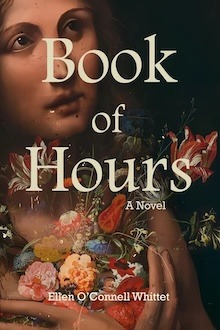
Dzanc Books, September 2026
I wanted to review Book of Hours by Ellen O’Connell Whittet not because I am a mother—I am not—but because I am a medievalist. I was curious to see how the author incorporated the lives of medieval female saints into a story of a modern woman. In this novel, Whittet weaves faith, medicine, feminism, and history to create a focused portrait of a woman’s struggle to have a baby.
The protagonist is referred to most often as “the woman”; everyone else in the novel has a name. At the novel’s start, she and her husband, Ted, are overwhelmed both by infertility and by interventions for becoming fertile. In addition to the expense, there are invasive appointments, well-meaning but clueless diet advice, internet searches and forums.
The protagonist’s struggle to believe in her own fertility is echoed by her resurgent interest in her Catholic faith. As a child, she believed so strongly that she experienced visions. She saw Saint Nicholas in the school hallway and Saint Catherine of Siena at her confirmation. By the time she gets to high school, her church, like so many, has been betrayed by an abusive priest. After spending a gap year in Bordeaux, she senses a rift “between the communion of saints and forgiveness of sins, and the promises of the rest of the world the priests warned her about.” She finds art, in its many forms, as miraculous as the acts of the saints who obsessed her as a child, and so her faith falls away.
She marries Ted, who has no interest in religion, and they eventually embark on the arduous path of fertilization treatments. She asks him if he thinks IVF is patriarchal or feminist, and he answers, “Feminist. It’s reproductive treatment, right?” The woman, being the person who must endure the process, agrees—with a caveat. “But it’s doctors telling you what drugs to take. It feels top-down, like I have no say, even though it’s the greatest privilege of my adult life.”
Struggling for control, she shifts her obsession from her body to a medieval text she had studied during her year in France, Le Roman de Mont Saint-Michel, which tells of a miraculous birth during a storm at sea. In the original French, the miracle is attributed to Saint Michael, while in English, it is attributed to the Virgin Mary. The protagonist becomes curious about how the story changes when it is told as a miracle performed by a man rather than a woman. The woman applies her intellect to every facet of her life, from a close reading of a poem to her decision to attend church again.
O’Connell Whittet has said in interviews that she herself had a difficult pregnancy and delivery, and this novel was a way of addressing those experiences through fiction. This makes her choice to leave the protagonist unnamed throughout the novel telling. Though the woman is a clear and complex character with her own history, relationships, and mind, she is only referred to according to the roles she fills throughout her life: the woman, the girl, the young woman, etc. The only name of hers we learn is her confirmation name, which is of course Catherine, after the saint who appeared to her as a girl.
At roughly the midpoint of the book, she and Ted decide to name their unborn baby, but the reader is not privy to that name. Is O’Connell Whittet protecting the fictional mother and baby from the reader’s prying eyes? Or is she showing us how women, especially those who are pregnant or trying to be, are erased from personhood? Does the decision erect a barrier between O’Connell Whittet’s real-life personal experiences and her imagined narrative, or does it provide a connection? I’m not sure I have an answer to any of these questions, but I do know that as a reader, I wished the character had been given a name if only to avoid repeating “the woman” so often.
Despite its weighty themes, O’Connell Whittet finds ways to inject humor into Book of Hours. Clueless male doctors are a reliable source of comic relief, as is the woman’s sister, Nora, who gives her a set of plotless leftist board books, including Baby Feminist and A Is for Activist. “There’s no story,” the sister explains. “But will they familiarize your newborn with the arc of the moral universe bending toward justice? No question.”
The novel ends just after the birth. This tight narrative frame holds several hundred years of the entanglement of medical science and Catholic faith without evading their failures or downplaying their successes. Nor does O’Connell Whittet shy away from the details and realities of IVF treatments, miscarriage, and difficult birth. Through her relationships with her husband, her family, her doctors, her doulas, her one church friend, and herself, the novel’s unnamed protagonist becomes a lens for a twenty-first century search for succor wherever one might find it.
+++
Ellen O’Connell Whittet teaches in the Writing Program and College of Creative Studies at UC Santa Barbara. Book of Hours is her first novel. Her memoir, What You Become in Flight (Melville House, 2020) was named a most-anticipated book by Refinery 29 and the Chicago Review. She has an MFA from Sarah Lawrence College. She co-hosts the podcast Good Moms on Paper with writers Annie Hartnett and Tessa Fontaine.
+
Kristen Hall-Geisler (she/her) is a freelance book editor and former automotive journalist with a master’s degree in English language and literature. Her work has appeared in the New York Times, the Pittsburgh Review of Books, Heavy Feather Review, and Reading in Translation, and the journal Fashion Highlight, among others. She can be found at kristenhallgeisler.com and in her backyard office in the Pacific Northwest.