Catapult, April 2026
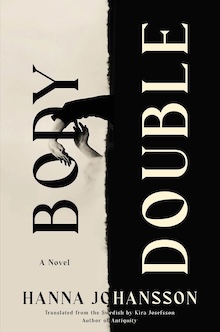
Early in Hanna Johansson’s Body Double, two women discuss the destabilizing experience of being left behind. The women, Naomi and Laura, have met by chance in a department store cafe after Naomi accidentally takes Laura’s coat, which is identical to hers. She returns it immediately, and over coffee Naomi confesses that the experience of being left—of the departure of another person whose presence had rounded out her routine life—gave her “a sense of having disappeared.” Later in the same conversation, she describes feeling as if she had been “split in half.” By the novel’s end, Naomi will again experience being left, and split from herself. This uncertainty, and the possible instability of identity, pervades the novel.
Naomi soon begins to obsess over whether she’ll see Laura again, and she attempts to recreate the circumstances of their first chance encounter without success—until she finally catches Laura passing by her swim club. Naomi remarks that it’s a coincidence seeing Laura again, though she’s been secretly searching for her everywhere. Laura agrees, but Body Double is a book that purposefully trains the reader to question such coincidences. Even by this early point in the novel, the reader knows there are no accidents of chance.
Which is why I’m convinced I’m not simply fangirling when I read Body Double and thought, repeatedly, of director David Lynch’s masterpiece Mulholland Drive. At the core of Lynch’s film are the ways in which perception isn’t always reality; identity is elusive. Body Double travels concretely through a similar setting of pseudo-mistaken identities, from mohair coats to people. Even the named characters in Johansson’s novel, Naomi and Laura, share the names of Mulholland Drive’s lead actresses, Naomi Watts and Laura Harring. Johansson primes the reader to question everything, and she’s too clever of a writer for the Lynchian overlap to be happenstance.
Laura soon moves in with Naomi and they begin a relationship. Naomi goes about her work at a radio station; Laura has no employment or outside connections at all. She sits alone in her lover’s apartment all day and only seems to come alive in Naomi’s presence. Though Naomi was the one who invited Laura to move in, she is often annoyed by Laura’s hanging about and is cagey with her friends about the exact nature of the relationship. Gradually, the women’s identities converge and slip—Laura answers the phone as Naomi, Naomi thinks she might try wearing Laura’s lipstick color—until one day, Laura cuts and dyes her hair blonde to match Naomi’s. She is becoming Naomi.
What does it mean when the things that tether us to who we are can be so easily copied, swapped, or stolen? Gradually, Laura steps into Naomi’s shoes—literally, she wears her shoes. When Naomi falls ill, Laura goes to work as Naomi instead, and no one notices that she’s an imposter. Or perhaps, the novel implies, she’s always been Naomi all along because identity isn’t fixed. It’s a thing that can change and be changed.
Interspersed with this storyline is that of an unnamed ghostwriter’s transcriptionist, a woman whose occupational edict is to be invisible. The transcriptionist’s job is to document recordings made by anonymous women who are narrating their life stories on tape; she then turns over the transcriptions to the ghostwriter, who makes them into legible narratives that give shape and meaning to the women’s lives.
One night, the transcriptionist receives a recording with only eight words: I have seen you. Have you seen me? Hearing this recording, she feels as if she’s been “split in two.” She says: “[It’s] as if someone were training their camera on me. Ever since I heard that whisper I’ve had the sense that I am disappearing.” It’s exactly what Naomi said to Laura in their first conversation.
Is the transcriptionist paranoid? Or is she losing herself inside of another woman’s story? The reader, too, begins to question the stability of the narrative, and the reading experience becomes one of uncanny echoes and a sense of déjà vu. Early on, Naomi confesses to Laura, “I love movies about paranoid women.” Reading Body Double, I felt a creeping paranoia. Johansson smoothly layers coincidences between the two storylines, then twists the narrative one more time by interjecting sections of the transcriptions independent of any context. The disembodied voice on the page has an unsettling effect, especially when specific details re-emerge later in the voice of Naomi or in Laura’s third-person point-of-view sections.
Is the transcriptionist listening to Laura or Naomi? Are the recordings from a future point in their lives? Or is the transcriptionist one of the two women, telling the story of her own life at a remove, in the third person? Or are they utterly unrelated, and this is a story of fantasy, art, and the creation of narratives? After all, isn’t identity a story we tell ourselves about who we are and wish we could become? This novel poses more questions than it answers, and for the reader who enjoys traversing red-curtained hallways into mysterious, checkerboard floor rooms, Body Double offers the rare opportunity to sink into an engrossing narrative of paranoia and uncertainty without ever emerging into the daylight on the other side.
With its firm grasp on the quotidian (a department store elevator, the liminal space of public transportation, the hardboiled eggshell left in the sink), the stories of Naomi, Laura, and the transcriptionist belie the ripple of falsities surrounding us—namely, the lies that uphold our belief in the stability of who we are. These characters are trapped in routine, yet they find their sense of self slipping away. The effect is disturbingly claustrophobic and unsettling. Body Double is a Lynchian puzzle of mistaken, swapped, and unstable identities, a book with the slippery, surreal feel of a cinematic fever dream.
+++
Hanna Johansson is a Swedish writer and critic who writes on such topics as art, literature, and queer issues. Antiquity, her debut novel, won the 2021 Katapultpris and was short-listed for the Borås Tidning Debutant Prize.
+
Kira Josefsson is a writer, editor, and translator working between Swedish and English. Her translations have been short-listed for the International Booker Prize and the Bernard Shaw Prize. She lives in the borough of Queens, New York, and writes on U.S. events and politics in the Swedish press.
+
Lacey N. Dunham is the author of The Belles (2025), named a Best Book of 2025 by Library Journal and Crime Reads, and the forthcoming Fall of the House of Graystone (2027), both from Atria/S&S. A Poets & Writers 2025 Writer to Watch, she has received fellowships from the Elizabeth George Foundation, the DC Arts Commission, the Sewanee Writers’ Conference, and Catapult. She lives in Washington, DC with too many books, but only two cats. Find her at laceyndunham.com.