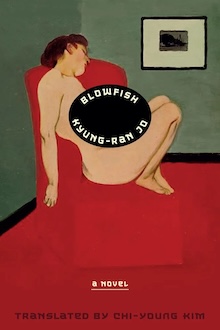
Astra Publishing House, 2025
Toward the end of Blowfish, the unnamed thirty-something female protagonist hears a harsh truth from a friend. “You should know something,” the friend says. “You’re always thinking about yourself.” She’s right: The sculptor has spent the entirety of the novel planning, attempting, or moving on from trying to die. But apart from this preoccupation, nothing else about this book or its narrators is reliable. As soon as Jo Kyung-ran settles into a theme or conflict, she subverts it. Although it is tempting to reduce the book to a moralistic or predictable parable, its relentless disorientation does not seem accidental. It’s more a knowing tease.
In this novel, published in 2010 and translated into English for the first time this July, Jo justifies the protagonist’s death obsession by excavating her family history. Decades before her birth, her grandmother committed suicide with a bowl of toxic blowfish soup. Her mother passed when she was young; her uncle lived only three months after a cancer diagnosis; the deaths of her surviving family members, she often thinks, are not far off: “If their family legacy was what she thought it was, her aunt should have died a long time ago.” Whether due to trauma and depression, or a more spiritual fear of succumbing to the same, ill-fated pattern, her suicidal fixations make narrative sense.
But her glib, unsentimental descriptions of death also obfuscate her true feelings. Suicide is a way for her to die without receiving people’s pity and condolences; she would have to subject herself only to the humiliation of giving into her temptation. “An emotion existed beneath every death, whether it was hate or rage or sorrow or resentment or shame or love,” she thinks. “Embarrassment—this was hers, and sometimes this emotion made her feel a stabbing pain.” Window shopping the day before her planned death, she resists the desire to step into a store: “She wasn’t used to feeling the need to buy something; it made her uncomfortable.” Anything that might be pleasurable, or freeing, encumbers her: “‘Not now,’ she murmured, then realized that everything was hurtling toward the end.”
What, then, is death to her? Is it a “predetermined course,” the logical conclusion to a family’s generational tragedy? Or is it a solution for boredom, embarrassing yet efficient? This dilemma permeates Blowfish. Chapters are narrated alternately by the sculptor and another, unnamed character, which immediately disorients the reader, but beyond structure, the novel also bounces back and forth between thematic opposites: light and shadow, life and death, Seoul and Tokyo. Amid this whiplash, there is no guiding clarity.
The sculptor crosses paths with an architect at a dinner party in Seoul. They don’t speak, but the sculptor, “that stranger with a bell-shaped bob,” lingers disproportionately in the man’s memory. He wonders if it’s the “kind of thing he would remember for the rest of his life.” They reunite in Tokyo, where he lives and where the sculptor hopes to kill herself. It is also the city where, four years ago, the architect’s brother leapt to his death, leaving him to care for his aging mother and severely depressed father. The sculptor appears to him as a challenge, a canvas against which he can untangle fears and regrets about his brother.
Blowfish is not a subtle novel. Its caricatures—the architect whose brother jumped off a building, the blowfish’s symbolism—are overt. But all this in-your-face obviousness is undercut by a series of mundane scenes. There is so much to do before dying: the sculptor makes phone calls and deals with utilities; she cancels subscriptions and grocery deliveries. Killing herself is merely the final item on her to-do list, the end of a winter day. In Tokyo she studies directions to an apartment complex, her “final address on this planet,” as though on vacation; the next day, she considers three routes to Ueno Station, then chooses between a 20-minute bike ride or a 40-minute walk to the park. She walks. “She wouldn’t be able to take the chair if she biked,” and she needs the chair to hang herself from a tree.
In terse, brusque prose, Jo writes the final, violent moments of a life no differently than she does the weather, or the flavor of fish. The architect recalls his dead brother’s body, whose “neck and limbs twisted in strange angles. His brother’s ruptured intestines spilled out, blood gushing from his temple. It had only been from the fifth floor.” After failing to hang herself, the sculptor visits a fish market to learn all she can about blowfish, but her experience is anticlimactic. She seems to be crafting an elaborate solo dining experience, not on a mission to kill herself. The sashimi “was close to having no smell or taste. She was deflated. She slid the whole thing into the plastic bag it came in and threw it out.” The next day, she buys dried fins, to steep in “a bottle of sake at the large supermarket near her apartment.” No notes on the flavor. She promptly transitions into another musing about her grandmother’s death.
Jo leans into gruesome details, but her matter-of-fact tone makes death both urgent and unremarkable. The overwhelm culminates with the sculptor’s suicide attempt. As the architect waits for her to awaken, everything in the room blurs together: The sculptor is his brother is the blowfish. The blowfish is everywhere; his brother is everywhere; death is everywhere.
He gently moved his brother’s head. It wasn’t his brother’s face; it was hers. She was sleeping deeply. She was breathing evenly, not having a bad dream. Everything stank of fish. He cleaned the entire apartment with care. He scraped the blowfish meat and guts, skin, and blood from the table into a huge plastic bag, and he even threw away the knife and the chopping board. He opened the living room windows to air out the place. The thing he had been afraid of had happened, and it was a little less terrible than he had feared. It felt like fate that he was there.
Jo might agree that their bond is a miracle of fate. Or, more likely, she scoffs slyly at her protagonists’ need for a tidy narrative that ignores the arbitrariness of life and death. In her author’s note, Jo confesses it had never taken her so long to write a novel: “I would think about the act of writing, the meaning of it.” There is no lesson to be learned or meaning to be gleaned. Matters of life and death can be just as urgent or pointless, or both, as taking the subway or creating a sculpture. Just like her protagonist’s works, Blowfish is evidence of that physical, aimless, sometimes futile, attempt.
+++
Kyung-Ran Jo made her literary debut in 1996 when her short story “The French Optical” won the Dong-a Ilbo New Writer’s Contest. She is the author of five story collections and three novels. Her novel Tongue was published in English by Bloomsbury in 2009. She is also the recipient of the Hyundae Munhak Award and the Dongin Prize, among others.
+
An award-winning literary translator and editor, Chi-Young Kim has translated works by You-jeong Jeong, Sun-mi Hwang, Young-ha Kim, Kyung Ran Jo, J.M. Lee, and Kyung-sook Shin, among others.
+
Yvonne Kim is a freelance journalist and fact-checker/associate editor at The Atlantic.