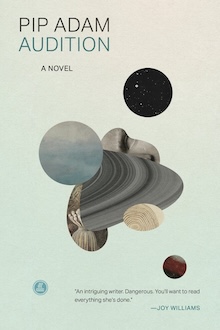
Coffee House, June 2025
In Audition, Pip Adam interested in finding ways to address the harms that people do to one another, and how society makes the people it doesn’t value disappear.
The first third of this ambitious novel is taken up by a single conversation. Three giants, each more than eighteen feet tall, live on a spaceship where they are trying and failing to reconstruct their pasts. They keep hitting a psychological wall, repeating the plots of romantic comedies and lists of meals.
The giants, named Alba, Drew, and Stanley, also literally hit the walls: growing relentlessly, they are squashed inside the ship, legs wedged in corners, necks bent against ceilings. Despite their size, the giants are still recognizable as people. Confused, with faulty memories, they repeat basic facts about themselves like spirits trapped in the Bardo. Their memory problems obscure the extent of their suffering. The ship, intended as a prison, resembles a tomb. They speculate, throughout the book, that they have died.
Although Audition is about prison, the story is not an elaborate metaphor for prisons. The giants are giants; the aliens are aliens. The giants have spent time in prison, before they were giants. Prison didn’t cause them to grow, but growing did make it impossible for them to stay in prison. Their prison has interesting mechanics: the spaceship runs on sound. It needs the giants’ voices to move. As they explain:
The ship is built like a huge amplifier. So, it can get as much energy as possible from the sound. Before all this it was always noisy. We made more noise than the normal-sized people because our bodies were bigger but we had big ears as well, so it was all scaled up. It had only been used for torture before but it worked for travel as well.
The ship compels the giants to speak. Speech both moves them forward and keeps them from growing. A strike—a prolonged period of silence— has led the giants to outgrow their surroundings. They are speaking to remember and remembering to survive.
As the giants’ pasts return to them, the book expands too, adding characters, locations, and eventually, a few aliens. It also returns its protagonists to Earth where they are revealed as two women and a trans man, all held in a women’s prison. There they are abused by guards and other prisoners. They are drugged, they are belittled. Their handlers use the phrase “what would you know” to trigger memory lapses and compliance, damaging giants’ minds and their sense of agency.
Off the spaceship and light years from Earth, the giants continue to grapple with the past while struggling to imagine future possibilities for themselves. They wait for the aliens to “tell them whether they’re in a prison or about to be taken to a prison, because when you’ve been in prison, these seem like the only two possibilities.”
Even before they became giants, Alba, Stanley and Drew were marginal. Once they started growing, they became both marginal and dangerous. In describing the process that ends with her protagonists in space, Adam shows how individuals resist empathy as a way of avoiding their own complicity in oppressive systems. This behavior spreads to the giants, who spend much of the ride repeating the insults to which they’ve been subjected: they are stupid, they should be quiet, what do they know?
Among recent novels perhaps the most obviously similar is Rachel Kushner’s The Mars Room (2018). Both books focus on women’s prisons and feature unflinching looks at the conditions of these prisons and the crimes that have led to inmates’ incarceration. Likewise, both recognize that the loss of agency inside can act as a continuation of conditions outside. There are aesthetic similarities too. Both, for example, include scenes of convicts running through fields and up into the hills before being captured. These pastoral images speak to a sense of freedom unavailable in the convicts’ lives before prison and while imprisoned. In both books, these brief moments of flight are the freest the prisoners have ever been.
However, where Kushner’s book returns its heroine to prison, Adam tries to imagine a way out. While it would have been easy to to rely on ideas of forgiveness, Adam avoids this temptation by offering a trippy, imaginative journey through space that also manages to resolve her characters’ issues, or at least set these characters on the road to resolution. The sci-fi aspect is both helpful and well-handled. For example, Adam offers a compelling theory of how alien intelligence might bridge the sensory and experiential gaps between itself and visiting earthlings.
Exploring the world of the prison and the violence enacted by both the prisoners and guards, Adam doesn’t conceal the damage inflicted by the book’s protagonists on their victims either. Coming to terms with past transgressions plays a big role. The result is a genuine exploration of forgiveness and empathy. Forgiveness is hard. So is empathy. Moving on is hard too, but ultimately it is this imaginative work that starts the process of breaking free of the past.
+++
Pip Adam is the author of four novels: Audition (2023), Nothing to See (2020), The New Animals (2017), which won the Acorn Foundation Prize for Fiction, and I’m Working on a Building (2013); and the short story collection Everything We Hoped For (2010). She makes the Better off Read podcast where she talks with authors about writing and reading, and she lives in Wellington, Aotearoa (New Zealand).
+
Davis Macmillan is a writer living in Jersey City, NJ with his family. He has fiction in a variety of places and is shopping a novel (or two).