Counterpoint, October 2026
A student of mine—not a Trumper—told me recently that the 1950s was the last great period of stability for American citizens. I was startled by her declaration—after all, it was the decade of McCarthyism, the Rosenbergs, Brown v. Board, Emmitt Till’s murder, and the Montgomery bus boycott, among other destabilizing events. The decade was good, I suppose, if you were white and prosperous, though it shouldn’t take retrospection or an adjustment to rose-colored glasses to see that the 1950s was less like Happy Days and more like Blue Velvet.
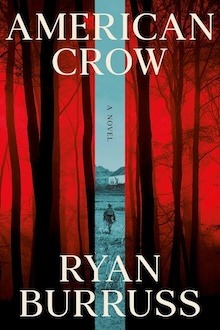
Ryan Burruss’s debut gothic novel American Crow tackles the rosy Fifties mythos on a granular scale, through the intersecting lives and fates of three families and several individuals in the fictional suburb of Brookshire, Maryland. Newly built and catering to World War II veterans and their young families, Brookshire is a neighborhood of two-story homes with yards and porches, a soda fountain serving malts, and lush grass where the neighborhood children play baseball. It is the American Dream.
Into this post-war 1952 idyll, a stranger arrives: mysterious, grizzled, and heavily tattooed, a man known only as the bookbinder. He quickly makes friends with Miriam Hollanger, Brookshire’s sharp-minded go-getter, and soon falls in love with the fierce and tender Rebecca St. Pierre. Rebecca’s neurodivergent daughter Ava possesses an uncanny knowing and perhaps supernatural powers. She can control the seemingly ever-present rain; she delivers visions to the bookbinder. The problem is that Rebecca is married, and Sam St. Pierre is a decorated war hero with a drinking problem and a proclivity for domestic abuse. Further back, in 1944 in this Mayberry-seque town, are Paul and Charlotte Dyson in their home on Tanager Way. Paul’s violence—and violent death—open the novel. Their story casts a pall that Brookshire cannot shake.
The Dysons’ tale is the source of the pus that oozes from the cracks in Brookshire’s shiny skin, a reflection of the secrets that compound behind closed doors, the result of men—who were sometimes mere boys—sent to the war front, where they were traumatized by the actions they were commanded to enact in the name of God and patriotism. There’s ugliness, too, as Paul Dyson’s racist self-serving speeches reveal. But decades before PTSD becomes an established clinical diagnosis, Brookshire’s veterans are struggling with the quotidian rhythms of civilian life. They wrestle with their unprocessed trauma silently, and even then “only late at night at a place like Wilson’s or around somebody’s handmade basement bar, and only in vague mutterings, euphemisms.”
The house on Tanager Way becomes the locus of an unspeakable darkness that feeds upon the brokenness of men like Paul Dyson, despair nourishing an otherworldly protean evil. It’s an evil that the bookbinder, a fellow veteran who’s experienced horrific violence on the front and at home, knows well. Burruss defines this evil as an Emptiness, a “hole that could not be christened.” It is beyond human attempts to name or contain, and outside of religious ideologies. The bookbinder has his own beast within, a supernatural presence whose iconography draws from Shinto beliefs, personified as a crow-like entity. Across the novel’s love story and reckoning with the myths of the post-war American Dream, these forces—the Emptiness and the crow—are forced together during a catastrophic flood in a battle of good and evil likely unimaginable to even Brookshire’s hapless Catholic priest, Father Jim.
American Crow is partly a gothic exploration of past sins, partly a gothic romance with its love story between two ill-fated lovers, and partly a philosophical treatise on the cyclical nature of violence. The novel explores that violence both within individuals, families, and communities, and as it is writ large in human history. The labyrinthine plot interweaves these threads with uneven pace, and the rococo language sometimes twists emotional moments into knots. This is not a novel for readers who prefer narratives with tidy conditions, or who require clearly delineated supernatural elements.
American Crow is both sprawling and enclosed; in the manner of trauma, it indirectly crosses time and place, occasionally jumbling or unnecessarily delaying the revelation of its mysteries. Still, at a time when the United States seems engaged in one long, continuous, undeclared war, and as we look backwards to the past even as we demand easy narratives for the present, American Crow beats its wings against such nostalgia and simplicity. This novel reminds the reader that evil exists because we created and continue to feed it, refusing the reckoning that might finally allow us to soar.
+++
Ryan Burruss has published work in Prairie Schooner, The Carolina Quarterly, Whiskey Island Magazine, and New Orleans Review, among many others. A native of the East Coast, he now resides on Colorado’s Front Range. He is a participating member of the Lighthouse Writers Workshop.
+
Lacey Dunham is the author of The Belles (2025), named a Best Book of 2025 by Library Journal and Crime Reads, and the forthcoming Fall of the House of Graystone (2027), both from Atria/S&S. A Poets & Writers 2025 Writer to Watch, she has received fellowships from the Elizabeth George Foundation, the DC Arts Commission, the Sewanee Writers’ Conference, and Catapult. She lives in Washington, DC with too many books, but only two cats. Find her at laceyndunham.com.