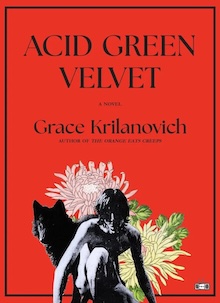
Two Dollar Radio, September 2026
Near the opening of Grace Krilanovich’s much-anticipated second novel, Acid Green Velvet, two youngsters give a bad man a good thrashing. “I’d only intended to smack him with a fence post, scare him a little,” explains Paulette—but plans go awry.
The man is Paulette’s father, and he deserves it. He’s been using his daughter as a prop in his con games—which might not even be the worst crime in this disturbing West Coast Gothic about power, survival, and how to trust what we know. It’s set chiefly in 1870s California, where the two protagonists, Paulette and her co-conspirator, Kenneth, are just threads in a knotty tangle of political philosophy and sexual economy in which every character betrays someone else, the dead don’t stay dead, and an attempt at a socialist revolution is seductive but impractical. As Paulette grows up, she writes steadily to her mother, and her letters are perhaps the most engaging part of the novel. A third-person narrative with multiple points of view occasionally comes into focus when Kenneth becomes obsessed with her, setting aside his involvement with a revolutionary leader.
Some thematic elements may be familiar from Krilanovich’s debut novel, The Orange Eats Creeps (2010), in which a mentally unsteady, homeless teenaged vampire seeks a lost foster sister and a supreme high. It won the author a spot on the National Book Foundation’s 5 Under 35 list, plus a legion of fans. They may find this one even more to their liking; it’s a stronger, more commanding book.
Fictional Anzar, California, is “a deeply unserious place” and “site of cosmic convergence,” where so-called tramps and vagabonds are claiming public spaces and the wealthy Hasley family broods in an Aladdin’s cave of a mansion. Paulette sees a chance at a secure life there in the arms of young Johnny Hasley, a faux socialist and wholehearted laudanum enthusiast who, frustratingly, puts off consummating their affair. Kenneth, meanwhile, sees a future in Anzar, if he can manage to correct the past—and get a handle on Paulette’s father, who turns out to be alive and into the ultimate con: politics. Before the agitators and Loganberries are through, a pitiless confrontation will end in heaps of corpses. By then, epic deeds and historic changes belong to characters with names like Violent Olga and Grandma Rat.
No, it’s not a nice world at all, but the electric language affords glimpses of beauty, horror, or truth in deceptively ordinary moments: “Girls were draped across the entrance, lounging beneath fluttering sun dapples, eating black toast and smoking.” Elsewhere: “His kisses were prim; in them I found Johnny’s truest form, that of a monster, delicate as a mosquito.”
Krilanovich’s writing is gorgeous and gritty by turns; her characters have substance, and the plot is beyond twisty. But this is not an immediately immersive read. For one thing, most of the characters don’t want to let anyone in; they emote about politics far more than about each other, and they seem chiefly bent on exploitation. Emotion is private—a luxury, a weakness.
Then there’s the oddity of anachronism. Terms such as luncheonette, girlfriend, lifestyle, uncool, and weapons-grade either didn’t exist or didn’t have much purchase in 1879; they kick the fictive dream into the present, as if to say that nobody gets to leave the problematic present-day world behind simply by reading a historical novel. When the Loganberries, militant Pinkerton-style enforcers, patrol the streets and load the tramps into wagons bound for the railyard, it’s impossible not to note that historical fiction is a product of both the time in which it’s set and the time in which it’s written.
Paulette speculates that “A generation from now people would pretend to know what happened here […] Digging up the bones of our community[,] they would pretend to comprehend the story of alien ancestors, whose skeletons lay scattered in party positions in graves dug by drunkards and sleepwalkers.” So end the dreams in which “anarchists in calico loincloths performed rituals on the plaza green, seeking to reupholster society, then sleep forever.”
She’s just described the work of the historian, and the historical novelist, whose conjectures are complicated by the impossibility of quantifying the humanity that once animated those skeletons. It’s easier to imagine ancient aliens than to reckon with the real costs of history. And in Krilanovich’s universe, things are only going to get worse … except, oddly, for women, because sex work turns out to be less onerous than other types of labor.
The new social “upholstery” of which the protesters dream is an unexpectedly haunting metaphor, apparently referring to a textile that manifests nowhere but the title. (Even the book’s cover favors a red straight out of a tasseled bourgeois parlor—or bordello—and the yellow spine of a dime novel.) That vivid yellow-green helped define the Victorian era. Made first with highly toxic arsenic, it sickened wearers who craved its beauty; later, new aniline dyes could impregnate even a luxe fabric like velvet without distorting its texture, making that exciting synthetic green cheap and easy to acquire. Yet Krilanovich’s characters don’t acquire it. Let it stand for luxury, danger, or the unattained—acid green faded with the century, coming back into vogue only during the equally turbulent 1960s.
Like that aniline dye, Acid Green Velvet sinks in where it touches. It’s a sweaty fever dream rolled into a nauseous acid trip riding roughshod over its tropes—a prickly, perverse, and often brilliant book.
+++
Grace Krilanovich is the author of The Orange Eats Creeps, a finalist for The Believer Book Award and the Indie Booksellers’ Choice Award in 2010, and reissued in 2025 for Two Dollar Radio’s New Classics series. Her work has appeared in Black Clock, The Rumpus, The Comics Journal, Los Angeles Review of Books, and elsewhere. She was a National Book Foundation “5 Under 35” honoree in 2010. She lives in Los Angeles.
+
Susann Cokal’s historical novels include The Kingdom of Little Wounds, Mirabilis, and Breath and Bones. Her short work has appeared in journals such as Cincinnati Review, Electric Lit, Prairie Schooner, Gargoyle, Eclectica, and The New York Times Book Review. Her website is susanncokal.com.