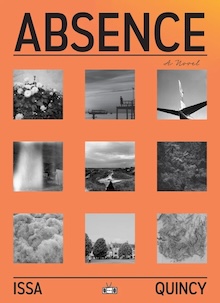
Two Dollar Radio, 2025
Ubiquitous, mostly innocuous, occasionally destabilizing, memory pervades our daily life. But for all its commonplace appearance in idiom and ritual, it’s a hard thing to understand; to, say, get one’s head around. This confusion is all the more heightened for the novelist, who will almost always rely on memory, in some form or another. But how to harness it, how to render and employ it effectively—aye, there’s the rub. In his debut novel, Issa Quincy looks at this problem squarely and dives in headfirst, constructing his book out of rather than around memory, and in the process crafting a thoughtful, imaginative work of fiction.
Absence might be described as a chimeric blend of Sebald’s Austerlitz and Bolaño’s 2666. The book combines the retrospective gaze of former with the disparate superstructure of the latter. The book’s foundational medium is memory, specifically that of the narrator. Haunted by a poem that his mother had loved, the unnamed protagonist embarks on a series of interactions and often embeds others’ accounts within his own. But it is Proust who seems to offer the most genealogical inherence here; Absence feels like a book in direct conversation with À la recherche, starting with its opening invocation of that poem beloved of the narrator’s mother:
When I think of the time before now, as remote as it seems, it is my mother I think of. When my thoughts are with her, I think of the poem that I’d so often hear her whispering or reading aloud to herself. [When I was] a restless little boy, unable to sleep, she’d sit at the foot of my bed softly singing its passages from a pale-yellow book to lull me to sleep. Even now, so far from those moments, I can still hear the sound of her voice, soft and gentle; distant as to suggest that it, along with her image, is slowly disintegrating in my mind. And so, at times, to suffuse that slowly appearing gap, I read a single line from the poem, or on my laptop I listen to the recording of a stranger reading it aloud. I close my eyes and allow the memories of my mother to surface, and in tunnelling through those narrow passageways, those burnt-out tracts of memory, I find her.
The book’s strengths are on display in this remarkable beginning, including a distinctive prose style and a clear understanding of how to play with literary influence. That Proust is being deliberately invoked here is obvious, but Quincy certainly has plenty of his own work to do, and a reader unfamiliar with the French titan would do just fine. This, it seems, is the best sort of allusion.
As the book progresses, the narrator weaves memory into a tapestry of narrative, both his own and those of the people he remembers. At its best, Absence moves through memory the way novels such as Proust’s and Sebald’s do: with a poignant depth retaining something of memory’s quicksilver quality. Quincy excels at allowing his narrator to exercise his skills in finely observed notations of the world: a “poorly cooked but well-intended pasta dish”; a “thin swelling of darkness upwardly encroaching from some unknown face of the earth onto the wide and deboned sky…[b]etween the thin grey beam of mountains and the back-facing sea”—bits of description that get into the reader’s shoes like sand, grounding them in the moment, even as it swirls out of reach.
The book is somewhat less successful in the fictive present. Quincy’s scenic work stumbles at times. It is almost as if, by creating a narrator so adept at bringing to life his own memory and the store of emotions within, Quincy struggled to realize him in the present. The difficulty is made more apparent by the somewhat perplexing use of italics for dialogue that sometimes runs on for pages and rather quickly taxes the reader. One is reminded of the centrality of such seemingly small compositional choices in forging the relationship between reader and text.
When this discursive narrator turns to a brief excursus—a novelistic maneuver that’s always tricky and often fatal—Absence is notably strong, underscoring how deeply Quincy understands his protagonist and how well his book works in those compositional intimate moments:
After some time frozen in that odd position, Margaret slowly sharpened upwards again like a burgeoning stalk and disappeared into another room for many minutes. I remained alone, devoid of clear thought, as in me a number of distorted fragments attempted to assemble into something linear but found themselves repeatedly unable. An immense noise eddied in me, stirring that which was dormant and concealed.
In instances such as this one, a fictive present scene becomes overshadowed by the outpouring of things the novel simply wishes to discuss, yet it works because of that meandering-yet-detailed plot line. This moment in particular feels like a microcosm of the whole, a drifting back to the unknown, and all the safer, waters of memory.
On balance, Quincy’s debut is an inspired one: there is no denying the sheer inventiveness and detail of his architecture, one that builds upon itself much as memories do, allowing the novel to enact the very thing that pulses at its core, less through description than with construction. Much of the book centers on themes that arise in that opening passage, how the slippery workings of memory might be wrestled down into the linguistic real. Which is, probably, impossible—but that shouldn’t stop us. Nor does it stop Absence, ultimately winding its way to a debut that is, in a word, memorable.
+++
Issa Quincy is a British writer. He spent spent several years working as a film archivist. His poetry has appeared in The London Magazine and been anthologised by New Rivers Press. His fiction has appeared in Transition Magazine and The Kenyon Review. Absence is his first novel. He is currently based in New York City.
+++
D.W. White serves as Founding Editor of L’Esprit Literary Review, Prose Editor for West Trade Review, and Publisher of Indirect Books, a new independent press launched this year. His writing appears in 3:AM, The Florida Review, The New Critique, Another Chicago Magazine, and Chicago Review of Books, among others. He’s currently a Ph.D. Candidate in the Program for Writers at the University of Illinois at Chicago, where he teaches fiction workshops. He also teaches classes on Rachel Cusk and Narrative Theory in the MFA Program at Roosevelt University in Chicago.