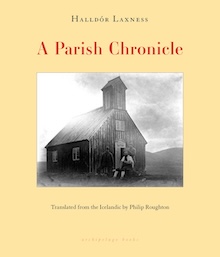
Archipelago Press, February 2026
Winner of the 1955 Nobel Prize, Halldór Laxness wrote novels, essays, plays, and translations, and was a champion of Iceland, its history, and its people. In this novel, published in Icelandic in 1970, Laxness takes readers on a stroll through Icelandic history, a history with few documents and populated by invisible men and women. Laxness’s materials are the ordinary stuff of Iceland’s history, which Laxness spent his life championing.
In 1774, the Danish king ordered the Mosfell Church, a remote parish church in Iceland, to be deconsecrated and razed. By 1887, a second church, Lágafell Church, was under construction, but the Mosfell Church hadn’t yet been officially deconsecrated, let alone demolished. The resistance to its razing is the occasion for the novel, which takes place in 1888. The primary resistance to the demolishing of the Mosfell Church comes from Farmer Ólafur of Hrisbrú and his son.
While occasional references to the Icelandic sagas connect the novel’s world to that epic realm, the struggle here is hardly epic. Nor is it particularly holy. The struggle is for the church itself and the cemetery associated with it, including free internments for the members of the parish.
Nearly a thousand years earlier, Christianity arrived in Iceland. With it came the establishment of small churches to serve its communities. One community was Mosfell, a small parish defined by peat, mud, volcanic heat, and, above all, sheep. Through those years, the church disappeared twice. One disappearance lasted two hundred and fifty years, from the fourteenth to the sixteenth centuries. A Roman Catholic church from the beginning, the Mosfell church saw, in its return, a reincarnation in being given over to the heirs of Martin Luther. Neither affiliation mattered much to the community. For them, Christianity was Christianity. The church and its site were also tied closely to a large skull assumed to have belonged to Egill Skallagrimsson—national hero, poet, and the anti-hero of Egill’s Saga, one of several medieval Icelandic sagas referenced in the book.
In their resistance to the razing of the church, the farmer and his son are opposed by the bishop and superordinates, who support its demolition. In their absence, Ólafur of Hrisbrú and his son go to the parish council to complain “that it was hard to keep holding one’s scythe at the ready without having anyone to test its edge on.” The resulting argument features back and forth references from Njáll’s Saga. A letter to the governor is drafted, and two people sign it: Ólafur of Hrisbrú and Guðrún Jónsdóttir, maid to the reverend of the church. Farmer Ólafur has also prepared for battle.
Through much of the chronicle, Laxness negotiates the line between historical record and invention with a variety of hedges, innuendos, allusions, and other indirect language. For instance, what does he know about what Ólafur is up to as he prepares for battle? He offers the evidence he has: “Some have claimed that now, when [Ólafur] rode through the district for the first time to muster the other farmers, he brought with him some sort of written declaration opposing the unification of the churches. There has been no confirmation of this and no document to that effect has been found archived.”
In his introduction, the novelist Salvatore Scibona points out that “the first Icelandic edition” of A Parish Chronicle featured “a prefatory note” cautioning readers that “‘[r]eferences to named individuals writing documents places times and events do not serve a historical purpose in this text.’” Scibona concludes that Laxness “plainly didn’t let the historical record impede invention.”
That historical looseness countered by some specificity regarding what Ólafur believed and said to other farmers so that they might be best prepared for battle. They include the need to remove the rust from their farm implements, to then sharpen them, and to polish any guns they might have, as well as the need for “the women [to] stand behind their men and have mugs of boiling urine on hand for burning those devils who ordered the destruction of Mosfell Church.”
Guðrún, who is twenty when the crisis occurs, is the most compelling character in the chronicle. She is also one of two characters whom Halldór Laxness, the “inkman” writing the chronicle, interviewed for his story. By the time he speaks with her, Guðrún is an old woman, something of a bard in her recounting of history and something of a sage in her conversations with the inkman.
Amidst the fight for the church, Guðrún heads off to collect a loaf of bread. The valley’s mist descends and she finds herself lost for three days. Any allusion to the spiritual in her wandering is undermined with her return. She’s fasted for three days, but when the inkman asks her why she hadn’t eaten the bread she’d collected, she says she gave it to the reverend. He, in turn, fed it to the horses. When the church is demolished, the reverend heads off to Copenhagen. He gives Guðrún a gold coin before he leaves. She has little use for it. She is a free woman, as she tells the inkman, and her choice of occupations through her working years was whatever most despicable job there was. This wasn’t penance. This is simply the way she lived.
In the end, the church is demolished. Its ancient bell goes missing, along with the skull of Egill Skallagrimsson and, arguably, the entire foundation of the community.
The final quarter of the book marks an odd and dramatic change in the tone of the chronicle and what Laxness pays attention to. In this section, Laxness turns his focus to a man named Stefán Þorláksson, a runaway who winds up with Ólafur of Hrisbrú and his family and stays for well over twenty years. During that time, the twentieth century arrives, along with increased prosperity for the town. Guðrún Jónsdóttir’s memory survives this transition, but this part of the story belongs to Stefán as he comes of age and into a momentous inheritance.
Up to this point in the chronicle, money hasn’t been important. People bartered with what little they had—sheep for the men, bits of silk cloth for the women. That changes with Stefán and his money, his charity, and his strong sense of community. He begins as a trader, but with a difference.
Stefán Þorláksson was always trading knives, which the men of Hrísbrú never did. He acquired all sorts of knives, starting by swapping like for like, but then trying to get a big knife for a small one or two for one. Once he came home with a machete for his foster father Ólafur so that he could go to battle, but Farmer Ólafur said he no longer had the sight for fighting and told the boy to take it to Finnbjörg. The woman sent the weapon to the kitchen and said it would be useful for cutting fish.
Nearly eighty years after the church was demolished for the third time in its history, the villagers discover that Stefán has bequeathed enough money for another church to be built to replace it.
Why read the chronicle? Not simply to discover the fate of the thousand-year-old skull or the similarly-aged church bell. Most interesting for readers is watching Laxness’s wild and free-ranging mind as he plays. It is always worth watching such a mind in action.
+++
Halldór Laxness (1902-1998) is the undisputed master of modern Icelandic fiction. He was awarded the Nobel Prize in Literature in 1955 “for his vivid epic power which has renewed the great narrative art of Iceland.” His body of work includes novels, essays, poems, plays, stories, and memoirs: more than sixty books in all. His works available in English include Independent People, The Fish Can Sing, World Light, Under the Glacier, Iceland’s Bell, and Paradise Reclaimed.
+
Philip Roughton has translated the work of Halldór Laxness, Jón Kalman Stefánsson, Kristín Marja Baldursdóttir, and many others. He has twice been awarded the American-Scandinavian Foundation Translation Prize for his rendering of Laxness’s work, in 2001 for Iceland’s Bell and again in 2015 for Wayward Heroes. He also received the 2016 Oxford-Weidenfeld Prize for his translation of Jón Kalman Stefánsson’s The Heart of Man. He lives in Iceland.
+
Among Rick Henry’s recently completed projects is a collection of fifty-five consensual novellas. He lives on the northernmost edge of the Adirondack Mountains, but can be found at www.rickhenry.net.