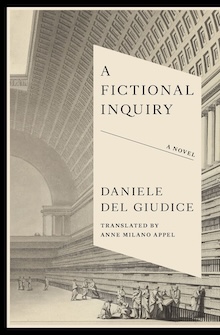
New Vessel Press, October 2025
Hailed in 1983 by Italo Calvino as “a classic of contemporary Italian literature,” Daniele del Giudici’s A Fictional Inquiry, recently published for the first time in English, consists of a mundane plot blanketed in dreamlike haze. Illustrating the inexplicable strangeness of living in an uncertain political landscape, del Giudice transforms a straightforward story into a series of transitions: a strange, misty landscape of in-betweens.
Set vaguely in the early 1980s, toward the denouement of Italy’s brutal Years of Lead, the novel follows an unnamed young man on a single-minded quest: to follow the trail of a dead littérateur who never actually wrote a thing. His goal is opaque, even to himself. He travels to Trieste and later to London in search of the not-writer’s friends and acquaintances. Once intrepid young writers themselves, they’ve been worn down by the cruelty of years and have only fragments to give, sepia-toned photographs or capricious bursts of memory.
The narrator recognizes that he’s dogging the heels of a ghost. He is himself a kind of ghost. He drifts between cities, interacting sparsely with locals, keeping his own narrative at arm’s length. In this way, he defines himself in terms of what he isn’t—again, in Calvino’s words,“ex negativo.” He listens and watches and writes. He thirsts for his own revelations but settles for those of others. In one conversation, after a woman remarks, “But you haven’t told me anything about you yet,” he finds himself at a loss, “unable to summarize myself on the spot, or instantly convey an idea of who I am.” Yet in rare and perhaps accidental moments of vulnerability, he reveals himself as a person who seeks control and answers amid the bewildering chaos of his era.
The people he meets blur into one another. Little distinguishes the women from other women and the men from other men. The writing seems crafted for someone who knows more than the reader does. Take the novel’s first line, a sentence seemingly excised from the middle of a conversation: “Even if it’s just a brief nap, like this half-hour one, afterward you have to start all over again.” Context comes after but even then, it can be hard to follow. The narrator repeatedly sits in some stranger’s flat, paging through their photo albums, and listens to their thoughts on writing and not writing. But with each iteration of the cycle, the ephemeral comfort of repetition fades. In one of these sessions, when a woman brings out her photographs, the narrator, aggrieved, asks that she put them away. His interest in everything has waned, even his interest in the truth.
The novel’s language is pervasively misty and nonchalant. At one point, the narrator reads a book “full of ellipses between one word and another; every so often those dot-dot-dots make my stomach drop, like when you drive over a speed bump in a car.” For the same effect, A Fictional Inquiry relies on phrasal frankness. Once, he dreams he is a spirit, letting out a “horrifying, lacerating shriek” to scare people. The dream is recounted succinctly, with no more description necessary. By removing the moment’s horror, del Guidice amplifies it, as if to suggest that meaning’s absence creates more discomfort than meaning itself.
The book does not end so much as it peters out. Even knowledge that the object of the narrator’s “fictional inquiry” exists outside the book (references scattered throughout reveal that he’s researching a real-world figure) provide no feeling of epiphany. Why does someone choose not to write? The answer, of course, varies: fear of failure, preoccupation with oneself, a lack of anything new to say. Everyone the narrator interviews has a different theory. But does any of it even matter? As the narrator comes closer to finding an answer, he discovers that he has become “indifferent to the question.”
Floating between truth and conjecture, drifting through the cold fogs of London and Trieste, the novel poses questions about writing as a discipline situated at the murky intersection of art, history, and individual psychology. A moment bleeds into another, and all that is left is a memory. Noting this, the narrator muses, “The idea that there must have been a moment, between invention and memory, when all this must have happened, will not make it any more concrete.” Such is the experience of reading A Fictional Inquiry. The message is obscure, the details half-memorable, but the chill of the fog remains.
+++
Daniele Del Giudice (1949-2021) was a contemplative author born in Rome but who lived most of his life in Venice, where he taught theatrical literature at Venice University. He wrote many novels and essays and received numerous awards. Del Giudice’s interest in science, aviation, and all forms of navigation found expression in much of his writing.
+
Anne Milano Appel has translated works by many leading Italian authors, including Claudio Magris, Roberto Saviano, and Primo Levi. Her awards include the Italian Prose in Translation Award and the John Florio Prize for Italian Translation.
+
Noelle McManus is a writer from New York. A 2024 NBCC Emerging Critics Fellow, their literary critique has appeared in publications such as The Women’s Review of Books, On the Seawall, and LIBER: A Feminist Review. More of their work can be found at noellemcmanus.com.