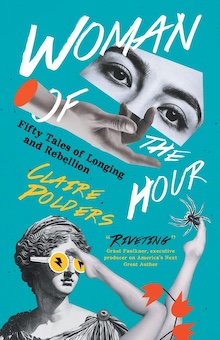
Our Research Notes series invites authors to describe their process for a recent book, with “research” defined as broadly as they would like. This week, Claire Polders writes about Woman of the Hour from Vine Leaves Press.
+
How does our mother tongue shape the stories we tell? What does it mean to switch languages in writing? Does simplification always lead to loss? Can I transform my limitations in English into opportunities for growth? Am I the same writer when I express myself in a foreign language? The same person? Who was I before?
These were some of the questions I had to confront ten years ago when I set out to write fiction in English.
Rather naively, I began with a novel. I had four published Dutch books to my name at the time—all novels—and I assumed that I could just continue on that path. But a novel is a large scary beast to tackle when you start writing in a foreign tongue. I was still enriching my vocabulary and learning how to use “nor.” So I paused that project and veered toward the small and smaller: flash fiction.
The brevity of flash made it less intimating and allowed me to thoroughly edit my work multiple times. When you’re writing the first draft of a novel, excessive attention to grammar and style can hold you back. Not so in flash.
The short short genre proved a fortunate choice for other reasons as well. I soon learned that switching languages as an author is not just a matter of swapping out one set of words and rules for another. It’s an existential change that requires experimentation.
Language is entangled with every aspect of our lives. We don’t use it only to express ourselves. Language is a lens through which we perceive the world and a tool for making sense of our experiences. It’s part of who we are.
Abandoning my mother tongue in literature was walking away from what felt like home, especially since I no longer lived in the Netherlands. After my studies, I’d moved to Paris where I lived sandwiched between the French of my new country and the American English of the man I married.
Writing in Dutch meant writing with an unquestioning ease: Using the language was like breathing air. Writing in English meant doubting each word: Using the language was like walking on a field of uneven stones that could tip with each step. I had to tread lightly and keep my arms out for balance. Nothing I wrote resonated in the same way. Writing in English meant undergoing a process of defamiliarization.
At first, this made me feel limited, boxed in. Uncertainty about the connotations each word brought to my stories led me to simplify my thoughts. There was a narrowing, a paring down. For someone like me for whom nuance is essential, this was a frustrating phase. Would I ever get close enough to my new language to hear its undertones?
But then I saw the potential for growth in my limitations. Slowing down, pausing to reflect, weighing each word carefully could only make me a more subtle author.
I consciously dismantled my ideas and reduced them to essentials. To my surprise, this led to more honesty on the page. It was as though my first language in its immediacy had protected me from the need to truly question myself. Now, in English, my raw nerves were exposed.
The process of defamiliarization became an embodied experience. As I wrote, I relearned how to feel, see, hear, and touch the world. Little by little, I adjusted to the exquisite tension of speaking intimately in a language that had not raised me.
English gave me the opportunity to reinvent myself. As an author and a person. I could become anyone I wanted. A woman who traces her lost mother in Venice. An idealist who invents a new leader. A child who learns the dangers of xenophobia. A guerrilla gardener who sows life-saving hope. A traveler who delights in tasting European chefs. A teenage girl who turns a cruel ritual into a revolution.
When we write a novel, we must work hard to find the right voice for the book—or for each character, if the story is told from multiple perspectives. When we write a collection of flash fiction, we get to experiment with a range of voices, a kaleidoscope of perspectives.
Inhabiting all the different women in my stories felt liberating and exhilarating. Their existential questions became mine by the choice of my words. Each character gave me the chance to learn something new about myself or more: They broadened my identity.
In the end, I submitted a manuscript of stories to my publisher as “fiction, mostly.” When I received the galleys, the word “mostly” was cut from the subtitle. I wondered whether I should tell the publisher and ask for it to be put back, yet I chose to let it go. Readers know, or ought to know, that most fiction, no matter how speculative, has plenty of autobiographical elements.
Now Woman of the Hour exists, not only as a collection of fifty flash fictions, but as a document of my transformative journey.
Sometimes we need to meet our limitations before we can move beyond them. Sometimes we need to dismantle ourselves to get in touch with a more authentic core. Writing Woman of the Hour was my undoing and my renewal. Through these fifty stories, I found a way into English and researched myself. I am stranger now, more vulnerable, sharper yet less defined. Ready for the second half of my life.
+++
Claire Polders grew up in the Netherlands, studied philosophy, lived in Paris, married an American in Italy, and now slowtravels the world as a nomad. She’s the author of four novels in Dutch and co-author of one novel for younger readers inEnglish (A Whale in Paris, Simon & Schuster). Visit: clairepolders.com.