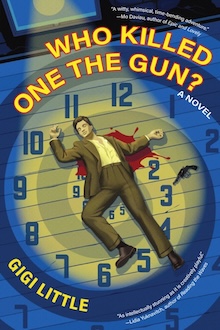
Our Research Notes series invites authors to describe their process for a recent book, with “research” defined as broadly as they would like. This week, Gigi Little writes about Who Killed One The Gun? from Forest Avenue Press.
+
I’m an old-time radio fanatic, specifically OTR detective shows. One of the things I love is their language. It’s deliciously pulpy, full of 1940s and 50s slang and over-the-top metaphors that a modern author could only wish to get away with.
She sauntered in, moving slowly from side to side like a hundred and eighteen pounds of warm smoke. Her voice was alright too. It reminded you of a furnace full of marshmallows.
I couldn’t help but be beguiled by the campy poetry of radio’s outrageous similes and quirky turns of phrase. I started making a collection of favorite excerpts, stopping my listening to write it down whenever a passage caught my ear.
A moustache was trying real hard on a piano.
He slipped out of my arms and stopped paying taxes.
One more crack like that and I’ll twist your trumpet.
What I didn’t realize was that I was also starting to do research for a novel.
I already had this strange idea to create character names for a book using numbers paired with rhymes. It was only natural that the story that arose from this naming convention be noir-flavored. The first name I came up with, One the Gun: well, he had to be an old-time detective. The second name, Two the True Blue: obviously his faithful assistant. And who was she true blue to? Her beau, the professor Three the Goatee.
As both this novel and my radio-phrases collection grew, they started to grow together. I realized nothing would be more fun than to write this book through the lens of old-time radio.
Look, Race, if you don’t call the cops about that stiff they are gonna tie a can to your tail but good.
In the margins of my assemblage of radio passages, I can see the transformation from simple collection to research tool. Under the radio show “The Adventures of Frank Race,” I start to write notes to myself about Detective Race’s sidekick Mark Donovan, a cab driver whose dialogue is flavored with working-class slang: “I can see the doorman/bouncer Four the Door talking just like this.”
I still think we should have waxed that crumb.
You know somethin’? We toss this crowd into a Mixmaster, we could make a dilly of a cake.
He must have been awful careless to let that Marty character get his mitts on the chatterbox.
Here in my file, I make a note that the word chatterbox means machine gun, then add, “It might be fun to have Four the Door’s dialogue become almost indecipherable.”
I started to organize my radio-phrases collection in a way that would benefit the research. Each radio program got two sections: one at the top for words and rudimentary expressions that would have been used by lots of folks at the time (sing up, pull a fade, no soap), and below that a listing of longer passages, snippets of snappy dialogue, simile-laden descriptions of femme fatales.
Whereas this second section helped me get skilled at writing my own pulpy language, the top section was even more important, to my thinking. It’s very easy to create a bad imitation of noir. All you need is a guy in a fedora, a cigarette, and some moody jazz. I didn’t want to fill my pages with hackneyed potboiler cliches—He was a cold-blooded, hard-boiled private-eye hot on the trail… of murder! By studying my radio shows down to the subtlest components (nuts as a swear word, tight for drunk, interjections like skip it when one is impatient), I could create an old-time language that felt authentic.
It’s a funny word to use, authentic. The world of the OTR detective is not the authentic world of 1940s and 50s America. But that’s one of the things I love. In a way, it’s like writing a play using Shakespearean English. My challenge was to be authentic within a beautifully inauthentic world.
Another thing that helped me make the OTR angle feel authentic was having my hero One the Gun poke some fun at it. Being a gumshoe himself, Gun gets a little salty about his assistant Two the True Blue’s favorite radio show, Who Is the Villain?: “A trite piece of schlock where the detective—one of those fakey radio detectives with nothing but brawn and clever quips—solves a different overblown case each week. The narrator’s always saying ridiculous stuff like ‘the dame had the kind of eyes that made you want to melt like honey on a hot biscuit.’”
Having Gun’s inner monologue dismiss the genre allowed me to establish the conceit, to introduce just where the language I would be using throughout the novel comes from. This gave me free rein to use the language myself however I wanted. And if you read far enough along, you find that even Gun secretly loves radio detective shows. I’d like to think that despite Gun’s protests and most definitely because of my treasure trove of real OTR language, the reader can see Who Killed One the Gun? as my love letter to noir and old-time radio.
Of course, I did other types of research along the way to this novel. But my years of happy study not only helped me deeply understand the language of the artform, but gave me intimate insight into a unique time in our true history through a unique lens.
Now that the book is done, I’m still listening to my radio detectives, still recording favorite passages. Sometimes it makes me a little sad. I miss playing in that sandbox. No other writing project has given me the same joy. How strange that my research file is once again just a collection. Or, no. It’s not just that, is it? It’s more like a photo album. A travelogue. Sepia-toned images of places I’ve been to. And I can be thankful that I had the opportunity to, for a while, live in that particular—and to me magical—some might even say ginger-peachy—world.
+++
Gigi Little is a writer, book designer, and bookseller. She’s the editor of the anthology City of Weird and the art director of the award-winning picture book A Tree of My Own. Her writing can be found in journals and anthologies including Portland Noir, Spent, Dispatches from Anarres, and The Magic We Miss. She lives in Portland, Oregon, with her husband, fine artist Stephen O’Donnell.