Our Research Notes series invites authors to describe their process for a recent book, with “research” defined as broadly as they would like. This week, Terri Lewis writes about When They Came Home from Miami University Press.
+
Finding Milton and Edith in Life and in Fiction
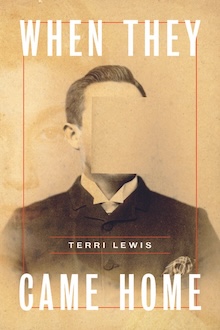
My first novel started with a practically unknown historical person. To bring her to life, I researched the few available references, envisioned her in a scene from my developing plot, and watched her personality emerge. Was she quirky or rude, shy or confident? Only after I fell in love with her, could I write her story.
But in the family history that became When They Came Home, the main characters would be based on my grandparents, Milton and Edith, whom I already knew and loved. So why not just put them on the page? Sounds easy, but in the story I uncovered, their actions and personalities contradicted what I knew.
My original interest was piqued by a battered candy box which my mother handed over, saying, “You’re a writer. There’s a good story in here.” Inside, crammed together in complete disarray, were documents about my grandparents’ early lives: letters, Veteran’s Bureau communiques, tiny black-and-white photos, a diary excerpt. When I sorted them by date, which took several hours, I discovered a record of bravery, love, and suffering that I’d never heard.
My grandfather Milton fought in the Argonne during WWI, came home, married, and had two daughters, but then plunged into delayed-onset shell shock, with screaming nightmares, unable to function. His breakdown was a disaster for the family because he was the sole wage earner and the government denied responsibility for his illness. During the years of his struggle to recover, my grandmother Edith heroically kept the family together through poverty and hospitalizations, always fighting for his healing and his pension.
Some of my best childhood memories are of visiting my grandparents in Enterprise, Kansas, a tiny town of about 800 people. There I could roam free, go alone down the back alley to the playground or around the block on roller skates. My grandmother kept a drawer of comic books and a cookie jar filled with the favorites: chocolate rocks, date swirls, and anise sugar; she wore her long hair in an old-fashioned roll and did laundry on the back porch using a machine with a wringer. A story-book grandmother who freely gave out hugs.
My grandfather was a timid and soft-spoken man. In Enterprise, he’d walk me downtown to the main street, all of three blocks long. We’d collect mail at the post office, visit the grocery where he’d show me off, then sit at the drug store counter where he drank one of his endless cups of coffee. I’d have Dr. Pepper in a mug so as to seem grown up. As I grew, I noticed one oddity. While my grandmother often traveled with my family, he always stayed home. When I asked about it, Mother said he didn’t like crowds and got car sick.
So who was this person who screamed and fled when he heard a Fourth of July bugle; who was eventually found by the river covered in mud and babbling about his Captain; who weighed 78 pounds when he was taken by train to the hospital? Who was this woman with a simple high-school education who wrote endless letters to authorities, dared to sue the government that denied Milton’s pension and won? Had I ever known them? I was stunned.
I needed to resolve these enormous discrepancies in order to write their story. I couldn’t ask them because they were both dead when I got the candy box so I started by interviewing my mother and aunt. They were best friends and the ensuing tape is a joy of reminiscing and laughter about their childhood. I learned that Milton was often in various hospitals and in summers while Edith focused on him and worked with his doctors, they’d be sent to stay with other family members, running footloose through the summer under the eyes of a great aunt or older cousin. My aunt spoke of Christmas dollies with wardrobes her mother had sewn. They both remembered a game called “Washing the feet of Jesus.” My mother wished she’d been kinder to her father—he didn’t come home until she was a teen and he seemed a stranger.
As I began to write in earnest, those wonderful details needed grounding, so I researched the war, the disdain for veterans with shell shock, the often bizarre treatments, and the constricting expectations of women in 1919 Kansas. The ensuing scaffold of events formed a timeline into which I inserted Milton and Edith before I knew them: young, falling in love, and then struggling through his illness. And how the force of that love kept them together. I believe the resulting story honors them, and although it is fiction, it reveals the truth of their lives. I want them to live.
+++
After a career as a ballet dancer, Terri Lewis focused on writing. She is the author of Behold the Bird in Flight, a Novel of an Abducted Queen, which was named one of the Washington Independent Review of Books’ favorite books of 2025. When They Came Home, a lyrical telling of hardship and love, won the Miami University Press Novella Award. Her third novel, based in the world of ballet, will be published in March of 2027. She lives in Denver with her husband and two entertaining dogs. To learn more about the author and to see family mementos which partially inspired the book, visit terrilewis1.com.