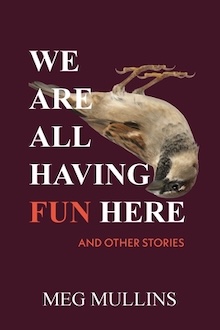
Our Research Notes series invites authors to describe their process for a recent book, with “research” defined as broadly as they would like. This week, Meg Mullins writes about We Are All Having Fun Here from Fork Apple Press.
+
Writing Behind The Scenes
Writing requires invention. Choosing which words, which scenes that will make the beginnings, the middles, and the ends is an inherently creative act. And yet we all know that writers cannot possibly invent the world. They already know the world–the world made them. It gave them the words and the scenes that make up their own lived beginnings, middles and ends. More specifically, then, it seems to me that writing is a creative act of mining the known world in order to tell the story of an invented one–a world that is less factual, but maybe more truthful. For me, this lovely dance between excavating and imagining while writing my first collection of short stories went something like this:
DIRT
A particular sunset bathed my own back yard in the exact kind of buttery light I remember from the evening when my brother took his fatal fall years earlier. That particular light reminded me not just of my brother’s death, but of his life — his young life — and the rumors of the acute shame that enveloped him after his father left. The way he invented stories of his father’s heroic death overseas rather than tell the truth of his ordinary abandonment. These thoughts determined the way in which I approached my desk, the sense of heaviness in my footsteps, the crushing certainty that parents, even when they desperately want to, cannot protect their children from the wounds of childhood. The summer sun was turning the days into blocks of white heat and I felt disoriented by time and how my creative life could mean anything in a world like ours.
+
WHAT TO DO WITH MAGIC
I could tell you that this actually began forty years ago in the summer before all of the other young women I knew also had a crush on the commander-in-chief. I could tell you that I had a yearning for older men I could not understand and a confusion regarding when it might be suitable for men to want me, too. All girls should want to be pretty, but to what end? If your prettiness made you an object of men’s attention, why was it so important to resist all of the desire you’d been cultivating? How could anybody win this game?
Whether or not the men who ran the country were patrician or folksy, they were, and had always been, unabashedly men. And whichever summer this happened, a hundred years ago or tomorrow, that would still be true. As far as I could tell, a girl’s life, her worth, her value were determined by the men who strode off of helicopters and airplanes, into exam rooms and lecture halls, out of curtains on late-night and across theaters everywhere. The men were in charge and when I was fifteen and searching for everything, the only thing I had that I thought they might want was my body.
+
A FAIR TRADE
This began on a tennis court way before its time. An older woman, a widow, with an abrupt manner and a sorrowful face was my opponent. We lobbed the ball back and forth, but it was clear that she was fighting for something that was not available to be won that day. There was a discontent, an impatience, a rage that felt impossible for her to live with much longer.
Months later, during the early days of the pandemic, I saw a woman who resembled this tennis opponent, but she was wearing a bath robe and had a towel around her shoulders, walking through my suburban neighborhood, miles away from any public swimming pool.
Also, cancer and my father’s dignified quiet, his easy tears, his longing for more. For whatever reason, those three moments became a beginning.
+
COULD ANYTHING BE IMPOSSIBLE?
I mean, it’s a fair question, right?
What would I tell you about this?
Would I tell you that after the Supreme Court reversed Roe v Wade, I walked around in a blur of disorientation? Would I tell you that our culture is notoriously cruel to the very children it pronounces sacred? It doesn’t protect them from hunger, poverty, pollution, disease, or ordinary cruelty. It allows bullets to be the leading cause of their deaths and enacts no legislation to prevent this. The only laws they want to pass will ensure that more women will suffer and more children will be born who might not be wanted from the very beginning.
Would I tell you that this is a story about ordinary cruelty, ordinary regret, and the impossible choices people make but that it is not about abortion? Yes, I would.
+
WE ARE ALL HAVING FUN HERE
It was clear that a friend’s marriage was falling apart, but their sex life was the canary in the coal mine. We sat on a curb and talked about non-monogamy, about negotiating desire separately from love or commitment. Could she, would she, could they try? What is it like actually asking a stranger for what you want, to plan in advance and articulate exactly how you need to be wanted?
Also, the words of a long-ago teacher idled through my mind, remembering how he mused that children would inevitably get in the way of the great American novel.
But, mostly, the character of Cleo who was birthed in a failed novel and just never quite let me go.
+
BIRD
If I told you it’s all true, would you believe me? Of course not. That’s ghastly — moving assets across society through the bodies of women; building empires through the wombs of child brides — and, yet, we all know the history.
A cloudy weekend morning, likely a hot tea in my hand and legs curled underneath me. My curiosity turned to the marriage section of the Sunday newspaper. One of the United Kingdom’s wealthiest men had been married that weekend and the article about the nuptials included a brief outline of the origins of his family’s fortune. It all began with another marriage many centuries ago. The facts surrounding that marriage gave me all I needed for this story.
+
BEA
In my experience of losing people that I love, one of the most painful moments is when you realize that you can never tell your beloved all of the things you want them to know, including how you’re weathering their absence.
+++
Meg Mullins is a writer from New Mexico and the author of three novels and the newly released collection of short stories, We Are All Having Fun Here. Her work has been translated into eleven languages and optioned for film. Her short fiction has appeared in numerous journals and has been included in The Best American Short Stories.