Our Research Notes series invites authors to describe their process for a recent book, with “research” defined as broadly as they would like. This week, Lindsay Merbaum writes about Vampires At Sea from Creature Publishing.
+
Anxiety, Self-Worth, and Vampires at Sea
My anxiety first manifested when I was a kid. I remember my mother sitting up with me at night, coaching me through paralyzing fears of humiliating band rehearsals and lunchtime bullies, instructing me in what I would now call meditation and mindfulness.
Since then, I’ve had many years of treatment with excellent therapists. I take medication to mitigate the effects of my disorder. I exercise and have a loving, supportive partner, yadda yadda. Nevertheless, anxiety isn’t something I can wholly resolve. Though its influence may ebb and flow, sure as the moon it arises, ready to reflect upon my weak spots. There’s a voice in my head constantly reporting on how I’m fat and lazy, an idiot and a failure – things I wouldn’t even say to my worst enemy. I’ve analyzed that voice, deconstructed its tone, rejected its choice of words. I’ve argued, I’ve dismissed it. But the voice persists.
Sometimes I feel jumpy and panicked for no particular reason. Other times I worry excessively about very specific things that are also entirely hypothetical like what if I get cancer? What if my partner dies? “What if?” is a slippery slope. Sometimes I’m scared to drive. Sometimes I have anxiety dreams night after night after night where I’m lost, screaming, and no one listens.
I worry, too, about good things that I know are coming, like classes I’m going to teach, or the book tour I’m embarking on to promote Vampires at Sea – more on that in a moment. Last time I went to a writing conference, I didn’t sleep for a week. Excitement and anxiety are such similar experiences for me that I can’t actually tell the difference. And neither can my nervous system.
It’s ironic that I ended up a writer. Writers are inherently vulnerable to criticism and misrepresentation and there’s not much we can do about it. We also spend a great deal of time waiting for things to happen; publishing moves at a glacial pace. It’s terrible for someone who’s prone to obsessively checking their email.
I used to tell myself I wrote my way through my psychic pain. I wrote my way through my relationships with my parents. I wrote my way through estrangement and divorce. Consequently, my first novel features sad, self-doubting characters who face a lot of internal struggle. To write that book, I dug into my wounds and pulled out this story of two strange hotels and the lonely, self-hating strangers stuck inside them. This is how writers process trauma, I said in interviews. What I didn’t say: my characters suffer a lot, but they don’t actually grow, they just become more broken.
After my first novel was published, my voice got a bit bolder. I entered my 40s, which triggered perimenopause, and I had fewer fucks to give. Plus I’d already written about a sad sex hotel, so why not dabble in humor? I started writing directly to the reader, toying with them, making jokes, getting bawdier. And then, with the support of my editor, Vampires at Sea was born.
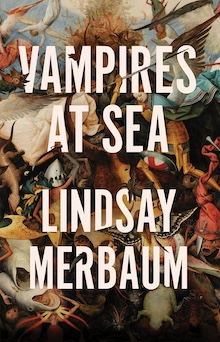
Sexy, cheeky emotional vampire Rebekah narrates the novella, as she and her immortal beloved embark on a queer cruise around the Black Sea with the hope of reconnecting with one another. Instead, they meet a non-binary influencer named Heaven, the lover of their dreams and nightmares. Orgies and emotional mayhem ensue.
Rebekah does not entertain self-doubt. In general, she doesn’t care for feelings of any kind. Instead, she presents with unbridled self-confidence. Embodying narcissism at its most fun, she tells the reader point-blank that she is desirable: “Getting eaten by me would be the best thing that ever happened to you.” Writing her voice is a kind of release, like making prank phone calls or shoplifting. This voice feels like joyful escape.
My narrator urged me on. No longer constricted or too careful, I drafted salacious scenes and dropped queer references with abandon, like the Harvey Milk Bar. My narrator never worried she said too much of the wrong things, never fretted over whether a friend was mad at her. Rebekah the emotional vampire did not lie awake at night in a panic.
Make no mistake, Rebekah’s not a good person. (She’s technically not a person at all.) She isn’t supposed to be. Nevertheless readers have told me she inspires them with her relentless advocacy for her own self-interest. When Rebekah navigates a unicorn-lover gone wrong, she has to contend with being ignored and devalued. Yet she refuses to allow this treatment to make her doubt herself.
Maybe behind every bad bitch character is an even badder bitch masking her anxiety? In any case, Rebekah isn’t my alter-ego, she’s my creation. Her voice actually belongs to me. She’s speaking, but I am the one becoming louder and more insistent.
I never thought I’d find such freedom in my writing. Or such joy. I never thought I’d enjoy my voice so much.
Sequel, anyone?
+++
Lindsay Merbaum is a queer author of strange tales, the founder of Pick Your Potions, and the high priestess of the Study Coven. Her first novel with Creature Publishing, The Gold Persimmon, was a 2021 Foreword Indies Finalist. Lindsay lives in Michigan with her partner and cats.