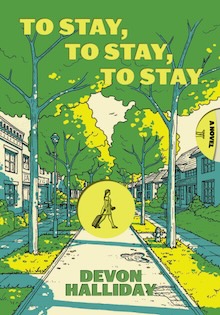
Our Research Notes series invites authors to describe their process for a recent book, with “research” defined as broadly as they would like. This week, Devon Halliday writes about To Stay, To Stay, To Stay from McSweeney’s.
+
New Mushrooms, Etc.
In the spring of 2023, I was working diligently through the second semester of my MFA. Every three weeks, I sent my advisor a new packet of work, containing a short story or two, a craft essay, and a letter. The letters were largely stream-of-consciousness, beginning with cursory updates on my day-to-day life and ending with long musings about writing and revision.
I was glad to be working on the short stories—but like many of my classmates in the program, I knew that the next step in my career had to be a debut novel. Rumors swirled about students who sent a short story to their advisor and heard the magic words: “This should be expanded into a novel!” With every short story I sent to my advisor, I crossed my fingers that she would finally say: This is it. This is the novel.
And one day, she did—but not about the short stories. Instead, what she had fixed on as the seed of a novel was the opening passages of my letters, in which I told little one-off stories about my daily life in Athens, Ohio.
I was relieved to get some assurance that a novel was in my future. But I was also a bit disappointed. I had always admired those authors who wildly invented other worlds, other lives, other preoccupations than their own. After all my absurdist and speculative short stories, was I really just going to write a novel about—home?
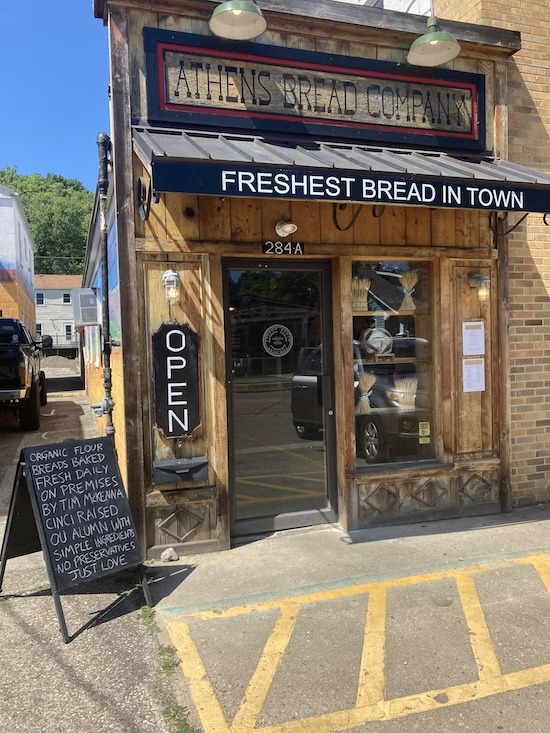
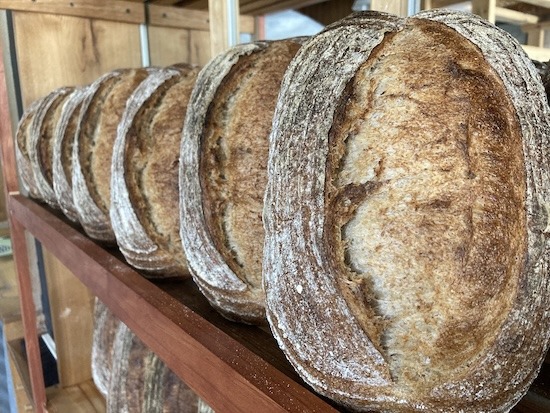
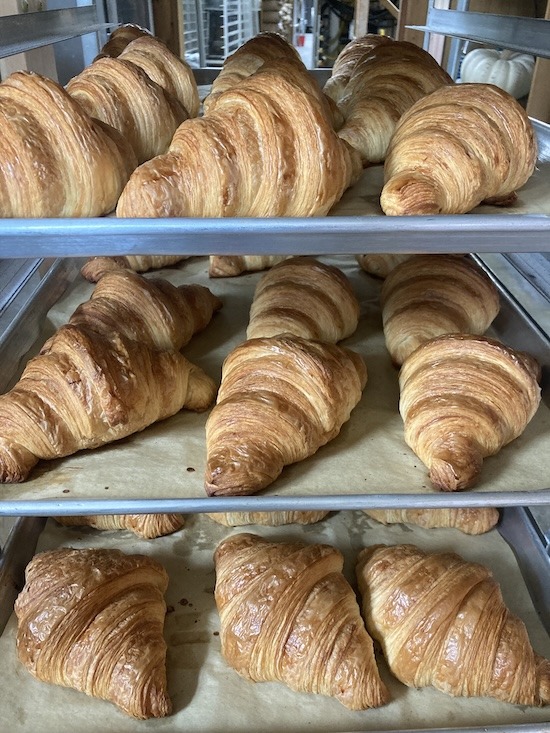
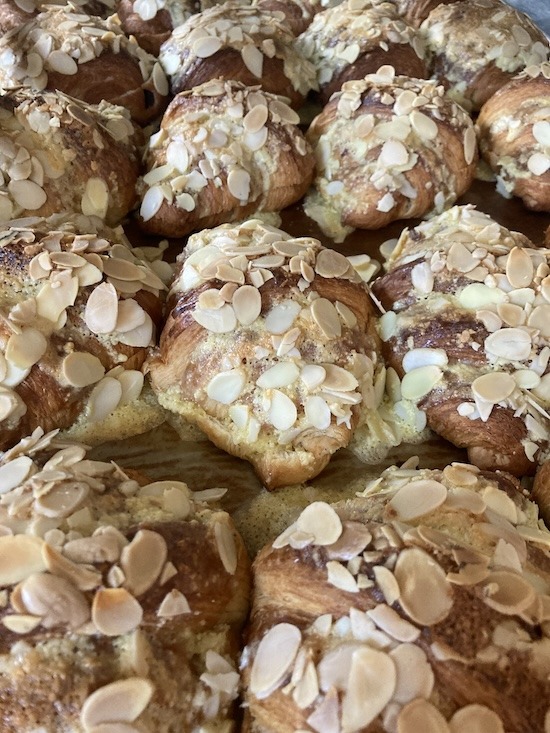
At that time, I was running a bakery with my husband. We had moved back to Athens during the pandemic—“back” because I had grown up there, and he had gone to college there. In the mornings, my husband went into the bakery at 4am to bake the day’s bread and pastries, and I stayed home and wrote. Then we would switch: he would come home in the afternoon to sleep, and I would run the bakery counter, selling the bread and pastries to our local customers.
In this way, we both became known faces around town. Athens is a small town, and even smaller if you leave out the transient university students. Everywhere I went, I was recognized as the baker’s wife. Though I had lived in Athens from when I was two months old until I left for college, I had never felt myself an integral part of the community. Now I began to understand that community as my own.
My debut novel is called To Stay, To Stay, To Stay. In the end, I didn’t stay—in the marriage, in the town, or at the bakery. But the novel grew out of the letters I wrote to my advisor, detailing the things I found charming and wonderful and strange about my life in Athens.
It can be hard to trace a novel back to a single point of origin. How do you isolate the day on which an idea took root? But I know exactly where my novel began. It began here:
Friday, March 24, 2023
Dear Marisa,
It’s been a night of thunderstorms here in Athens, which is excellent, because rain sounds really good on our roof. Last night the sound reminded me of those ten-hour-loop rain videos on YouTube, it was that perfectly calibrated. I knew the rain was coming because I get regular weather reports from our customers at the bakery. Everyone rather sweetly wants me to know what it’s like in the outside world—they hope that I’ll have a chance to get out there and enjoy the sunshine at some point, or they applaud my luck in getting to stand near a hot oven all day instead of being out there facing the cold. And they always give me forecasts, and then we exclaim over Ohio weather being unpredictable.
One customer (a real estate agent and former mycologist) told me he’d just sold big tracts of land in Athens to two separate climate scientists. Apparently weather patterns and other converging climate things mean that Athens is becoming more fertile, the growing season is getting longer… he told me the other day he’d spotted a new mushroom he’d never seen before. My partner and I also recently met two farmers, a married couple, both of whom used to raise dairy cows and make cheese at Martha’s Vineyard. They told us they found Athens by looking at an electoral map: they wanted a dot of blue in a sea of red, because they can afford red land but want to be around blue people. Blue land is too expensive, and red people won’t pay the necessary high prices for their artisanal goat’s-milk chocolate (which was quite good).
I find tidbits like this really wonderfully affirming, however true they are. I’m grateful for anything that validates my feeling that Athens is a magical haven, remote (though not cut off) from the badness of the world. It’s strange to consider that in all the wreckage of climate change, there are going to be weird blips of good fortune in particular places. New mushrooms, etc.
My advisor Marisa Silver wrote back and told me that she would read a novel about Athens: the people who come there in search of something, and whether they find what they’re looking for. I read back through the letters I had sent her, and from the offhand details I had shared, I began to build a cast of characters whose lives would intersect in a town very much like Athens, Ohio.
The first draft of the novel had twenty-four main characters. The second draft of the novel had twelve. The third draft of the novel had eight. It took a long time and a lot of patient friends for the novel to reach its eventual shape, and by that time I had traveled quite some distance away from the true stories that had inspired the novel. I wanted to write about Athens as I experienced it, not as it actually was. I took liberties with the facts and tried instead to capture the feeling of the place. At the very end of the editing process, I renamed the town Eden.
A year after Marisa’s letter to me, telling me I should write about Athens, I told her that I had finished a new draft of the novel. She asked me what I was calling it. “To Stay, To Stay, To Stay,” I said. We were sitting in a lecture hall at Warren Wilson, shortly before the lecture began. “I love it,” Marisa said. “But what about just To Stay, To Stay?”
At the end of the lecture, Marisa came up to me again. “I was thinking about it the whole lecture,” she said. “It’s got to be To Stay, To Stay, To Stay. You need all three of them.”
The novel makes the case that it’s hard to stay. It’s not always a passive choice, or the path of least resistance. Sometimes it’s a decision that you have to make every morning, battling against some other impulse: I’m going to stay, to stay, to stay. For me, writing the novel was a way to process that choice, to imagine it from every possible angle, to live out both branching timelines of the choice at once. I hope the novel helps readers to face similar choices in their own lives, and to come to terms with the way it all shakes out in the end.
+++
Devon Halliday is a Pushcart Prize winner and a Rona Jaffe Foundation Graduate Fellow. Her short stories have been published in Ploughshares, One Story, West Branch, and McSweeney’s Internet Tendency, among other journals. Her book reviews and criticism have appeared in Liberties and the Los Angeles Review of Books. Devon holds a Fiction MFA from the Warren Wilson Program for Writers and a BA in Comparative Literature from Brown University. This is her debut novel.