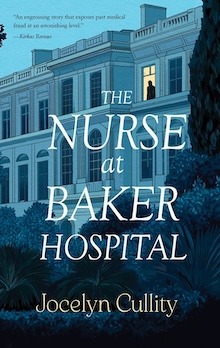
Our Research Notes series invites authors to describe their process for a recent book, with “research” defined as broadly as they would like. This week, Jocelyn Cullity writes about The Nurse at Baker Hospital from Regal House Publishing.
+
When I moved to Columbia, Missouri, in 2015 to teach creative writing at Truman State University, I arrived with two children, two dogs, and two cats in tow while my partner remained based on the East Coast, commuting back and forth so I could accept the position. With a new job and a busy household, I needed a place where I could disappear into a manuscript for a few uninterrupted days, and I found it at the Writers’ Colony at Dairy Hollow in Eureka Springs, Arkansas.
The Writers’ Colony offers exactly what writers dream about: an affordable retreat where the only real responsibilities are writing, eating extraordinary meals, and enjoying the quiet companionship of other artists each evening. I had never been to Arkansas before and knew almost nothing about the state. I certainly wasn’t prepared for Eureka Springs.
Perched high in the Ozark Mountains, Eureka Springs feels unlike anywhere else in America. Built into the mountainside rather than laid out upon it, its streets twist and climb with the contours of the land so that almost no intersections meet at right angles. What began as a Native American healing site became a booming Victorian spa town after the discovery of its supposedly curative springs. Following decades of decline, artists, hippies, and back-to-the-land communities reclaimed its abandoned Victorian buildings in the 1970s, earning it the affectionate nickname, “the town where misfits fit.” Today it remains an eccentric, welcoming place where history, folklore, and artistic imagination coexist with unusual ease.
Its history is as colorful as its geography. Hidden beneath many of its buildings lies a network of underground storefronts and limestone passages once used by bootleggers and gangsters who frequented the Basin Park Hotel during Prohibition. Temperance crusader Carry Nation spent her final years there. The town is also considered one of the most haunted places in America, due in no small part to the Crescent Hotel and its infamous association with Norman Baker.
Baker fascinated me immediately.
Known as “America’s King of the Quacks,” Baker was a charismatic radio personality whose influence rivaled that of modern political figures using social media today. In the late 1930s he transformed the Crescent Hotel into a fraudulent cancer hospital, convincing desperate patients from across the country to place their trust—and their money—in his miracle cure. His crimes left behind not only ruined lives but also the ghost stories that still draw thousands of visitors to the hotel each year.
I knew I wanted to write a mystery set in Baker’s hospital.
As an outsider writing about a town I barely knew, I began cautiously. Before drafting a single chapter, I immersed myself in books about Eureka Springs, trying to understand not only its history but its culture. I interviewed Keith Scales, who managed the Crescent Hotel’s ghost tours and had developed an extraordinary knowledge of the building’s history through years of research. Through John Cross, Claude Fuller’s grandson, I gained access to a remarkable collection of correspondence between his grandfather and Norman Baker that had been preserved by the Fuller family. These letters opened a small window into Baker’s ambitions and personality.
Confident I had gathered enough material, I wrote a complete first draft.
It wasn’t very good.
Or rather, it was good fiction, but weak history.
When I shared the manuscript with local artist and historian Rebecca Becker, whose work focuses on the Crescent Hotel’s years as a women’s college, she reacted strongly to the liberties I had taken. She worried that I was adding yet another layer of myth to a town already overflowing with legends. Historians devote themselves to separating fact from folklore, and in Eureka Springs that work matters deeply. There are already enough stories that blur the line between truth and invention.
Her criticism stung. She was right.
After spending more than a year writing that manuscript, I put it away and started over.
The second time I approached the novel less like a novelist and more like a detective. Every historical detail required documentation. Every scene had to be anchored by evidence. I returned to Keith Scales and interviewed him repeatedly. I spent countless hours with John Cross discussing family archives and local history. Thanks to the generosity of Crescent Hotel owner Elise Roenigk, I was able to make two extended research visits to the hotel, exploring spaces not ordinarily available to guests and immersing myself in the setting that became central to the novel. I read Norman Baker’s radio broadcasts, and worked through the voluminous court transcripts from his prosecution in Little Rock that have been preserved by the American Medical Association in Chicago.
Five years passed. Rebecca Becker continued to read drafts, generously pointing out every historical inconsistency she could find. Sometimes those conversations were uncomfortable, but they made the book immeasurably stronger. Eventually, after what felt like the hundredth revision, I submitted the manuscript to Regal House Publishing. The Nurse at Baker Hospital will be published on October 6.
Historical novelists often say that absolute accuracy is impossible. No matter how carefully you work, small errors inevitably remain. I’ve come to believe that this is true, but I’ve also learned something equally important. Careful research doesn’t simply prevent mistakes; it creates discoveries.
As you sift through letters, court transcripts, newspaper articles, photographs, and forgotten archives, unexpected connections begin to emerge. You notice a gap between two events. A motive suddenly makes sense. A seemingly insignificant object reveals something essential about a person’s life. Research becomes a form of detective work, and those moments of discovery can become the emotional heart of the novel.
Ultimately, I don’t think readers come to historical fiction expecting a perfect reconstruction of the past. They come seeking immersion—a believable world populated by people who feel real. The novelist’s responsibility is not only to honor the historical record but also to capture the emotional truth of another time. If I have succeeded, I hope readers will leave The Nurse at Baker Hospital with a deeper understanding not only of Norman Baker and Eureka Springs, but of an imperfect, complicated, purely American past that continues to shape our present.
+++
Jocelyn Cullity is the Director of Creative Writing and the Stokes Center for Creative Writing at the University of South Alabama. Her first novel, Amah & the Silk-Winged Pigeons, won the 2018 Best Book Awards in Historical Fiction, and has been translated into French and Tamil. Her second novel, The Envy of Paradise, was a finalist in Multicultural Fiction for the 2020 International Book Awards. The Nurse at Baker Hospital (October 6, 2026) is a historical mystery set in Eureka Springs, Arkansas during the Depression. Cullity’s short stories, essays, and interviews have been published in Blackbird, The Missouri Review, Hayden’s Ferry Review, and The Writer’s Chronicle, among others.