Our Research Notes series invites authors to describe their process for a recent book, with “research” defined as broadly as they would like. This week, Wendy J. Fox writes about The Last Supper from Santa Fe Writers’s Project.
+
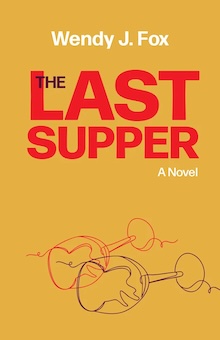
My forthcoming novel, The Last Supper follows three chaotic months in the life of Amanda—a mother of two young children who has just turned forty—who is desperately trying to reclaim her economic and creative agency.
Her story is very different from my own, and it’s fiction after all, but I did write the book after a creative crisis.
I had been working on a different manuscript for seven years. I referred to it as my “climate change cult / school shooting” book, and from that, it’s not hard to guess the basic tilt. It was taking a lot of time, because I wanted it to be big and sweepingly cinematic. The manuscript is big (it ballooned to 120K words) and it does have some gorgeous panoramas as I wrote about a charismatic leader deeply concerned about a warming planet monkeywrenching his way across Colorado. Alongside him is a woman newly radicalized into anarchist action by the murder of her young brother—in you guessed it, a school shooting.
While I was writing Big Book, other things were happening in my writing life. I published a novel and a collection of linked short stories. Yet, while I spun a complicated plot with deep backstory which included the Soviet invasion of Czechoslovakia, two earthquakes, a wildfire, multiple prison stints, and a protracted scene featuring Arrabiata sauce, I still had not managed addressed the characters’ ultimate motivations nor quite figured out parts of the action.
There was no explosive moment when I realized Big Book wasn’t working. It was more like one of those romantic relationships where things aren’t terrible, but also not great. When you wonder: do I keep working on this? Or do I break it off and start over?
I broke it off.
It hurt, to put Big Book into the drawer. I had really believed it would be a breakthrough for me as a writer, and I had really believed I was telling a compelling story.
Yet, The Last Supper was not a rebound relationship. The genesis tracked back to a character sketch I did in 2013. Anyone who knows me in a certain personal way is aware I keep a very clean home, and if you ever come to visit, I will make you pour-over coffee in the morning and cook scratch meals according to your dietary preferences and make sure the dishes are done before bed.
But my files. My files are a hoarder house. My files are a mess of two separate cloud backups and a physical for good measure, and terrified-to-lose-a-single-word Save As versions, with names like “Fauntleroy no semicolons_3_12-14_d8” and “advice4telling-secrets_lose-the-adivce-column_draft8.”
I had to dig pretty deep to find that character sketch, and I was grasping after abandoning Big Book. Opening the file felt a little bit like a you up? text.
Still, I needed to shift. Initially, I renamed my character sketch “RESET NOVEL.”
Instead of intersecting characters, timelines, and long lyrical sentences—a hallmark of Big Book and some of my prior work—I intentionally started working in short sections, chronologically, each chapter confined to a single day for my protagonist.
I didn’t realize it then, but I was forcing a sense of forward motion on myself: as in, I have five new chapters! Never mind that five chapters was barely a dozen pages.
For me, it takes a lot of time to really get a manuscript together, and I can see the inflection points in my life that correspond to book publication dates. Five years before my debut in 2014, for example, I moved to a new state. Feeling extremely socially isolated, I threw myself into the work; that desperation shows up on the page. Six years before my last book, the collection of linked stories, I started a job that was both very career-defining for me and also often truly unhinged. This experience also shows up on the page: Publisher’s Weekly called some stories “bizarre” and Booklist said the book was “at times absurd.” (Nailed it?)
It made sense to begin again with something—the character sketch—that was from years earlier. In my tangled rat’s nest of files, I can see the lifeline that writing has always been for me, and how saving everything actually serves my creative practice.
The question I ask myself all the time when I am writing is: how do I make the reader feel what I am feeling? It spans from hurt to joy and from torpor to electricity. That’s why I personally read, to inhabit the experience of someone else. In The Last Supper, writing in something of a narrow way, helped the work feel personal and allowed me to push into emotional crises and the inner lives of character, something all of my published fiction has in common.
The structure of The Last Supper while rigid in terms of each chapter being a single day, which also means a delicate balancing act with backstory, actually jangled something loose in me and helped get back to what I actually love about building narrative. My protagonist Amanda has to discover something about herself in order to understand how she will go forward. Writing about her, including her struggles, including her fears, moved me away from the didactic issues of Big Book. It helped me care about one person’s story. I hope readers will care about the story too.
+++
Wendy J. Fox is the author of five books of fiction, including What If We Were Somewhere Else, which won the Colorado Book Award and the forthcoming The Last Supper. She has written for many national publications including Self, Business Insider, BuzzFeed, and Ms. and authors a quarterly column inElectric Literature focusing on independent books. She is a former SVP of marketing for a green tech firm and lives outside of Phoenix.