Our Research Notes series invites authors to describe their process for a recent book, with “research” defined as broadly as they would like. This week, Roger King writes about The Industrial Revolution of Love from Regal House.
+
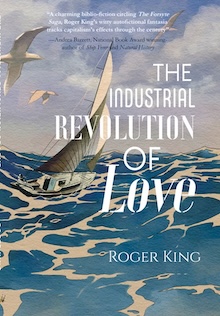
I was reaching for big meaning. How had we got to be the way we are, and how could a novelist write about it? The way we are is: living online in a climate crisis.
This new way of living was only the latest expression of the changes wrought by the industrial revolutions that began in England two hundred and fifty years ago. Scientific invention was supercharged by the invention of capitalism to restlessly create new industries and new ways of life. Change had become the norm, and most recently, in my view, change was carrying us away helplessly into a future that humanity had never chosen: the feared catastrophes of climate and AI.
I felt I could understand something of the bigger economic story because I had been a UN economist before I was a novelist, and had eminent economists among my friends. But as a novelist working on his seventh novel, the job was to illuminate all this through the intimacies of the human heart.
At the time when I was first casting around for a way to write such an insanely overreaching book, I was at an artist residency in Washington state, and a news story caught my eye. An online sex worker – a camgirl – had been prosecuted for streaming her sessions live from her college library. Public indecency. The company platform she streamed on promised customers a combination of friendship and remote sex. I thought: what a perfect exemplar of technology and capitalism combining to profit from human desire. It could be argued in this case that the loneliness it addressed was itself the consequence of capitalism. I had discovered one intimate human nexus for my grand concerns. The camgirl herself, was unrepentant and unashamed. The publicity had opened new doors for her. Her parents were supportive. It was too good an example to ignore.
My research now included, climate change, economic history, human stories from the industrial revolutions, and cam models.
To help explain the sweep of capitalism and its consequences on lives, there was the particular gift of Thomas Piketty’s 2013, Capital in the Twenty-First Century. Rather than concentrating on this century, the book is a fastidious compiling of data since the beginning of industrial capitalism, to show exactly who got rich and how, and the consequences for us all. This depth was served up with a fluency that often drew its human examples from great literature.
The best human examples I found in literature were the Forsytes. In 1932, John Galsworthy won the Nobel Prize for, The Forsyte Saga, and its sequels. Galsworthy claimed he did not want to tell the history of the modern age’s changing technology but to tell the sentimental lives of those involved. This he did in great detail, following the lives of an English family who went from English peasants in the eighteenth century to rich international industrialists by the end of the nineteenth, to a state of confusion in the early twentieth. Galsworthy died in 1933. I became so involved with some of his characters, who so perfectly represented my interests, that in the end they turned up in my own book. Irene Forsyte, in particular, who was not given an inner voice by Galsworthy, became a vocal commentator in my novel.
An understanding of climate change is not hard to research. The line of that story of heedlessness is clear. The more I read and thought, the more it came to seem emblematic of a flaw in the human project that might one day end us. More locally, I spent part of each year living close to nature on a sailing boat in Maine, noticing the changes in the life around me, and the new weather threatening me. This too entered my book.
My research on the cam model industry started with web searches, since the literature is small. I noted its rapid growth into an enormous global industry with an enormous number of participants, even while my older friends all claimed to have never heard of it. I discovered the intimate technologies of teledildonics, wearable devices that drove excitement and payments, and were suggestive of nascent cyborgs. I noticed too how matter of fact the participants were — that all this was already an accepted normal. When I finished that research, I contacted a camgirl directly who, being articulate and an artist, was generous in sharing her many insights and opinions, including the assertion that the industry was wholly beneficial for all concerned. A camgirl character, similarly articulate and at ease with her work, appears in my novel.
Incorporating these various research insights into an entertaining novel of emotional depth was the mad ambition. Trial and error led to a novel that starts in intimate fragments, sometimes poetic and demanding of explanation, which are gradually assembled by the narrator into a coherent single story. It is a story about the making of a story. The short novel covers 250 years, contains invention, autobiography and appropriation, and incidentally pushes
Galsworthy’s Forsyte family story up to present day America. It is a chain of human hearts – and human shame – that interrogates the modern age, to ask, “What’s next.”
+++
The Industrial Revolution of Love is Roger King’s (www.rogerking.org) seventh novel. He is a prizewinning writer, widely praised for the intelligence of his novels and his poetic prose. He has also worked in twenty countries as a socio-economist for UN agencies, made documentary films with indigenous peoples, and described global future scenarios for the World Bank. His shorter fiction has appeared in Granta (as Leonard Frank), and Parnassus. He grew up in London and lives in Western Massachusetts.