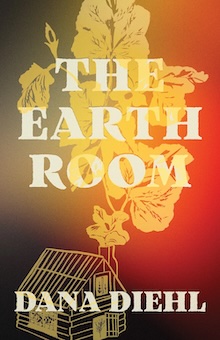
Our Research Notes series invites authors to describe their process for a recent book, with “research” defined as broadly as they would like. This week, Dana Diehl writes about The Earth Room from Black Lawrence Press.
+
Learning to Throw
This is how you throw a cup.
It starts with a ball of clay of uniform texture, stuck firmly onto the center of a pottery wheel.
This second step is the hardest and most important. You must center the clay. As the wheel spins, press the base of your palm—that firm spot where the hand meets the wrist—into the clay. Lock your elbow into your hip and hold steady. Let the clay adapt to you, not the other way around. You know it’s centered when the wheel is spinning, but the clay looks like it’s not moving at all.
Press your thumbs into the clay like they’re synchronized swimmers diving in. Open the cup’s mouth.
Use your knuckle or a sponge to pull the clay up. Give it height. See how tall you can make it before you risk collapse.
+
I signed up for my first pottery class with a couple of writer friends, two or three years before the pandemic.
Our teacher is full of pottery lore. He tells us in the East, pottery wheels spin counterclockwise. But in the West, they spin clockwise because the Puritans considered the left hand sinful, so they decreed pots must spin through the right hand first. I learn about a ceramics instructor who split their class in half. One half was told to make one, perfect pot. The other half was told to make as many pots as they could. The half that prioritized quantity over quality made a lot of crappy pots, sure, but the successful pieces were more creative, more beautiful, than those from the group that was focused solely on perfection.
On the wheel, our teacher’s large hands pull shapes from balls of clay like a sorcerer summoning spirits from the ground. He watches us struggle and tells us our pots are beautiful, too, even when they’re wobbly and chunky and off-center.
When the two-month class is over, I take another. When the pandemic hits, I sign up for a membership, which means I can stop by the co-op studio almost any time, day or night, to throw pots or glaze.
The pottery co-op studio has both indoor and outdoor work spaces and pottery wheels. The front of the studio is painted a friendly orange with purple accents. Shelving is everywhere. Every flat surface is piled with half-finished pots, trimming tools, bowls being repurposed as molds, containers of glaze, clay dust. There is an orange studio cat, Alfie, that emerges from the clutter for head scratches. The space is crowded and dusty and makeshift. There are always cool people doing cool things, willing to chat about what they’re doing. In the worst days of the pandemic, it was one of the only places I felt safe and life seemed normal.
+
I guess I’ve always been interested in earth.
My parents were geologists, and on family drives we’d spend a lot of time talking about dirt and rocks and how the earth was formed. I’d hear about how that valley had been shaped by a glacier, how this waterfall was the result of sandstone stacked against shale that eroded more quickly than its rocky neighbor. There was always a story about why the land looked the way it did, and the clues to uncovering that story could be found in the shapes, the colors, the textures in front of our eyes.
These stories were long and very old. The impossibly slow movement of tectonic plates, the compression of ancient swamps that became coal, the glacial erosion.
As a kid, I loved the idea that secret happenings were occurring beneath our feet. Moles and earthworms and groundhogs and mice and burrowing insects carved tunnels and had babies and lived their lives. Toads slept out the winter. Trilobite and brachiopod fossils were nestled inside shale, waiting to be cracked open.
+
My first finished, glazed, fired pot was a marvel. I put it on the windowsill next to my writing desk and couldn’t stop picking it up and turning it over in my hands.
It was a very imperfect pot. The walls were uneven. The base was messy. But it was an object I had made, an object that could be used to hold a hot drink or a small succulent. I liked that the action of making the pot was preserved the finished object. You could see the spot where my thumb had pressed into the rim. You could see the throwing rings where my fingers had pulled up its walls.
The experience felt very different from finishing a story. This pot I had in my hands was complete. The soft clay had been dried, glazed, fired at over 2,000 degrees Fahrenheit, and altered at a molecular level. I couldn’t copy and paste it. I couldn’t break it down again and change its shape, even if I wanted to. It could be shattered, and though I might be able to glue it back together, this pot in its current form would never exist again.
My pot felt both less and more permanent than any story I’d ever written. Even if I publish a story, the raw material will always remain. I can go back to the Word document and endlessly fiddle.
I passed my completed pot from one hand to the other. There was some relief in the fact that this was the only version of that pot that would ever exist.
+
I think doing pottery is the closest I’ve come to meditation. When I am having a good session, I am both very present and not. I’m reacting to the clay, and the clay is reacting to me, and I’m acting based on instinct rather than logic.
I like not knowing exactly what I’m making. Maybe if I was a better potter, I’d feel differently. But I like going to the wheel, slamming a knot of clay onto the wheel, and figuring it out as I go. I like when they clay determines the form.
Writing can also feel this way. My favorite thing is when I forget I’m writing. I’m not looking at my word count or watching the minutes tick by. I’m not getting sidetracked by my phone. I’m immersed in a world of my own creation, both guiding and being guided by the story.
It makes me self-conscious to admit, though, that getting to this meditative space is easier for me in pottery than it is in writing. Maybe it’s because when I’m making a pot, I’m bound to my wheel by how immediately messy I become. I can’t so much as check the time on my phone without a five-minute clean-up routine.
Or maybe it’s because with writing, it’s harder for me to detach my ego from my project. When I do pottery, I’m doing it for me. I’m satisfied with a compliment from my husband when I bring home new work and the satisfaction of being able to eat or drink out of something I made with my own hands. But when I write a story, it’s hard to silence the insecurities: Will anyone want to publish this? Will anyone connect to this?
With pottery, there are so many stages at which the pot could fall apart. I might drop it. It might crack during bisque firing. It might explode in the kiln—or be destroyed by someone else’s piece exploding. The glaze might be mixed to the wrong consistency and bubble or drip. If I became too attached to the potential of every pot I made, I’d be repeatedly heartbroken. The joy has to be in the process, not just the final product.
+
Trimming a pot feels a lot like editing a story.
To trim a pot, wait until the clay is leather-hard—firm enough to keep its shape and not buckle under pressure, but pliable enough that it can still be changed.
Secure the pot to the wheel, upside down, with balls of wet clay. Spin. Use a sharp tool to trim off the excess, the imperfections. The uneven walls? Make them even. The thick bottom, the halo at the base where the pot stuck to the wheel? Cut it off. Give the pot a delicate foot to stand on. Trim away the evidence that the pot ever contained mess.
As I’ve gotten better at pottery, the trimming process has gotten simpler. My original form, straight off the wheel, has inched closer and closer to what I want it to be, and I’ve had less to edit away. But also, I’ve found myself more drawn to the imperfections, the proof of human hands. The throwing lines. The crooked line left by a fingernail. Sometimes I like to press my thumb into a cup, making an indent that can hold someone else’s thumb. The human touch makes the shape easier to hold.
+
Almost two years ago, I took my first Raku class with the same instructor who taught me how to throw pots on the wheel.
Raku is a process (I’m referring here to the Western version, which differs from the traditional Japanese process) in which glazed pieces are fired until they’re bubbling and glowing with heat. They’re removed from the kiln with tongs and placed in a container, like a metal trash can, with combustible material such as newspaper or wood chips. As the material catches on fire, you put a lid on the container, starving it of oxygen. The unglazed clay traps the carbon released by the burning materials and turns black.
Raku involves a lot of heat and fire and smoke and occasionally burned fingers.
Raku is much faster and more unpredictable than traditional kiln firing. Pieces break more frequently.
But as a reward, you get an object that feels like a true collaboration between yourself and the elements. The glaze might crackle with spiderwebs or shine like an iridescent shell pulled from the bottom of the ocean.
The process is captured on the form. Where the air hit first, where it lay in a bed of wood chips, where the kiln’s flames licked a bit hotter. The method shows in the arrangement of colors and shapes on the finished product.
I can’t help but connect pottery to my writing practice. Pottery has taught me that creativity means to hold control in one hand and spontaneity in the other. It’s taught me that sometimes you need to hold firm and lock in, but often beauty comes from letting go and allowing the material to determine the shape.
When I write, it’s so hard to let go of my dreams for the finished product. It’s hard not to endlessly fiddle with a draft, editing away the parts of a story that seem too strange or too risky. Developing my pottery practice has helped me to see that I need to enjoy the process of writing just as much as I do the finished piece, and that perfection isn’t my ideal in art.
+
Near the end of my time in college, there was a flood in Central Pennsylvania. The flood reshaped the creek that my home township was named for. Like fingers smoothing away the rough edges of a pot, the water eroded at the banks until the creek took a new form. It kind of looked like the creek I’d grown up canoeing on, swimming in, but it was different.
One of the most surprising changes was that the widening creek exposed an old landfill. The new creek bank was littered with old glass jars and bottles and broken ceramics. When I was home from college, my mom and I would go to that section of the creek and comb the shore for treasures. Old Coke bottles. Medicine bottles. Ceramic plates. Most of it was broken, but sometimes we’d find an intact, vintage gem to take home.
I liked this new shape the creek had taken. It didn’t care about the borders that had been formed around it—the parking lots, the roads, the yards with waterside campfire pits. It had found a new way to be, and in doing so it had uncovered treasure.
+++
Dana Diehl is the author of the short story collection, Our Dreams Might Align, and the collaborative collection, The Classroom. Her chapbook, TV Girls, won the 2017-2018 New Delta Review Chapbook Contest judged by Chen Chen. Diehl earned her MFA in Fiction at Arizona State University. Her work has appeared in North American Review, Necessary Fiction, Waxwing, Mid-American Review, and elsewhere. Raised in Pennsylvania, she now teaches and writes in southern Arizona.