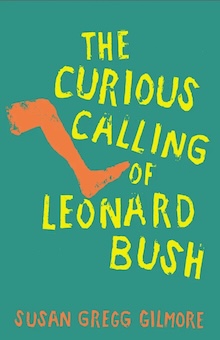
Our Research Notes series invites authors to describe their process for a recent book, with “research” defined as broadly as they would like. This week, Susan Gregg Gilmore writes about The Curious Calling of Leonard Bush from Blair Publishing.
+
A death march is what my teenaged students called it. In a literal-kind-of way, I guess they were right.
For two summers, I taught fiction writing at a week-long summer camp sponsored by Humanities Tennessee. We gathered at Lincoln Memorial University—that pinpoint on the map where Tennessee, Kentucky, and Virginia meet. Many of the students were from the mountains that surrounded us. Many were on scholarship. All came eager to write—mostly about zombies, vampires, shapeshifters, and other supernaturals.
And although I appreciate the fantastical genre, I wanted my students to stretch a little farther, explore something new, push themselves and their writing out of their comfort zone. I wanted them to create a well-developed, very human character that could move a story forward.
So we walked en masse to a small cemetery on campus. No more than a half-mile from our classroom, but under a scorching Tennessee sun, this is what the kids dubbed a death march. At the cemetery, I gave them one instruction: nurture a character using information they could glean from a tombstone and the land surrounding them. For my student writers, it was the beginning of a week of character research and development. For me, it was the beginning of a novel because there, on that hilltop, I found a tombstone that read LEONARD BUSH’S LEG 1912.
Incredible, I thought. I snapped pictures of the marker. Pointed it out to my students who seemed rather unimpressed. In fact, of all the kids who walked to the cemetery with me those two summers, only one developed a character based on this tombstone. I could not shake it though. Back home in Chattanooga, I’d fall asleep thinking about Leonard Bush. I’d wake in the mornings thinking about Leonard Bush. So I wrote the school and asked if they knew anything more about this Leonard Bush. A woman promptly replied. Leonard was twelve years old when he lost his leg. That was all she knew. But that was enough for me. A few months later, I emailed my agent six pages of a novel about a twelve-year old boy who lost his leg due to an infected cut on his foot. And in the wake of loss, Leonard insisted that his amputated leg be buried in the family cemetery.
During the next seven years that I worked on this novel, I never wanted to know more about the real Leonard Bush. Most of what I needed to know about my Leonard was written on that tombstone in Harrogate, Tennessee, and rooted in the pastures and farms nestled at the foot of the Appalachian Mountains. Of course, I needed to know how a twelve-year-old boy would both physically and mentally cope with amputation, specifically in 1962 when my novel is set. So I spoke with prosthetists. I met with experts at Fillauer, a global leader in orthotics and prosthetics. And I spoke with psychologists, not only about Leonard’s reaction to his loss, but his parents’ as well.
Once I was finished with the book, and it was in the hands of my publisher, a stranger messaged me on Facebook, claiming to be a distant relative of the real Leonard Bush. Wait a moment. The boy I had spent almost ten years with now, in my head and on the page, was real. Albeit not human. But I was intrigued. For weeks, my new Facebook friend and I chatted back and forth on Messenger. We even kidded that perhaps we, too, were related. We shared an unusual name on our family trees, Gulley. Perhaps I, too, was distantly related to Leonard. Stranger things have happened, we both admitted.
With this information, I began to research in earnest the gentleman from East Tennessee who, it turned out, had cut his foot on rusty barbed wire when he was twelve years old and lost his leg because of the infection that had ensued. I dove into Ancestry.com, a rich, DNA-rooted repository of data.
I now know Leonard Bush was born in Tiprell, Tennessee, just over the mountain from Harrogate. He was married twice. His first wife was named Macie, his second was Dexter. He had two sons. One named Lillard. The other Kyle. (I must admit I have worried about the boy named Lillard, imagining a childhood of bullying and taunting leading to years of broken relationships, gambling, and too much drink. Perhaps I’m stewing on another novel.) Leonard had two sisters. One brother. One half-sister and four daughters. One of whom married a Gulley. He was a lifelong member of Pump Springs Baptist Church, a former school teacher, and the Claiborne County Register of Deeds for eight years before elevating to county trustee. He died at the age of sixty-six, and his body was buried at Harrogate Cemetery, four miles from his leg.
When I first discovered the tombstone, I thought it strange that a boy, or his mama and daddy, felt it important to bury an amputated leg in a hilltop cemetery, to commemorate it with such a formal stone marker. Now I wondered why the leg had not been reunited with the body. For some people in this part of the world, there’s a firm belief that every bit of a person must be buried together, to ensure reunification in the afterlife. But perhaps that was not Leonard’s concern or his parent’s. Perhaps it was simply their need to treat their son’s leg with care, to honor that part of Leonard that had enabled him to run across a field chasing a lightning bug, or wade into cool waters to cast a fishing line, or to hike a mountain on a clear morning to watch the sun rise. Perhaps burying the leg accomplished nothing more than to help child and parent cope with the mighty loss. In that way, my Leonard and the real Leonard were the same.
+
Susan Gregg Gilmore is the bestselling author of four novels, all of which are rooted in her native South. Her debut, Looking For Salvation at the Dairy Queen (Crown), was a USA Today and Amazon bestseller as well as a 2009 Southern Independent Booksellers Association Book-of-the-Year Award nominee. Her third, The Funeral Dress (Broadway Books), was called a “revelatory novel that offers an evocative account of the lives of Appalachian working women” by Kirkus Reviews. It was both a Target Recommended Read and a Target Emerging Author Selection.