Our Research Notes series invites authors to describe their process for a recent book, with “research” defined as broadly as they would like. This week, Ellen Meeropol writes about Sometimes An Island from Sea Crow Press.
+
Zooming with my characters
I always wonder how other writers let go of their characters, because I can’t.
Full disclosure: I don’t easily let go of my friends either. I’m the person who emails far-away friends every few months —my best friend from junior high school, my sisters from the early women’s movement—and says, hey. We haven’t talked for a while. Let’s zoom.
But my characters can’t zoom with me. Or can they? I wrote a story for my forthcoming book about characters zooming with each other, but I couldn’t find a way to insert myself into a little box and they proceeded without me.
My old characters still hover in my brain, tied to me by invisible but robust threads.
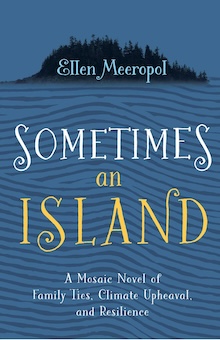
This is not a new problem. My characters have always resisted their expiration at the end of a novel. One “secondary” character was nine years old in my first novel and returned as a college student as one of the main voices in the third novel. His twin brother only mentions him in the fifth novel, but he returns with more force in my new book. My publisher calls it a mosaic novel, defined as one in which individual chapters or stories with different viewpoints and styles share common settings or characters that contribute to a through narrative line.
I wasn’t planning to write this book. After my last novel was published in 2022, I announced I was finished with long form fiction, didn’t have the energy to promote another novel. I’d focus on short stories. I could still bring back old characters, give them new adventures and challenges. The problem was that the stories, the old ones and the new ones, wanted to play with each other. They wanted to become novels, or parts of novels.
Ok, I reasoned, this will be a linked story collection, and I happily wrote a bunch of new stories. As I wrote, I began to understand that the dozen stories shared three related settings and several main characters. As I wrote, a strong through-narrative emerged.
This wasn’t linked stories; it was a family reunion.
Something else emerged as I wrote these stories under the shadow of the early pandemic and political dread with only zoom to connect me to friends and groups. The narrative linking my cherished characters and their home-settings was increasingly dark and dangerous. “Apocalypse light,” I called it. “Grim,” my daughter said after reading a draft. Not only was I gathering my made-up family and friends, with their ancestors and their pets and their intricate backstories, I was insisting that they inhabit the frightening world we live in today, and even worse in the near future. I was putting these dear old friends into a landscape of environmental disaster, bereft of the safety nets we take for granted: a world both unfamiliar and chilling.
What a way to treat my beloved characters.
Fiction is about trouble and I’ve always challenged my characters with big-picture difficulties: bias and persecution, arrests and prison, political kidnapping and enhanced interrogation, breast cancer and dementia, secrets and lies and all the good/bad stuff that makes for exciting storytelling. But this book feels different, bigger and more global. Sometimes an Island is set primarily during the dozen years up to and following a major climate disaster; the survivors band together to rebuild after massive infrastructure collapse and personal loss.
Perhaps this is about turning 80 and facing the loss of dear friends and family. Perhaps it’s about the fear of fascism coming to our nation and our world. Perhaps it’s about pushing the limits of what I can bear to think about and a way to find hope and new sustenance in the grim circumstances of masked ICE hoodlums and environmental crisis. Perhaps it’s about the need to look backward towards ancestors and forward about those coming next.
Maybe a zoom call, with my made-up family of characters in their little boxes but somehow all in the same place and all contributing to a storyline, isn’t a bad metaphor for a literary family reunion.
+++
Ellen Meeropol is the author of the previous novels The Lost Women of Azalea Court, Her Sister’s Tattoo, Kinship of Clover, On Hurricane Island, and House Arrest, and the play Gridlock. She is the guest editor for the anthology Dreams for a Broken World. Essay and story publications include Ms. Magazine, Lilith, The Writer Magazine, The Boston Globe, Solstice Magazine, Guernica, Lit Hub, and Mom Egg Review. Her work focuses on the lives of women, especially those on the fault lines between political activism and family, and has been a finalist for the Sarton Women’s Prize, longlisted for the Massachusetts Book Award, and selected by the Women’s National Book Association as a Great Group Reads. Ellen lives in western Massachusetts, where she is a founding mother of Straw Dog Writers Guild.