Our Research Notes series invites authors to describe their process for a recent book, with “research” defined as broadly as they would like. This week, P.J. Blumenthal writes about Self Portraits from Sagging Meniscus.
+
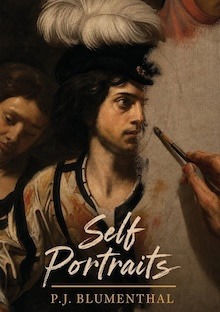
Where do books come from? Maybe from puddles. Or from livery drivers sent to transport you to an undisclosed destination. They come from dark places and light places — and often they arrive in disguise although you are certain you are expecting them.
Frankly, I know little about these things, and I rarely find the words to describe the mystery — despite the fact that I use words frequently. And when words do come to me, I hardly ever receive advanced notice. Sometimes you think there’s only one of them, but in no time, you find an entire family (if family is the right word) standing at your door. And suddenly they grow vociferous. You’d like to imagine they had a proper upbringing, but that’s seldom the case. They can get quite unruly in fact and are always making demands. Sometimes they do things directly before your eyes that most usually do in private. You might be tempted to turn away. But no, words of this kind have never felt bound by the rules of customary behavior. At least not in my experience.
Why am I telling you this? I suppose it’s my feeble attempt to describe the making of a book of short stories entitled Self Portraits. Is this an appropriate title for this book? Selves Portraits would have been a more accurate rendering of my intentions, but it sounds awkward. Portraits of Selves might have worked, but Self Portraits it is — despite the fact that I was concerned my title might give rise to a serious misunderstanding. Which is to say that I was obsessively preoccupied with my own mirror image.
And yet, the stories in this book are portraits of selves, many selves of course — including the author — although he is only occasionally a character in his own tales — even when a narrator is posing as the author.
Personally, I like to think of these self portraits as verbal counterparts to Hokusai’s One Hundred Views of Mount Fuji. In Hokusai’s graphics, sometimes you see the mountain, sometimes you don’t. Sometimes Fuji’s role is central, sometimes you catch a glimpse of it off to the side or somewhere in the background. Or it may be hidden behind a cloud — or totally invisible.
These stories did not come about as parts of a preconceived whole. Years separate the genesis of many of them. Gradually however, I did recognize them as parts of a whole, and they do fit together as if this mixture had always been my plan.
Each of these tales was born out of necessity, by which I mean they resulted from the author’s need (or curiosity) to pull on a thread of words that became visible one day. Here and there, intertextual sources played a role in their conception.
The first story in the book, for example, owes a lot to a painting by the Dutch Baroque painter Nicolas Regnier (who incidentally once painted a “Self Portrait”) and René Descartes’ Discourse on Method. I have no way of explaining why I juxtaposed these two contemporaries. It simply happened.
Tolstoy’s “Three Deaths” played a role in a story called — appropriately — “Two Deaths”. Oh, and Yeat’s “To a Friend Whose Works Have Come to Nothing” served as the title of a story that portrays events in the lives of real people I have known personally.
Although a number of these stories are portraits of real selves of my acquaintance, others portray — how shall I put it? — places and situations, realms far from what we understand as the quotidian. Some of these pieces may strike some readers as “Kafkaesque” or “Borges-esque”. Suffice it to say that any writer who feels compelled to touch on such themes probably just shares a need with others to portray places, events and people rooted in…how shall I put it?… in a dimension different from the one upon which we usually place our focus. At any rate, the title, Self Portraits, is relevant to all the stories in this book.
The real mystery is that they came into existence at all. Which leads me back to my opening question: Where do books come from? Saying that they come from puddles is at least an attempt at an answer. But maybe it isn’t necessary — or possible — to answer this question.
+++
P.J. Blumenthal is an American writer living in Munich, Germany. He is the author of the novel Winston Hewlett’s Impotence (Sagging Meniscus, 2024), a nonfiction book on feral man, Kaspar Hausers Geschwister (Kaspar Hauser’s Siblings), as well as a German-language blog, “Der Sprachbloggeur.” Three volumes of his poetry have appeared in the USA so far: A Lusty Romance, Poems for Readers and Slow Train to Cincinnati.