Our Research Notes series invites authors to describe their process for a recent book, with “research” defined as broadly as they would like. This week, Donna Miscolta writes about Ofelia and Norma from Regal House.
+
I was a science major in college. I won’t explain why. Suffice it to say it was a case of pretending to be someone I was not. I was a fiction. I was not analytical but relied on feelings. Rather than collect data, I was inclined to gather anecdotes.
If I wasn’t meant for science, what was I meant for?
If I wasn’t meant for hard, quantifiable facts, was I then meant for lies?
I decided I was meant for fiction. Fiction is about making things up. Fiction is about telling the truth. Or about arriving at the truth.
In science we are asked to identify the problem and create a clear, researchable question. Not unlike the question we ask ourselves when we set out to make up a story. What does the character want and what’s keeping her from getting it?
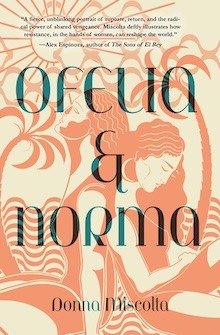
There are two protagonists in my novel Ofelia and Norma as is clear from the title. They are twins, mirrors of each other, inseparable. Until they’re not. Until they realize what they want and are denied it and they must persevere until they get it but only after trials and trauma because that is life. Even in fiction. Especially in fiction.
And in this particular fiction about Ofelia and Norma, body image, sisterhood, the mother-daughter relationship, and revenge are the themes that emerge from all that desire and suffering and perseverance that Ofelia and Norma achingly, angrily, and confusedly feel and act on.
And what do I know of those themes? Through what methods of inquiry have I arrived at an understanding of their complexities?
Have I mentioned I’m bad at research? Instead of research, I will give you anecdotes.
+
Body image
Ofelia and Norma is about bodies. Female bodies that are assessed and judged. The bigger they are, the more they are judged. What do I know about large bodies? I, who am thin still, who as a child and adolescent was skinny, who was called names, who was a joke, who was a prank.
In seventh grade, as we sat waiting for Señora Martinez, whom I loved, to clip-clop in on red high heels and a colorful dress cinched with a wide belt and a scarf flamboyant at her neck to drill us in a Spanish dialog, a boy who had never said a word to me, jumped out of his seat in the next row, reached down and ran his hand up and down my toothpick leg.
A boy had touched me without my permission, and he had done it on a dare amid punishing laughter while I sat frozen at my desk seething, humiliated at the misuse, and wondering at the cruelty, aware that my error, my failing, had been my body.
+
Sisterhood, twins or not
I grew up with three sisters. None of us twins. But doesn’t everyone wonder at some point what it would be like to walk down the street with their double, to eerily speak a word or phrase in unison, unrehearsed and uncued, to simply mystify people? I offer this only marginally related anecdote about sisters.
When my older sister and I, a year and half apart, were growing up, people often thought we were twins. We didn’t think we looked alike, but two brown girls with dark hair and glasses and of similar height can be optically confusing to some.
Once when I was, maybe, eight-years-old, a woman stopped me at some function and asked if I was Maggie’s niece. Maggie was my aunt. I had no idea what a niece was, but I figured that this was a case of mistaken identity, so I answered, “No, but my sister is.”
+
The mother-daughter relationship
I employ the definite article (the mother-daughter relationship) as if I were speaking of a syndrome. A disorder. I’m no expert, but I was a daughter first. Then I became a mother. Now I watch my daughter mother her daughter. Each of us believes we are better than our own mother at mothering. We’re not wrong. But we’re not totally right either. And it’s not a contest. But it is.
What do we need from our mother? Everything, which is an impossible thing.
She housed us in her body and when she delivered us into the world, we were vulnerable to its perils. And thus, if there’s someone to blame for our unhappiness, we can say we didn’t ask to be born. Is there a mother who has not been cut by that rebuke?
Ofelia and Norma have a clueless, self-absorbed mother. Where in my imagination or subconscious did she come from, this woman who had dreams of being someone, dreams that were rendered superfluous by a stingy society?
Ofelia and Norma learn early that they must mother themselves. I am with the daughters. Because their mother failed them in some way. It happens. Mothers fail. Not all the time. But even then, they are blamed. Mothers can never win. I am with the mothers.
+
Revenge
We all want it. Even before we have a reason to want it, that is, before we are harmed. We want it. Revenge. Once again, an anecdote.
When I was five years old and had just begun kindergarten, my sister and I were playing in the parking strip in front of our house. It was the farthest we were allowed to go. Two boys, whose names I didn’t know but whom I recognized as classmates, careened along and stopped at our parking strip. They asked what we were doing. Nothing. They said they were going to the playground and asked why we weren’t going. Because we couldn’t. They laughed and then they wrestled on our parking strip, and we had to move out of the way of their arms and legs and cover our ears at their shouts. When they were done, they sprang up and ran off, still roaring at the top of their lungs in their freedom to move around in the world while we watched from our strip of grass, quiet and constrained, and feeling the stirrings of anger that I knew was meant to be suppressed to exist as a female in the world.
This happens in real life. It happens in fiction. So does revenge. In Ofelia and Norma.
+++
Donna Miscolta is an award-winning writer of three previous books of fiction as well as dozens of stories, essays, and book reviews. A recording of her work is part of the Library of Congress PALABRA Archive, a showcase for Latin American and Latino writers. She blogs monthly at donnamiscolta.com about writing, reading, and her life in Spain where she has lived since 2023 after spending most of her adult life in Seattle, Washington.