Our Research Notes series invites authors to describe their process for a recent book, with “research” defined as broadly as they like. This week, Brian Kiteley writes about Jack & Emily from Astrophil Press.
+
Intimate Research
Research has always enriched my creative activities as a writer, much more than just as a way of finding useful information for my books. I do research in order to write. I use the reading I do for my books to provoke composition.
Jack & Emily grew out of two linked novels—Emily’s Book andJack’s Book—telling the same story from their respective points of view. I began Emily’s Book in 2008. All I knew when I started it was that I wanted to investigate a village I visited, the summer of 1988, between the two years I taught at the American University in Cairo. Kalyves was an idyll for two friends, their very young children, and me. I revisited Kalyves in 2010 to do research. The trip back to Crete 22 years later was necessary in part because I lost the journal I kept in 1988 long before I started Emily’s Book, so I had almost no written record of my time there. One important decision I made when I started Emily’s Book was to write it by hand in a beautiful Italian blank book my wife gave me. I did this for over a year, without typing up any of the growing novel onto my laptop, without commentary on what I was doing, and with a forward momentum that had its own logic and organization. I finally transposed the book to the computer in November of 2009. I knew from the moment I began writing the story that it would take place within the time frame of my own stay in Kalyves, from early June to early September 1988. I tried the same thing with Jack’s Book, composing it by hand in another blank book. I took yet a different blank book with me on two trips to Greece, one to Kalyves in 2010 and the other to the Peloponnese Peninsula in 2016. Those travel journals held a great deal of important writing for both books. I had not written my previous two novels by hand (except for dozens of postcard stories—another story).
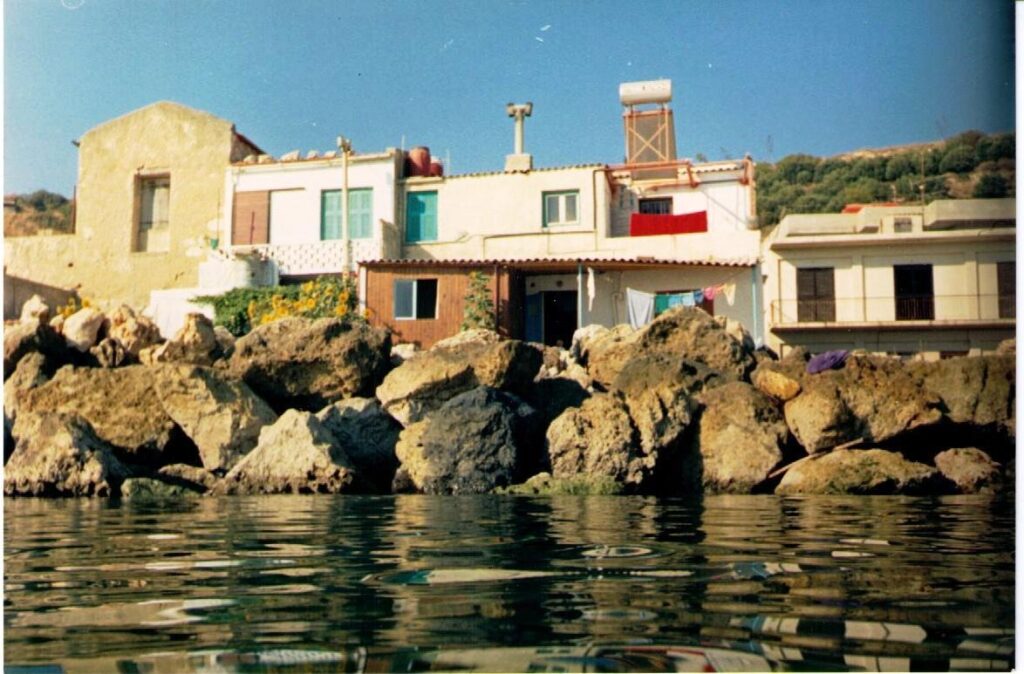
Jack & Emily is rooted in my memories of the ground-floor apartment in Kalyves Nora, Allen, and I rented the summer of 1988. The story is not autobiographical, but I used this specific apartment as the model for Jack’s three-month home.
I finished Emily’s Book in 2015, and quite a few editors told me it was not successful (I disagreed and disagree still). In a slightly crazed reaction, with a little bit of score-settling thrown in, I began Jack’s Book. When I started work on Jack’s Book, I knew I had to do more research into his life and work, the best of which were documents made public by Freedom of Information Act inquiries to the CIA, giving me a great sense of the day-to-day lives of case officers and researchers in the bowels of Langley.
Two very important books helped me write Jack & Emily.
In 1942, Helen MacInnes published Assignment in Brittany. British Intelligence agent Martin Hearne is gathering information on German naval activities along the French coast. He has an uncanny physical resemblance to Bertrand Corlay, a wounded French soldier recovering in England after the evacuation of Dunkirk. Hearne parachutes into Brittany and tries to fool Corlay’s family, including his mother and his fiancée, to maintain his cover. The mission becomes more dangerous when Hearne realizes the real Corlay was not a victim but a Nazi collaborator. Hearne is from Cornwall, and Breton is a close linguistic cousin to Cornish. His job was to learn to speak Breton comfortably, as well as French. He did not fool Corlay’s mother, because he was clearly a good man, whereas Corlay was not a good man, even if she didn’t know the extent of his collaboration with the Germans. Assignment in Brittany was so accurate a portrait of espionage that James Jesus Angleton (what a great name), head of counterintelligence at the CIA in the 1950s, had recruits read the book for years.
Kai Bird’s The Good Spy is a biography of Robert Ames, who argued with his supervisors that deep personal honorable friendships with Middle Eastern men—most importantly Ali Hassan Salameh, a high-ranking PLO official—were vital to his spycraft. Ames rose toward the top of the CIA hierarchy, and he advocated peace talks between the Israelis and the PLO, very quietly, long before the Oslo Accords. He was killed in 1983, along with seven other CIA officers, who were meeting in the American embassy in Beirut, when a truck bomb sheered off the front of the building.
These two books exemplified themes I sought in Jack & Emily, friendship and improvisation, the first quite rare in espionage and the second crucial but underrepresented in spy fiction.
But the real “research” for Jack & Emily was the ghostly previous novel I’d written. I worked on the second novel, and I would keep the files of the first book open on my laptop, so sometimes it was necessary to go back to Emily’s Book and adjust the story in that book. I wrote both books at the same time, or I rewrote Emily while I was writing Jack. This was a novelty for me. Jack was a very familiar figure in my mind and experience. I could see him from another point of view, a very rare circumstance for any novel of mine. Jack was already a researched and well-rounded fictional character, a being I’d spent six years creating, before I even began his own novel.
Eventually, I did feel that Jack’s Book was more relaxed and authentic than Emily’s Book. The background work for Jack & Emily was of a different order than anything I’ve done before. This research was intimate and very localized and yet also far-flung (the British occupation of the island of Crete during the war in 1941). Jack & Emily is the result of nearly two decades of writing about two characters. Emily is in the book’s title, but she doesn’t arrive for 37 pages in a 152-page novel, and then she appears only intermittently for the next 93 pages. Yet she is the backbone, the spirit, and the heart of the novel. I could not have created Jack without having created Emily.
+++
Brian Kiteley is the author of Jack & Emily, The River Gods, I Know Many Songs, but I Cannot Sing, Still Life with Insects, and The 3 A.M. Epiphany. He lives in Merrimac, Massachusetts.