Our Research Notes series invites authors to describe their process for a recent book, with “research” defined as broadly as they would like. This week, Brittany Micka-Foos writes about It’s No Fun Anymore from Apprentice House.
+
In the beginning, there was a thumb.
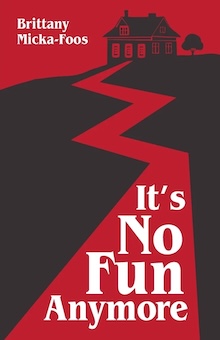
In those early days of the COVID-19 pandemic, when the future was formless and dark, I wrote the first story in what would later become my debut short story collection, It’s No Fun Anymore (June 2025, Apprentice House Press), I called it “Thumb Stump,” and it was good.
Of course, it didn’t appear out of the void. The origin story of “Thumb Stump” traces back to a class I took with Hugo House (a community writing center in Seattle) called “Phantasmagoria: Writing Monsters and Myth.” We read Gogol’s The Nose and were tasked with writing a story in a similar vein—to anthropomorphize something about ourselves. I considered personifying my anxiety disorder, because I’m basic like that. But my husband, bless his soul, suggested, “You should write about your weird thumb.”
So I did.
I possess a thumb on my left hand that is approximately a quarter inch shorter than the other. It’s … weird-looking, especially if you’re the kind of person who notices thumbs, which, frankly, I’d rather you weren’t. I did some research and found that it’s colloquially called a murderer’s thumb, a term I found strangely and perhaps unreasonably empowering. The scientific term is brachydactyly type D, and it’s a genetic trait that occurs in approximately 3% of the population. Megan Fox has one on each hand, much to the morbid fascination and sometimes ire of the internet. Historically, phrenologists and palm readers have maintained that people in possession of such a thumb are violent, untrustworthy, and stupid—natural-born criminals. One small thumb, a whole world of meaning.
That seed of research eventually grew into “Thumb Stump,” a story about a woman who has just had a baby and, in the haze of newborn sleep deprivation and hormonal upheaval, becomes transfixed by the fear that her child will inherit her weird thumb. The thumb acts as a sort of mythological creature. During her own childhood, the protagonist’s father—“a frenzied Adam, blithely bestowing monikers upon the creations surrounding him”—had nicknamed it “the homunculus.”
At that same time, I was also reading Women and Other Monsters by Jess Zimmerman, an essay collection on female monsters from Greek mythology. Each myth that Zimmerman examines reveals other traits that society teaches women to suppress. Medusa becomes a symbol for women who don’t conform to patriarchal beauty standards. Charybdis stands in for insatiable appetites. The Furies: female rage. It’s all too easy to turn women into monsters, and I love that feminists have interrogated this pattern. But I wonder, with a popular culture that now seems to think itself “post-feminist,” what are our present-day monster-women? When “feminist” has come to mean “whatever thing a feminist chooses,” what is left to be monstrous?
Mythology has long been a fascination of mine, ever since my fourth-grade teacher introduced a unit on Greek mythology. I was assigned a paper on Artemis and learned what the word “lesbian” meant. I was hooked. Greek mythology is, in a word, upsetting: packed with incest, murder, bestiality, you name it (much like the Bible, which was already required reading during my youth). My early interest in mythology led me to take Latin throughout middle and high school. And, let me tell you, I was all-in on the classical lifestyle. The highlight of every academic year was attending the Virginia Junior Classical League convention. For those unfamiliar with the glory of a Latin convention, picture throngs of middle- and high-schoolers in togas, orating and taking tests for fun. I made Latin-inspired crafts to enter into a county-fair style competition: a quilt! a roman centurion doll! a scale replica of a roman villa! And I would do it all over again. No regrets.
In Latin class, I picked a Latin name, for we all had Latin names. As if being elbow-deep in declensions wasn’t alienating enough. I chose Callisto. It sounded pretty. Callisto, a follower of Artemis, was raped by Zeus (who, to do so, disguised himself as Artemis, adding another layer of betrayal). Once Hera found out, guess who was turned into a bear as punishment for being assaulted? As a fourteen year old, I was struck by the myth, but unsurprised. After all, there were countless other myths of Zeus “seducing” nymphs and Hera’s misplaced vengeance. It was part of the furniture.
No wonder that, today, I often categorize my writing as “domestic horror.” Myths are the original domestic horror stories. They are relentless. They usually focus on a character and their choices, and much like short stories, they are meaning-making devices. They are rooted in the cultural values, norms, and concerns of the time. For men, they give tips: don’t be greedy, don’t be arrogant. For women, they offer survival strategies. Myths tell you how to be safe, how to avoid violence: literally, how to live.
This mythic influence is especially clear in the opening story of my collection, “The Experiment.” In it, a woman reads a 1950s self-help book (modeled after a real-life gem called Fascinating Womanhood—which I cannot, in good conscience, recommend). She is inspired to conduct a kind of gender-regression, tradwife-style experiment. Ostensibly, it’s research for a book she’s going to write someday (taking cover under the unimpeachable cloak of capitalism). But at her core, she is vying for control in a world that seems unsafe and untenable to her. She’s absorbed the cultural myths about motherhood, the silent warnings. Don’t be a bad mom, don’t be mentally ill, don’t make a scene. So she’s looking for a manual, a way forward, even one she knows is flawed. Like many mythic women, she’s willing to shapeshift. Maybe, she thinks, it’s better to turn herself into the beast than to wait around for a god to do it on her behalf.
Ultimately, “The Experiment” reckons with the same questions the ancient myths asked: How do we live in a dangerous world? How do we survive it? There’s a wave of recent nonfiction that’s helped me explore this terrain, books like Sisters in Hate, Momfluenced, and Homeward Bound. Each text examines how and why some women are choosing—and I use that word loosely—to return to what appear to be regressive roles. Why do the old monsters keep resurfacing?
Mythology reflects our current values and wishes back to us. In my writing, I examine how women navigate expectations that are both outdated and eerily resonant, like ghosts in trendy clothing. It’s No Fun Anymore was my way of wrestling with the myths and messaging I’ve accumulated—as a girl, yes, but also as a grown woman with an Instagram account. Less bloodshed these days, more branding.
So back to the thumb, where it all began. After all, a thumb is never just a thumb (especially when it’s attached to a woman). For me, it became a marker in my own personal mythology: the genesis of my debut collection, an origin story. The thumb represents noticing the odd, overlooked parts of ourselves—monstrous or not—and reckoning with what they reveal.
+++
Brittany Micka-Foos is a writer living in the Pacific Northwest. She is the author of the poetry chapbook A litany of words as fragile as window glass (Bottlecap Press, 2024). Her work has been published in Ninth Letter, Witness Magazine, NonBinary Review, Hobart, and elsewhere. To read more, visit: www.brittanymickafoos.com.