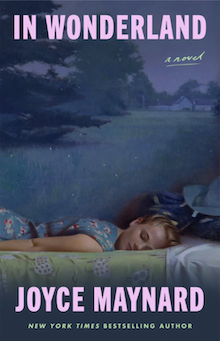
Our Research Notes series invites authors to describe their process for a recent book, with “research” defined as broadly as they would like. This week, Joyce Maynard writes about In Wonderland from Little A.
+
How I Write A Novel
(It starts with my obsessions)
In all the years I’ve lived as a writer — which is to say, all the years of my adult life — that moment of facing a blank screen or a blank piece of paper and typing the number “1” never got any easier. I can’t think of a single aspect of the writing process that’s easy, but I’m pretty sure what qualifies as the hardest: Starting a new novel.
I published my first novel (Baby Love) 45 years ago. My 14th (In Wonderland) has just come out. Every time I write a new work of fiction, it’s as if I’m embarking on a trip to a whole new place I’ve never been to before. Uncharted territory. Thrilling, but scary.
I wouldn’t have it any other way. If any writer ever came up with a tried-and-true formula for how to navigate the route between first page and last one, I doubt I’d want to read the novel that person produced. Because a work of fiction shouldn’t follow a template. A piece of writing imbued with heart, originality and authenticity needs to come out of the writer’s imagination and … here comes a crucial word… her obsessions. There are no rules governing these, or explaining the relationship between the sparks that ignite ideas in a writer’s mind and the story that catches fire as a result of them.
Some obsessions endure for a lifetime. Others come and go. Among those in the second category, for me: Family. Home. Siblings. Love. Loss. Sex. Adolescence. Bodies — my own, and others. And — here’s one that might seem like an outlier — Murder.
I don’t need to keep a running list of my obsessions, I know them so well, but every time I begin a new piece of work, I remind myself what those obsessions are. They’re the engine to which I attach my work, and propel me forward.
So I’ve learned to take these obsessions of mine seriously. If an experience stays lodged in my brain, even decades after it took place, there’s a reason. It speaks to something deep inside. As a writer, I know that’s the most fertile territory to explore.
In our daily lives, obsessions — whether with chocolate, or alcohol, or a person you can’t get out of your brain — can make for problems. In my writing life, paying attention to those things has served as an endless source of energy and inspiration.
Here’s what that process looked like when I set out to work on my most recent novel: It always starts when I land on a single random moment from my life, or a handful of them, or maybe just an image, a snapshot lodged in my brain. These random fragments may not make any sense at the time, but I’ve learned to take them seriously.
This time around, as I embarked on the search for my next book, I went back to the summer when I was almost fourteen years old — the only girl in my class who hadn’t gotten her period yet. My lack of breasts so mortified me that when it was time to put on my gym uniform at school, I changed in the toilet cubicle so the other girls wouldn’t see my undershirt. I was not exactly a child anymore. But I didn’t feel remotely womanly either. I was caught in the middle. Nowheresville.
Another image came to me from that time, from all those Saturday nights I spent babysitting, and the hours I spent in other people’s houses, caring for other people’s children, while still just barely out of childhood myself. Wondering about the lives of the people who lived in those houses. Wishing I was part of their family, maybe, instead of mine.
Some of us deal with uncomfortable experiences by trying to shut out memory, but I do the opposite. When I’m getting ready to begin something new, I invite unsettling moments from my life into my brain and study them closely. I can always count on finding the seed of a story there. I’m not talking about the seed of a memoir, though I write memoir on occasion too. I’m speaking here about fiction.
This time around, when I was in that early stage of work on a new book — the thinking stage that always precedes the writing part — I thought about my father, a man I adored, who was an alcoholic. I made myself return to what it felt like as a young girl, when he got drunk. I remembered the guilty thoughts that came to me then, of wishing I had a different kind of father, a different family.
For me, the way of living out some of that longing to be part of a different family came when I babysat. I loved watching the children, but I also studied their parents. The fathers in particular.
One moment stood out for me — of a night (or many of them) after the parents whose children I’d been watching came home. The children had been in bed for hours. I might have spent the evening watching television (or — another guilty admission — snooping around the parents’ bedroom, trying on one of the mother’s dresses, opening a bedside drawer, examining an unopened condom). I’d collected my fee of fifty cents an hour. Now the father of the family was driving me home.
Girl that I was — trying to figure out sex, and love, and what might go on between men and women in families other than mine — I sat in that front seat, next to this father, whose condom stash I’d recently examined during the long hours of waiting for the parents to come home after I put the children to bed, and tried to imagine what sex was like.
The images that filled my brain — inaccurate as they surely were — terrified and fascinated me. A certain kind of energy hung over the two of us — father, and babysitter. It was partly sexual, but partly innocent too. In whatever form, I wanted to know the love and care of a man who wasn’t obsessed, himself, with alcohol.
That wasn’t all that came to me, in those days I spent wandering through the forest of my obsessions, looking for my next novel.
Random pictures rose to the surface too (random, but not really, because they spoke to deep sources of yearning): What came to me were images of girls I observed, from families very different from mine, who went skiing on weekends, girls who belonged to a club where they got to have tennis lessons. Over the entire course of my childhood and youth I never held a tennis racquet in my hands. One time and one time only a friend took me skiing with her family but I couldn’t figure out how to get off the chair lift, so I rode down the entire stretch of mountain, the same way I went up. In the chairlift.
I longed to play a sport. More than that, I longed to be one of those girls in a little white pleated tennis skirt. Looking deeper, I know what playing a sport signified for me: a certain sense of power and agency over my body that I didn’t possess. What that country club signified was a sense of belonging I never possessed.
Like many people who grow up to become writers, I saw myself as a perpetual outsider: watching everybody else’s lives was how I lived out mine.
Once a person gives herself permission to wander around among her obsessions, all sorts of interesting random thoughts and images come to mind — ones I know better than to question, or to insert neatly into an outline. When examining one’s obsessions, there’s no discernible structure or order to the process. As a writer, I let them run free.
The picture came to mind of my first bicycle, and how much I loved it, for the freedom and autonomy it gave me. The summer I got my first journal, and how passionately I’d written down my most intimate thoughts in it — until I learned my mother had been reading every night’s entry. I thought about my first attempt at inserting a tampon (unsuccessful.) Discovering The Joy of Sex (the book, not the feeling), and how closely I’d studied the pictures. I can still see them now.
One more giant obsession came to me then. Friendship, and betrayal of a friendship — and the way, when I was young, I had sometimes given myself over to trusting and believing someone who turned out to be an unreliable person. Possibly leading to disaster.
Now came the part where, as a writer, you take the stuff of your obsessions and allow them to come together into the portrait of a character who is both you, the writer, and not you, but a character you may have wished you’d been, or one you’d been terrified of becoming. You ramp the whole thing up, or turn it upside down even. What if a person you trusted deeply proved to be not simply unreliable but dangerous — capable of murder, even?
What if, in the course of attempting to win favor by serving as that person’s loyal friend, you found yourself the unwitting accomplice to the destruction of someone else’s life? What if the person whose life you destroyed was also the one you loved most in the world (a father whose children you’d been hired to care for as a babysitter, maybe? Only who was caring for you?)
Once these questions came up, I was ready to build a story around them and let it unfold in a way that played out very differently from anything that happened in my real life. The setting I chose this time around was a beautiful house on the shores of a lake in Maine, where a young girl named Frances comes to spend the summer with the wealthy couple who own the lake house, to work as their mother’s helper. For Frances, the husband in this couple seems like her dream dad. Though more than that, he’s everything she believes a man should be — which provides a confusing sexual component to her feelings about him.
Then his flaws begin to reveal themselves. He’s having an affair. And though when the summer began, all of the girl’s allegiances lay with the husband and father in the couple, now, slowly, Frances begins to align herself with the mother. She’s tasked with the role of helping the betrayed wife assemble proof of her husband’s infidelity. She accomplishes her detective work by following him, and staking out his assignations, on her bicycle. She documents everything she’s feeling in her private journal. Only someone gets hold of that journal. Her innermost secrets are out there somewhere in the world, where other eyes — she doesn’t know whose — can read them.
There’s more of course.
Back at Wonderland, the girl finds an old copy of The Joy of Sex in the boathouse. The mother in the family keeps taking pills. There’s a room at the house nobody is supposed to enter. (That part was inspired, no doubt, by another obsession — my early love of Daphne du Maurier’s classic novel, Rebecca.)
By mid-summer in my writing, I was off to the races, weaving in the story of the husband’s unlikeable lover, who makes the incorrect assumption that their affair is more than a summer fling, and suggests they get rid of his wife. The betrayed wife goes a little crazy, if she wasn’t that way already. She can’t stop knitting.
A big part of the girl’s job for the family revolves around taking the children to tennis lessons at their country club. Thanks to the kindness of a young tennis pro there, she begins taking tennis lessons herself. She discovers a surprising talent for the game. More than this: a passion. Here comes that word again: obsession. Her coach enters her as a dark horse competitor in an end-of-summer tournament at the country club where she never belonged.
As I wrote, I knew that all of this had to reach its climax over a single summer, culminating in the events of a disastrous Labor Day weekend that includes a tennis tournament, a Rice Krispie Recipe bakeoff, a misplaced Teddy Ruxpin toy, a bloody tennis skirt, a dead body.
I started writing this new novel of mine at the beginning of summer just a year ago. I worked on it all day, every day, all summer and finished the last page just after Labor Day weekend. It doesn’t always work out this way — that I start and finish a novel over the course of three months, but I was writing in a kind of white heat. Attaching one’s story to the engine of one’s obsessions can do that to a person.
I gave my new novel the title In Wonderland — “Wonderland” being the name the family has given to their beautiful summer house in Maine, where some terrifying events will take place that are about as far as they come from wonderful.
In Wonderland was just published last week. Which means I’m back again, looking for the seeds of my next novel. I’m looking closely again at my obsessions — different ones this time, as well as the old familiars.
When I unpack my obsessions — however odd they may be, however embarrassing — I do so unfettered by judgement or self-doubt. I know enough now that I give these obsessions of mine free reign over my imagination. A writer’s obsessions are the well she returns to, again and again. It never goes dry.
+++
Joyce Maynard (https://www.joycemaynard.com/) is the New York Times-bestselling author of fourteen novels and five books of nonfiction and the longtime syndicated column “Domestic Affairs”. Her memoir, At Home in the World has been translated into eighteen languages. Her novels To Die For and Labor Day were both adapted for film. She is a fellow of MacDowell and Yaddo residencies, and is the founder of a retreat center, Casa Paloma, on the shores of Lake Atitlan, Guatemala, where she has been hosting writing workshops, helping women tell the stories of their lives, for over twenty-five years. Her Substack is @homeintheworld.