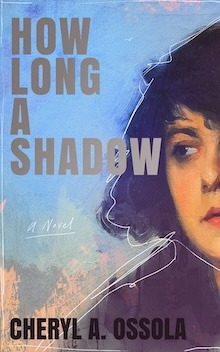
Our Research Notes series invites authors to describe their process for a recent book, with “research” defined as broadly as they would like. This week, Cheryl A. Ossola writes about How Long A Shadow from Cynren Press.
+
How to Turn a Photo into a Novel in 20 Easy Steps
1. Receive a message from your cousin saying that a book about your father’s hometown of Barre, Vermont, includes a photo of a family with your surname. They must be your relatives, he says. Pooh-pooh the idea, then buy the book. Study the faces in that photo. Despite squinting, see no resemblance to your known relatives. Still, who knows?
2. Book a flight from Berkeley to Barre to spend hours peering at cryptic notations in a dusty vital records archive. Discover a branch of the family that your parents never mentioned, which includes the people in the abovementioned photo, one of whom is Joseph D. Ossola, a prominent Barre businessman.
3. Speculate about why, all those times you visited Barre as a kid, your father didn’t introduce you to the descendants of this branch of the family tree. Why didn’t he show you Ossola Place (a street apparently named for Joseph D., who put up an outdoor theater near there), which surely would have thrilled your kiddy soul?
4. Discover that your family kept more secrets than you realized. Wonder why your grandmother lied to your dad about his father’s birthplace, which she definitely did because your dad told you and your brother that his Ossola ancestors came from Domodossola in Piedmont. Nope. (Years later you will learn the truth when you find documents buried beneath cookware in a trunk in a relative’s garage.) Italians keep mum about family scandals—for example, your grandfather’s suicide—like nobody’s business. Literally and figuratively.
5. Lacking any real answers (because by now anyone with answers is dead), develop a theory. To wit: your father’s ancestors were stonecutters, almost certainly socialists because the men who left the quarrying town of Viggiù—ta-da! your grandfather’s birthplace—circa 1900 brought their socialist ideals with them to Barre (another quarrying town). This Joseph D. fellow was the owner of a stone shed, a hotel, and various businesses (see above: outdoor theater), including sales of shoes and sauce. Diversification was the name of the game, apparently, or else he wasn’t good at any of the above. The point is: Eek! A capitalist!
6. Resulting theory: A political rift divided this other branch of the family from yours—a theory that aligns with the tinderbox nature of Barre in the early years of the labor movement, when socialists sparred with anarchists and both of them loathed capitalists.
7. Realize that a family rift could make a good nexus for a novel.
8. Become a time traveler. Study old maps of Barre. Stand on Main Street imagining it when the granite industry boomed and the city shook with construction noise. Cross the train tracks into Burnham Meadow to envision it filled with stone sheds and the acrid smell of granite dust. Visit the Labor Hall to pay homage to the men (some of them your ancestors, probably) who built it. Stay in a turreted B&B that will become a location in the shitty novel you will write.
9. Read obsessively about the tragic effects of mal d’america, a vicious lung disease that killed stonecutters in their prime. (It was unknown in Viggiù, where the men worked in the open air and the softer stone was less likely to slice through lungs.) Decide to inflict mal d’america on an important character in your novel because tragedy = drama.
10. Discover that Joseph D.’s sister was a midwife. Steal this idea. Read up on the history of midwifery. Learn that some midwives did much more than birth babies.
11. Write the abovementioned novel, centering it on the 15-year-old daughter of a stonecutter/union leader who’s caught up in a politically motivated family rift. Name the girl’s father Carlo after your dad, who was neither stonecutter nor union man but believed in justice and human rights. Make the girl passive and uninteresting. She doesn’t know who she is because you don’t know who she is because this is your first stab at fiction and you have no idea what you’re doing. Congratulations! You’ve written your first shitty draft.
12. Book a flight to Italy. At the municipal offices in Viggiù you’ll learn about your great-great-grandfather’s two marriages and your great-grandfather’s six siblings and eight half-siblings (including Joseph D., born Giuseppe) and your grandfather’s four siblings. Decide that Joseph’s middle initial likely stands for Daniele, your great-great-grandfather’s name. Realize that’s probably why your brother’s middle name is Daniel. Begin to see the long thread of ancestral blood, only the tip of which lies in the U.S. Follow it.
13. Revise shitty novel comprehensively and ineffectively due to conflicting feedback and your own lack of vision. Shelve it periodically, vowing each time that you are effing done with it. Break those vows again and again.
14. Use the shitty novel, which apparently has some value, to gain entrance to an MFA in writing program. Write a different novel. Get it published.
15. Move to Italy. Discover that between your father’s and mother’s northern and southern roots, respectively, you have fourteen ancestral towns in Lombardy, Lazio, and Campania. Keep digging.
16. Admit that you’re not effing done. Your dad died without knowing his family’s history, but you know a lot and can imagine the rest so you’re damned well going to write a story for him.
17. Befriend Viggiù’s unofficial town historian and learn how your ancestors there lived and why they left. Visit all your ancestral towns. Despite having lived in Italy for eight years, begin to feel very, very American.
18. Write a better draft, then another, and another, and another. Because the characters have evolved, change the names of the young woman and the man who loves her. Make that passive young girl, now named Rosina in honor of your mother, a feisty young woman who knows what she wants and absolutely will not compromise. Inhabit her. Let her tell you who she is. Use what you know of Italy, historically and personally, to deepen the story. Take the advice of a beta reader who suggests that a story involving a labor union strike should have more violence in it. Take other advice. Keep some of it.
19. Realize the book you’d begun as an earnest family story is now emboldened with feminism and workers’ rights and social justice outrage. Retitle it for the third time, using the words of Eugene V. Debs, one of the founders of the International Workers of the World.
20. Find a publisher who believes in your work. Begin to believe in it yourself.
+++
Cheryl A. Ossola is a second-generation Italian American and a descendant of the stonecutters who shaped Barre, Vermont’s, granite industry, on which her forthcoming novel How Long a Shadow (Cynren Press, 2026) is based. A new edition of her debut novel, The Wild Impossibility (2019), came out from Cynren Press in 2026. Her third novel, Sisters of Lucrezia, about art and obsession and set in Italy, is forthcoming in 2028. Her work has appeared in Fourteen Hills, Writer’s Digest, Switchback, VIA: Voices in Italian Americana, and Eastern Iowa Review: Best Prose Poetry 2025. A former editor and freelance writer with an MFA from the University of San Francisco, she writes Italicus: a writer’s life in Italy (italicus.substack.com) from a hilltop town in Umbria.