Our Research Notes series invites authors to describe their process for a recent book, with “research” defined as broadly as they would like. This week, Case Q. Kerns writes about Habitat from Black Lawrence Press.
+
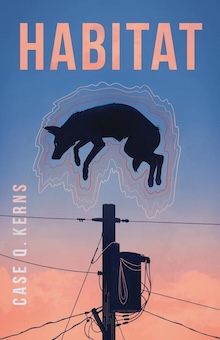
My novel Habitat started as a short story. I found myself curious about the world of that story and wanted to explore it more, so my focus shifted to writing more stories in that world. After writing maybe three or four, they began to gel together as a book, all moving towards and contributing to the same ending. The first eight sections are set in a near future and the ninth section is set approximately one hundred years after the first eight.
The reading, watching, and listening I consumed while writing Habitat differed from narrative to narrative. Here are a few examples…
+
Our Day Will Come:
The protagonist of this story (Jolene) has just been released from prison in the Southwestern United States after a ten-year sentence. While in prison, she had “donated” one of her feet to be transplanted to a wealthy donor in exchange for a voucher covering the cost of her daughter’s entire education, in turn making her daughter (Felicia) more appealing as an adoptee. Most of the story centers around Jolene’s search to find Felicia who has been adopted by a wealthy family in Providence, R.I.
There were two works (a book and a film) I revisited, both on my mind as I wrote this. First, The Life and Times of Michael K by J.M. Coetzee for the excruciating journey Michael embarks on to return his ailing mother to her birthplace during a fictitious South African civil war. I reread sections of the novel as I was writing Jolene’s journey to find her daughter, navigating her release and reentering the world after ten years with very little money as she sets out on an arduous journey, not knowing where her daughter is living.
The film was Douglas Sirk’s adaptation of Fannie Hurst’s 1933 novel Imitation of Life. I revisited this film for its depiction of the shame a daughter (Sarah Jane) has of her mother (Annie), which is devastating to Annie. In “Our Day Will Come,” Felicia is ashamed of Jolene when they reconnect having spent most of her life with her adoptive family and suddenly confronted with seeing her mother again, overwhelmed with resentment stemming from feelings of abandonment and the emotional impact of facing the sacrifices Jolene has made.
+
The Lodging of Tigers:
When I began to envision these pieces as a book, I decided to focus more on the accelerated extinction of species rather than climate change to illustrate the environmental crisis afflicting the world of Habitat —as a result, animals play a large role throughout my book. This story centers on a group of American tiger conservationists searching for what they believe to be the last Indochinese tiger born and living in the wild, based on some alleged sitings in Thailand near the border of Myanmar.
My research for this was primarily focused on which species of tiger would be the best fit for the story and not the location. For the purposes of the story, I wanted to find a tiger species whose extinction wouldn’t mark the immediate end of all tigers, but one populous enough that it’s extinction would suggest the extinction of all tigers born in the wild was on the near, not distant, horizon. I’d first considered the Bengal tiger, which is endangered and the most populous species of tiger. But back then (in autumn of 2017) there were successful conservation efforts in India and, though still endangered, the population was slowly growing. The next most populous species was the Indochinese tiger, which was more critically endangered with roughly a twelfth the population of the Bengal tiger. So, I chose the Indochinese tiger for “The Lodging of Tigers.” The largest population of Indochinese tigers reside in the Western Forest Complex along border of Thailand and Myanmar, leading me to choose western Thailand as the location to search for the Indochinese tiger in the wild.
One lesson I took away from the process of writing this story was that, there isn’t one immovable process for researching and building off of a new idea. Often, I do start with the setting after establishing the premise, but in this case, the setting didn’t dictate the physical ecology of the story—its inhabitants led the way.
+
My Epigraph and the influence of music on Habitat:
Earlier on in writing Habitat, when the pieces I’d written were starting to come together and the themes that work as connective tissue throughout the book had been established (an education system based on corporate sponsorship, a subculture of wealthy young Americans who fetishize anatomical transplants from living donors, and a large corporation named Phyla that clones animals), I was listening to Neil Young’s song “Like an Inca” and the first two lines stuck with me and ultimately serve as the epigraph to Habitat. The song opens with a condor and a praying mantis discussing the fall of a human civilization. I thought about these lines constantly as I finished the book and what they say about the roles animals play in human history, as both its victims and witnesses.
Music is ever-present throughout my writing process. I create playlists for whatever I’m writing to have ready for those moments when I need background noise to concentrate. For Habitat, I created a playlist for each of the individual parts—some only had a handful of songs, but others reached dozens.
For “The Book Preacher,” the titular character is said to appropriate blues lyrics and biblical passages into his own speech, so I created a playlist of over forty songs to help ingrain his pattern of speech and phrasing into my writing of his story.
Sometimes I include music explicitly mentioned in the text. For instance, the character Sophia in “The Salt Box” listens to a Ben Webster ballad as she drives home, so I included his rendition of “Over the Rainbow” on that playlist.
But music doesn’t just serve as a writing aid, it often helps me reach a deeper understanding of a character or a setting or a period of time. For instance, the new novel I’m working on has a character who is a young but accomplished cellist and is spending her summer days practicing the pieces she plans to play for music school auditions. So, I researched the application requirements for several music schools (i.e. Berklee, Julliard, etc.), specifically the requirements concerning the pieces to be performed at auditions for cellists, and I created a large playlist of over one hundred classical cello pieces to play while developing and writing her character.
Here’s a list of some more of the songs I included in my playlists for Habitat:
The Man Who Knew the Collage: “Solitude,” by Eartha Kitt
Potluck Barbecue: “Vortex,” by John Carpenter
Our Day Will come: “Cry to Me,” by Betty Harris
The Lodging of Tigers: “Danger Bird,” Neil Young
The Book Preacher: “Here in the Dark,” by T-Bone Walker
Protected Land: “Have a Cigar,” by Pink Floyd
Armstrong: “Winter Wonderland,” by Sonny Rollins
The Salt Box: “In My Room,” by The Beach Boys
Spare Parts: “Caribou,” by The Pixies & “Werewolf,” by Cat Power
I’ve found over the years that I research my inspiration and ideas with my eyes, ears, and taste buds (one of my favorite pastimes is cooking and eating, and food is often featured in my writing). I’ve also learned that each new idea/story/novel has its own unique fingerprint, requiring its own set of rules, inspirations, and pathways.
+++
Case Q. Kerns is the author of Habitat (Black Lawrence Press, 2025), a novel of interconnected narratives beginning in a near future New England and ending a century later. Originally from Buffalo, NY, he received a BS in Cinema & Photography from Ithaca College and an MFA from Emerson College where he served as fiction editor for the literary journal Redivider. His work has appeared in The Literary Review, The Harvard Review, and West Branch. He lives in Massachusetts with his family.