Our Research Notes series invites authors to describe their process for a recent book, with “research” defined as broadly as they would like. This week, Anna Bruno writes about Fine Young People from Algonquin Books.
+
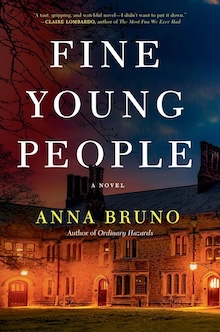
Sitting in the back of my dad’s minivan, smelling the stench of my older brother’s hockey gear after a tournament in Buffalo or Neville Island, or some other place that boasted a hockey rink and nothing more, I didn’t know I was doing research for a novel that I would write three decades into the future.
Anyone who has ever been around hockey players knows that smell, the mix of sweat and mildew that concentrates inside the gloves. When I began writing Fine Young People, a scene popped into my head where a brother rubs his putrid hands in his sister’s face until she freaks out. That scene was ultimately cut from the novel—not every childhood interaction is relevant to a murder mystery that takes place in high school—but I still think about it. I honestly can’t say if I wrote it based on an actual experience or a nightmare. It feels like something my brother might have done when we were kids.
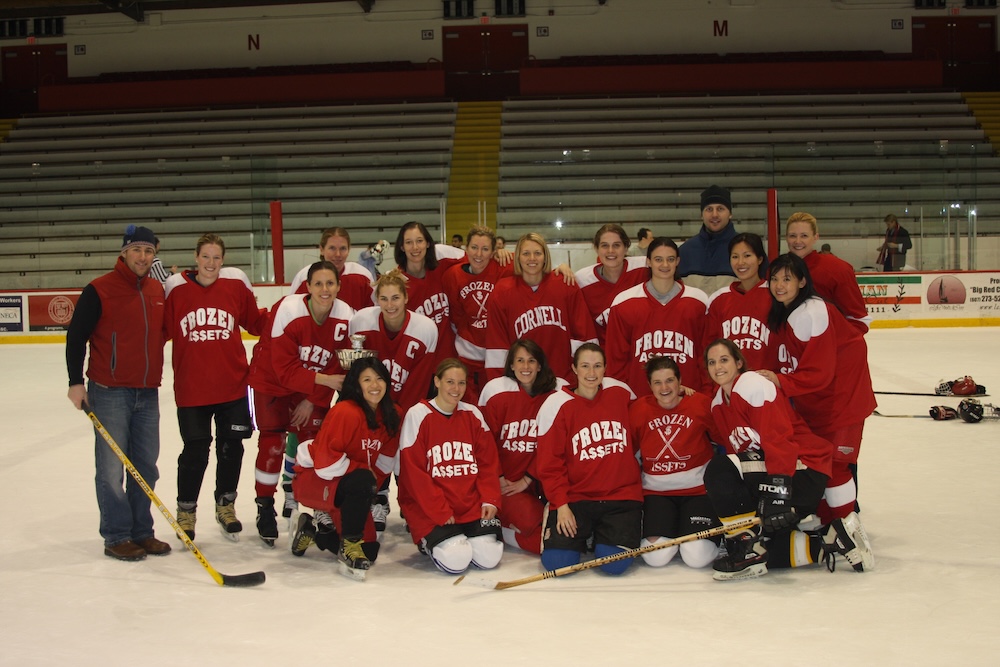
Growing up in Pittsburgh, hockey was everywhere. The Penguins won back-to-back Stanley Cups when I was nine and ten years old. In his bedroom, my brother kept an old Wheaties box, adorned with his heroes hoisting the Cup over their heads, unopened for years. By the late nineties, my high school had a girls’ hockey team, which I played on. Badly. And I would play again on the Frozen Assets a decade later, when I was at Cornell, pursuing an MBA.
This year, for the first time, I took my two sons, aged six and four, to a hockey game. We live in Iowa City—not a hockey town by any means—but a minor league team called the Heartlanders plays nearby. It was the first time my boys had seen checking (and fighting) up close. They were surprised by the violence of the sport. I was impressed by the intensity of the young men on the ice. About half of them hail from Canada. The mother in me wants them to do something else—a desk job, maybe. But the realist knows they are happy for the opportunity to hang out in the middle of nowhere for six months of the year, and sacrifice their bodies, to play the sport they worship in front of a scant crowd. They dream of the pros.
My novel touches on some of the negative realities of contact sports—injections to manage pain, concussions, the possibility of CTE. I remember worrying about my brother when I was a kid. I remember when one of the best players on his team started sitting out games because he had one concussion too many. But I researched the scariest aspects of the sport by reading about professional players I’ve never met, rather than from personal experience.
I read articles about Kevin Stevens, who played alongside Mario Lemieux and was a central figure on the champion Penguins team that loomed so large in my youth. His life unraveled as a result of an addiction to prescription drugs that started with hockey injuries. I read about multiple players who died by suicide and were posthumously diagnosed with CTE. As I researched these stories, I thought about that kid on my brother’s team. I don’t remember his name. I don’t know if he gave up the game willingly, or at his parents’ behest, or if he returned to the ice the minute he was cleared by a doctor. My guess is that he kept playing as long as the sport would have him. That seems to be the way these things go.
After reading Fine Young People, an early reviewer wrote, “One thing’s for sure: I’m not gonna let my kid play hockey.” I realized that I wrote a book about how people worship a sport at their own peril, and yet I would let my kids play hockey. My instinct is to protect them, but if there’s one thing being a writer has taught me it is that you can’t protect people from the things they love.
The beauty of fiction is that there are no answers, only complications. A good writer doesn’t judge; she merely observes. And hockey is fun to watch.
+++
Anna Bruno is the author of Fine Young People and Ordinary Hazards. She holds an MFA in fiction from the Iowa Writers’ Workshop, an MBA from Cornell University, and a BA from Stanford University. She grew up in Pittsburgh and now lives in Iowa City with her husband, two sons, and blue heeler.