Our Research Notes series invites authors to describe their process for a recent book, with “research” defined as broadly as they would like. This week, Lisa Slage Robinson writes about Esquire Ball, Stories From The Great Black Swamp from Black Lawrence Press.
+
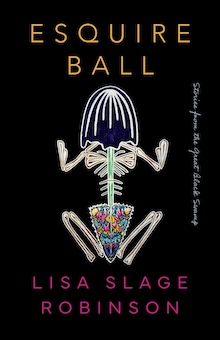
I landed in Toledo, Ohio in August of 1987. I had just taken the bar exam and was getting ready to start a job as an associate with a large firm where I would be a lawyer-in-waiting. Not fully admitted into the practice, the “brotherhood” of lawyers, as my name had not yet acquired its “Esq.” tail. Balancing on a tight rope — fearing what would happen if I didn’t pass — I uneasily navigated those early days while I waited for the results which would take months.
On my first day, arriving in my shoulder-padded gray suit with a red pin-on tie, the associate assigned to take me around, to make me feel comfortable, and to show me the ropes greeted me with a big grin and said, “Welcome to the Great Black Swamp!” I thought it was a lawyer joke and I waited for the punchline. None was forthcoming.
I later learned that the city and the surrounding treeless farmland had once been a dark, dense, boggy, swamp forest thick with mosquitos, malaria and frogs. I was totally consumed with learning how to become a lawyer and managing my professional apprehensions that I didn’t give it much thought until many years later when I started writing rather mundane workplace stories about lawyers while I was an MFA student at Chatham University.
I set the stories in Toledo because that was where I started my legal career. With Toledo as the backdrop, I could summon the emotions and anxieties of a young associate.
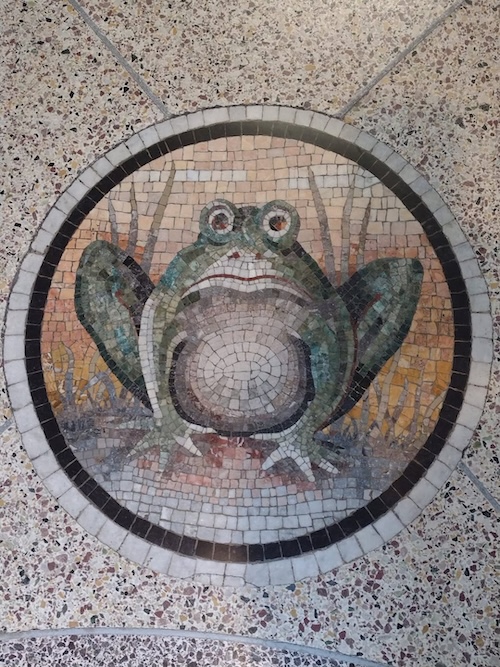
Everything broke open in a wild and wonderful way when I took what I thought would be a brief detour to research a minor detail: how to get a character from her office building to the Lucas County Courthouse. I wondered what route would she walk and how long would it take? To my delight, I discovered that there is a charming tile mosaic of a frog in the courthouse rotunda (how did I not see this when I worked there?) There are frogs carved into the exterior of the building as well, in the intricately carved “spandrels,” the triangular panels in between the triumphal arches of the Adams Street entrance, and frogs hidden in the rusticated sandstone at the base of the building. In the Beaux-arts style popular during the Gilded Age, the architect David L. Stine incorporated these whimsical details to pay homage to the marshy landscape inundated with frogs and to the city’s nickname at the time, “Frog Town.”
+
My brief detour turned into a deep dive. I became fascinated with this place. As I learned about the Great Black Swamp, the local folklore, mythologies, ghost stories, hardships suffered by the early settlers and the Native Americans pushed into the swamp and then driven out of the region forever by the brutal Mad Anthony Wayne, the financial riches gained from draining the swamp and cutting down the forest, my realistic stories started to veer into fabulism as I began to wonder how this spooky landscape affected the DNA of its inhabitants. Was there a genetic memory that informed future generations’ actions? I began to explore magical feminism, as I conjured new mythologies and folktales to explain sexism and greed and unfettered ambition. As I continued to craft the narratives that would become the linked collection Esquire Ball, the Great Black Swamp became not only the place from which all the stories sprang but also the overarching metaphor for the practice of law.
Following David Stine’s example, I sprinkled frogs throughout.
In the title story “Esquire Ball” Trevor, a young associate, seeks a wife to help him succeed. The Partners see his promise and conspire to help him acquire a helpmeet in the swamp, a tadpole he can raise up into a frog wife
While research can at times become procrastination, for me it lead to many fun froggy details and story threads.
When we first meet Trevor, he finds little joy in receiving the news that he has passed the bar exam because his first betrothed Jenny has left him at the altar. Jenny is a scientist, a Dr. Frankenstein in training, who is fascinated with Luigi Galvani’s theory of animal electricity and his experiments on frog legs. She conducts her own experiments in her dorm room using frogs stolen from the university bio lab. Galvani’s nephew, Giovanni Aldini would later take these experiments to the next level using human cadavers and is credited with having inspired Mary Shelley’s Frankenstein and Jenny’s future ambitions.
Trevor reluctantly attends the Esquire Ball, a fancy dress garden party, held annually by the firm to celebrate the passing of the bar. The managing partner’s wife, who may be a frog wife herself, finds him despondent and drunk under a weeping willow tree. She agrees to take him down the river to the Banjo Man and a gathering of partners.
I read somewhere that a male frog’s mating call sounds like plunks similar to the plucking of a loose banjo string. One summer evening, as I was jogging along a trail that followed a stream, I heard their twangy call, which indeed sounded like banjo. This discovery led me to invent the “Banjo Man” who calls forth the potential brides to be with a wailing rendition of “When Sorrow Encompasses Me.”
“Esquire Ball” was inspired by Italo Calvino’s “The Prince who Married a Frog” [found in his anthology, Italian Folktales] in which a frog bride helps her prince inherit the kingdom by performing a series of tasks and Steven Milhauser’s New Yorker story, “The Visit,” in which a writer travels to upstate New York to visit his old classmate and his new wife, a frog.
Research also inspired the many weird details in “Legend” in which a young woman, Cassie, a PhD candidate, reveals the secrets of the universe via an improbable sexual encounter, by having sex with her boyfriend, Rusty, while her hair tangles with the roots of a tree for destruction.
The idea of “Legend” started percolating when a writer friend casually mentioned that her grandmother spoke to trees. Around the same time, forestry scientists like Suzanne Simard and Peter Wohlleben began publishing books about how trees communicate with one another. Their decades-long research revealed that trees have a symbiotic relationship with underground fungi whose fine silk-like filaments called mycorrhizae connect and become entwined with trees’ roots causing messages [watch out for the parasite! or drought is coming!] to be transported from one tree to another. I began to wonder if trees chose to speak to humans, what mechanism would they use and what would they say, what warnings would they convey? Because fungus is the largest living organism with some stretching 2,400 acres and because some have been determined to be more than 1,500 years old, I began to imagine the wisdom passing through this underground network to be ancient and profound. Meanwhile, I was also ruminating about the short story “The Aleph” in which a fictional Borges’s love for a woman leads him to a cellar, where if he positions himself just right, he can see every point in the universe all at once. What he sees is personal, tender and overwhelming.
In “Legend,” Cassie’s PhD dissertation chronicling the history of the world from the beginning of time into the future, all that she has learned from talking to trees, has been rejected by the university as the ravings of “a crazy white chick.” She selects a young undergraduate student to be her avatar so that her knowledge and the warnings of the future will be heard. He will later write a compendium of all that he learns during that fateful encounter, become famous and fail to give her credit.
In “Swimming Lessons” a teenager drowns in a sea of corn. This story was inspired by an NPR expose on the occupational safety hazards of grain silos and the deaths and crippling injuries caused by the practice of sending young workers into the bins to “walk down the grain” when it clumps and gets stuck in the auger, preventing the free flow of grain into trucks that will transport it to market. Notably the legal penalties for failing to provide training and safety harness due to lack luster OSHEA regulations are minimal.
I could go on. Every story in the collection is rooted in some research driven tidbit mostly grounded in the place, the region known as the Great Black Swamp.
+++
Lisa Slage Robinson writes to explore invisible landscapes and magical feminism. She is the author of Esquire Ball, Stories from the Great Black Swamp (Black Lawrence Press, February 2026). Named a finalist for Midwest Review’s Great Midwest Fiction Contest, her work appears in or is forthcoming from Iron Horse Literary Review, Atticus Review, Smokelong Quarterly, The Adroit Journal, PRISM International, Storm Cellar, Lit Pub, Necessary Fiction, Meat for Tea, and elsewhere. Lisa serves as a board member for Autumn House Press. A graduate of Bowling Green State University and Case Western Reserve University School of Law, she holds an MFA from Chatham University. A former corporate attorney and litigator, Lisa practiced law in both the States and Canada. She lives in Pittsburgh with her husband and keeps the lights on for their daughters who live in LA and NYC but who still like to come home.