Our Research Notes series invites authors to describe their process for a recent book, with “research” defined as broadly as they would like. This week, Christopher Linforth writes about Directory from Indirect Books.
+
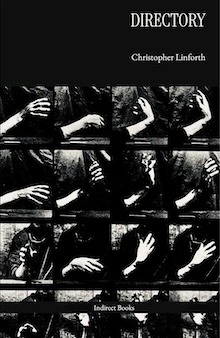
A fluctuating, unstable choral voice narrates Directory, an experimental, interlinked collection of flash fiction. The “we” governs the pages until the final story, whose revelation I won’t spoil. Yet the siblings who inhabit the pages—sometimes twin boys or triplet girls and everything in between—are so far removed from my only-child upbringing that I had to supplement my imagination with an eclectic range of research.
First, I must confess that the book was written under strange circumstances. At an artist residency in Vermont, an unseasonable heatwave hit and drove us all from our air-conditionless writing studios. One morning, I braved the oppressive stuffiness armed with a powerful fan and a cup of ice water, and sat down to write, though I was supposed to be working on another book. Progress on that novel soon stalled, and I decided to write something else, something short, so that I could leave the studio and swim in the cold river. I wrote one flash about twins killing their father in the style of a pagan folktale. Empowered by the urgency of the first-person plural, I wrote another, then another. Over the remaining two weeks, I wrote almost forty pieces. Few of them came so easily.
Most mornings, I struggled to get started. I often needed a concept or image to begin the process. I would flip through books left behind in the studio or read the dictionary for interesting words. Usually, though, they yielded very little. On the other hand, in the dining room, I would talk to other writers or overhear artists’ conversations and latch onto an idea. Discussions about the Theosophist Madame Blavatsky or Julia Kristeva’s early use of Set Theory or the oeuvre of sexologist John Money or the origin of Chekhov’s quote about moonlight on broken glass would send me running off to the studio, where I would disappear into black holes of esoteric knowledge, not knowing where I would end up. Some of these sparks became stories; others survived only as obscure references, vestiges of ghostly wholes.
The forty-odd stories of Directory emerged in a variety of styles and forms. Connected by point of view (though with revolving sets of characters), the stories take the form of prose poems, lists, tall tales, fabulist flashes, and moments of realist despair. In a new blurb for the reissued book, Ben Loory describes the stories as “American nightmares,” and this feels right to me. The first draft arose from my unconscious and an intoxicating compulsion to write and write, and the result was both an exploration and critique of identity, trauma, and sexuality in contemporary America.
The brevity of each story allowed me to experiment, to see what worked and what did not. The stories sit somewhat outside the flash fiction we usually encounter in literary magazines. Though of comparative length, most of the stories are what I term “densities,” blocks of mono-prose or lists of compact, rich, allusive sentences. The stories take on Viktor Shklovsky’s notion of “defamiliarization.” That is, I attempted to make the familiar unfamiliar. Whether through character, point of view, story material, thematic resonance, or page-text structure, I wanted to estrange the familiar and offer a different reading experience. By some combination of instinct and design, I created an abstruse text that invoked disconnection and alienation, but also an invitation to persevere through the mercifully brief (eighty pages!) and surprisingly dark-humored collection.
When it came to wholesale revision, I found the book required substantial reordering of the stories and a few instances of connective tissue. I turned to some of my literary ancestors—Joy Williams, Amy Hempel, Carole Maso, Justin Torres, and Aimee Bender—as I worked to fulfill the vision of the book. The greatest challenge was configuring and reconfiguring the first-person plural in ways that deliberately suggest different readings of the ambiguous choral narrator(s), while also allowing the reader to follow along. It was both joyous and arduous to contend with the ambiguous nature of the “we,” and it was during this process that I drew upon the unifying idea of a directory.
The first edition of Directory appeared during the outbreak of COVID-19 in 2020. Thankfully, with only a PDF version to hand, the book garnered a handful of reviews, including a generous one in Necessary Fiction. Yet soon after, the publisher shuttered, the distributor SPD went bankrupt, and the book was orphaned.
Years passed.
The current reissue from Indirect Books allowed me once more to dive back into the madness of the text. It had been a long time since I had read the book, and I was struck by the peculiarity of the stories and by a moment in my writing life that I have not experienced since. Directory felt as if it had come from a dreamspace, a since-untapped part of my psyche. Completing a few minor edits seemed like an intrusion into that version of myself and the book, though they were necessary for sentence-level clarity and large-scale coherence. And so this new edition proposes a form of writing, of short fiction, of story collection, that I hope beguiles and entertains as much as it intrigues and provokes, and I offer it up to you.
+++
Christopher Linforth is a professor at Shanghai Jiao Tong University’s Global College and the author of four story collections, including the forthcoming Very Short Lives (JackLeg Press, 2027), the reissued Directory (Indirect Books, 2026), and the award-winning The Distortions (Orison Books, 2022).