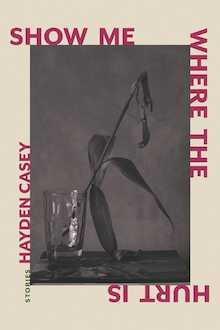
Hayden Casey’s first book, Show Me Where the Hurt Is (Split/Lip Press), opens with a quotation from Anne Carson’s The Beauty of the Husband: “A wound gives off its own light/ surgeons say/ If all the lamps in this house were turned out/ you could dress this wound/ by what shines from it.”
In the thirteen stories in this collection, Casey’s characters are luminously wounded by loss, longing, and alienation. In one story, a woman takes a job as a companion for those struggling in the aftermath of breakups. Another character secretly makes a habit of a newly released weight-loss drug, even as its dire side effects become apparent. In the final story, which explicitly references the Anne Carson quote in the epigraph, the narrator is physically transformed by their experience of unrequited love for a housemate, first losing, then being almost consumed by, their shadow.
Hayden Casey and I spoke at a pasty restaurant in Tempe, AZ, where moody country music provided a backdrop for our conversation. This interview has been lightly edited for clarity and concision.
+
Maya Chari: What was the first story you wrote for this collection, and do you feel like the stories emerged together, or do you feel like you put them together after the fact?
Hayden Casey: The first story, “Hot Yoga,” was from my first semester in my MFA. It was one of four that I wrote for that first workshop, and it was the only one that wasn’t a stinker. The other ones were very much me warming up and learning how stories worked. But that one, something about it just worked.
I never had any intentions of writing a story collection. I really just wanted to learn how stories worked, because I was very much in novel mode all the time before that. It was genuinely only when I saw a submission call for story collections that I was like, “I don’t have one of those — hold on, wait! I kinda do!”
I went back and looked at all the stories I had accumulated since starting my MFA, and they had a similar vibe to them. A lot of them feel almost like practice for longer works, like I was testing something out to see where it would go before I implemented it in a longer work. I made a list of all the stories that I had that I liked and then I shuffled it into an order and I submitted it to a few places and here we are!
MC: Did you take any of them out because you felt like they didn’t fit?
HC: There were a few that didn’t feel like they fit conceptually, and there were also a few that I just didn’t feel were good enough. After I made that initial list, I went through it again and made sure that they all seemed linked in a thematic way. There were a couple that I crossed out. I ended up with thirteen, which is my favorite number. Nothing to do with Taylor Swift. Just my favorite number.
MC: The title of the collection is Show Me Where the Hurt is, but it’s full of characters trying to conceal their pain. For example, there’s an office worker who keeps working at their job despite being gravely injured and a woman who’s hiding her use of a weight loss drug from her partner. So do you see the title of the collection as being ironic, or as being a command to the characters, or something else?
HC: I see it more as a command. It seems to me like the stories are trying to get the characters to show where the hurt is, either to themselves or to other characters or to the reader, depending on the circumstance. There’s a lot of masking going on, so the unifying factor was this unraveling of that mask in some sort of way.
MC: Some of the stories involve fantastical elements, and often that takes the form of some kind of bodily transformation: in “Pretty Things” a couple, and then a third person, begin to sprout each others’ body parts; in “Smoothing” a man loses his mouth and then other body parts after a fight with his fiance. Why do you think you’re drawn to this motif of bodily transformation and what does it do for you?
HC: I think it was just being in an environment with people who were working with surrealism, using it to explore things that a more realistic story couldn’t. I was inspired by seeing that around me. It felt very fresh and it was something I had never done.
I started with the purpose the surrealistic element served in the story. With “Pretty Things,” for example, I was really interested in codependency, and so I was thinking what are ways that that could manifest physically? With “Smoothing,” I was thinking about the ends of relationships, and relationships that should have ended when they haven’t, and the wordlessness that comes with the ends of relationships.
It’s a different entry point, and it leads me in different directions than if I’m approaching it from a strictly story-based or character-based perspective. I was concerned for a while that it took them too far outside the realm of the other stories, but I ultimately decided that the thematic cohesion bound them together with the rest of the stories in spite of the surrealism.
MC: How do you choose your epigraphs and what is the relationship between the epigraph and the work?
HC: It’s fully vibes. Sometimes I’ll actually lead with an epigraph. If I have an idea for a novel, I’ll hunt around for a little bit in some texts that I value and see if there’s anything in there that sticks out to me.
MC: Before you start writing?
HC: Yeah, sometimes they can act as directives for what’s going to follow, whether it’s the playfulness of a certain work that I’m evoking or the lyricality of a certain quote or a thematic angle. Sometimes they come late.
In the case of the epigraph for the story collection, I chose that quote in particular not only because The Beauty of the Husband is one of my favorite books, but because I invoke that particular quote in the very last story, and I’m playing around with that epigraph in the work itself. So I thought it would be a cool bookend if the epigraph comes at the beginning and sets the scene for some of the stranger stuff that’s coming along the way, and then the last story actually brings it into the text itself. Just a fun thing!
MC: Speaking of the last story — the two main characters don’t have names, but there’s another major character that does. What do you think naming a character does? How does it change your relationship with that character, if at all, and how do you think it’ll change the reader’s relationship with that character?
HC: For me naming, as with a lot of details, is a specifier. There are certain names that have strong connotations for me that I won’t use. And generally, if I choose to leave a character unnamed, there’s a certain — I don’t know if relatability is the right word, but in some instances I like to leave gaps for the reader to fill in with whatever they want, and that feels like one instance of that. In the last story in particular, there are not names for those particular characters because I wanted the story very much to be about a more general love and not necessarily about this love. I wanted it to feel like a broader love story I suppose.
There’s a couple of other stories that have nameless narrators. In the first story we get the narrator’s work name but we don’t ever find out her real name, and that’s meant to represent the cold, proprietary role she plays within the corporation. She’s just a pawn.
MC: In that first story, the narrator is hired to fill the gaps between relationships. A few of the other stories concern roommate relationships. A roommate relationship could also be considered an in-between or placeholder relationship. It has some characteristics of intimacy but lacks others. I was wondering if you saw those as linked, and what draws you to writing about these kinds of “quasi-relationships?”
HC: I just really like those unique relationship scenarios. I think they’re so ripe with potential. I’m fascinated by the grayness. With roommates, there’s so many different versions of what a roommate relationship can look like — so many different emotional complications as a result of that. And also the crampedness, the tightness. They’re in the same space so much of the time, but then they have separate spaces, and there’s a tension there. I just find it fascinating as a dynamic. I’ve never gone into a story thinking it’s going to be a roommate story, it just emerges out of the setup for whatever reason.
It’s fun for me as a writer because it’s less predictable than other relationships. I often don’t know where it’s going. I find it fun to sit in those intimate-not-intimate spaces and see where it goes. It’s entertainment for me as much as — hopefully — for someone who’s reading it.
MC: One story explicitly takes place in 2023, and another references news items that allow it to be placed in a specific time period. Do you always know when your stories take place and how do you think about the relationship between your work and the contemporary moment?
HC: The lame answer is that I have a very bad memory about what the past was like, so my stories tend to be set in the present day because that’s where I am and that’s what I see around me. Also, I’m often writing into or around things that are happening in the present day, whether it’s political events or social movements or trends. A lot of the time I don’t specify the time period, not because I want stories to be timeless but because it’s less important what’s happening outside in the world and more important what’s happening in this contained space.
MC: To return to roommates, it strikes me as very modern the idea that we could live with people we don’t know. It’s weird even to not know your neighbors I think, even though I don’t. The idea that we could live with people and not really know who they are seems strange and historically specific.
HC: Absolutely. It feels very much like a product of the now.
MC: Last question — are there specific books that you feel like are particularly influential on this collection. Hard mode: you can’t say Anne Carson.
HC: Aside from the last story, Anne Carson feels less in the conversation for this particular collection. My brain operates differently in story mode than novel mode, and I think in story mode my influences are story writers. When I was cobbling this collection together but also still learning how stories worked, a collection that has really stuck with me is Black Light by Kimberly King Parsons. That was a North Star for me in thinking about the breadth that a story collection can have and the flavors that can come in along the way and the permission I can give myself to diversify the contents of the work. Also Wait Til You See Me Dance by Deb Olin Unforth was a big influence on especially the shorter pieces in here. The range of story lengths is very wide. There’s a bunch of flash and there are much longer works as well, so I turned to that as a way to figure out how the longer and shorter pieces can fit together and how the arc of the book would work. And Get in Trouble by Kelly Link. Again, with all the flavors that still feel like they belong together. There’s more that I’m going to think of on the drive home and smack myself. But for now, yeah, those three.
+++
Hayden Casey is a writer and musician currently living in Phoenix, AZ. He earned a Bachelor’s degree in Psychology from the University of Washington and an MFA in Fiction from Arizona State University. His short story collection, Show Me Where the Hurt Is, was published by Split/Lip Press in April 2025. His debut novel, A Harvest of Furies, is forthcoming from Lanternfish Press in fall 2025. His work has appeared in Witness, West Branch, and Bat City Review, among others, and was shortlisted for the Dzanc Books Prize for Fiction and longlisted for the Palette Chapbook Prize for poetry. He teaches writing at Arizona State University, where he was the 2024 recipient of the College of Arts and Sciences Outstanding Instructor Award.
+
Maya Chari is a journalist and writer. She reports on technology, the environment, and the cost of living for American Public Media’s Research Lab. Her creative work has been supported by the Virginia G. Piper Center for Creative Writing and by the Glendon and Kathryn Swarthout Awards. She is currently working on a novel about trains and real and imagined histories.