
The story usually goes: an immigrant comes to the United States for a better life—for a job, for an education, for any number of reasons—and it’s all just waiting there for them, perfectly neat and for the taking. There may be some hardship, but it’s temporary. There may be some disillusionment, but it’s temporary, also. Of course, this is all a trope, and far from everyone’s story. And certainly, it is not the story of Hans, the main character in Pardeep Toor’s debut collection, Hands, which was published with Cornerstone Press in April.
Early in Toor’s linked stories, we meet Hans as an outsider at his high school in Michigan, then we follow him through the years from service jobs like taxi driving and delivering pizzas, to fractured relationships, romantic and familial. Throughout Toor’s writing there is an aching question of whether Hans, an immigrant from India caught in the middle of the Midwest, came here for more than a life of long shifts and little pay. But what Toor does is skillfully upend the question itself: he doesn’t give his character any material answers. Instead, he shows us that a blue collar life in America is a hard one and reminds us that one’s inner life can remain something else entirely: a rich world of one’s own.
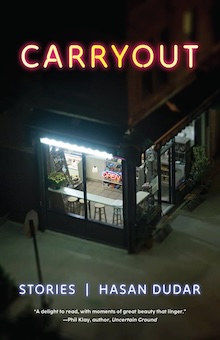
My own debut collection of stories, Carryout, published by the University of Iowa Press in May, also follows the lives of immigrants in the Midwest, in the post-industrial city of Toledo, Ohio, right on the border of Hans’ Michigan. It’s a place where many immigrants came to, fled to, and built something new. In this case, they are Arabs and Muslims from Palestine and Lebanon, who have been displaced and find themselves again and again on the margins.
The shared terrain, in place and theme, gave Toor and I a lot to talk about in a recent conversation that took place online, including the idea of representation in fiction, coming-of-age narratives, and more.
— Hasan Dudar
+
Pardeep: Carryout feels like a novel at times because of its connectedness. Did you ever consider writing it as a novel? And because of its cohesiveness, do you see it as an immigrant coming-of-age story?
Hasan: The structure of the book helped not only to tell the story I was hoping to tell, but also, to avoid things I didn’t even know I was avoiding. Including the “coming of age”. I’m not sure I believe in coming of age, as far as self-discovery. That would assume some form of completion in ourselves. And I don’t think we are ever complete. Only under illusions that we are—which may be interesting in itself. And so in retrospect, the structure helped me write myself out of this trap and to see that we may be more fractured than we are complete, especially immigrants who may have left so much of themselves elsewhere.
For a long time, thanks to Harold Bloom, I’ve been drawn to this concept of the “unlived life”, which I took to mean some form of longing, a feeling that one’s life could have all been different. And I think it is crystallized in the immigrant experience. Life was different, it is now different, and it could certainly in an alternate future have been different. I’m not an immigrant, my parents were, and at times I felt they would be circling between these two selves. Reminiscing about Beirut, then reminiscing about the old Toledo they immigrated to–almost like they wished to live in both places at once.
In terms of how the structure developed, the stories took root in my mind as stories. That’s how I thought of them, individually, as I wrote. There would be some image or thought or line that felt like the beginning of something self-contained, and I’d go from there.
Though I knew early on that I wanted the collection to be linked, I didn’t know the extent of that linkage. Stories about Toledo, maybe stories about different characters in an Arab and Muslim diaspora in Toledo. But over time, with each story, the material began to form itself around this family, the Idilbis and their circle.
When I had gotten far enough into the writing, I began to see the stories come together as one book, as something more uniform, something akin to a novel. But I knew all along that I had not written a novel and I resisted the idea to turn it into one for its own sake. It may seem obvious to say but I think form and structure have a lot to do not only with what an author puts into a book, but with what a reader gets out of it. And I don’t think you can so easily undo a book’s structure without paying a price. Something will be lost, and that something may well be its essence and what you were trying to say all along.
How about you? You chose a linked structure as well. How do you feel the form contributed to your writing? And did you consider a novel?
Pardeep: I love your thoughts on the trap of the “coming of age.” I feel like coming of age is a very American idea. There’s a false dogma to American life. You move out at 18. Go to college or get a job. Marriage, family, house etc. And at some point along the way you’re expected to have an “ah-HA” moment so it all makes sense. My experience is totally different. Progress hasn’t been linear. There’s been numerous setbacks (rejection, job loss etc) that have made me reset my expectations and assumptions about success or self-actualization. Epiphanies are rare in anyone’s life, but especially in the life of immigrants because there’s always the “what if” to consider, specifically: “what if we never left?” There’s no end to self-doubt.
I never considered a novel because of the way the stories were derived. Each of my stories originated from a singular moment, dialogue exchange, or scene. Then, I worked backwards (or forwards) to develop stories around the singular moment. A novel requires a certain sequence and flow and that was never part of my writing process. My stories were written independently and then morphed into a body of work much later on.
Also, I feel there’s immense pressure in novels to be comprehensive, detailed, and complete. But a linked story collection allows more space for ambiguity. I’ve always been fascinated by what’s left unsaid on the page and my hope was to play with that concept in my collection. This is why I prefer not to get into the specifics of the immigration journey. It’s obvious that my characters are South Asian but I prefer not to focus on the specificity of their identity or culture. Instead, I want to focus on the issue of displacement, regardless of where the characters are from. I trust the reader to fill in the gaps and project their own experiences to the stories.
This applies to the linked nature of my collection as well. For example, what were my characters doing between the third and fourth story in the collection? I wanted to show the reader where they ended up in the fourth story but preferred that the reader tap into their psychology to determine the steps that got the characters there. I often find that the reader’s imagination is more haunting or revelatory than what I can actually write on the page.
I don’t want to spoil your collection but you have this mesmerizing part where you use silence and blank pages to convey emotion. How did you decide what to write and what to leave unsaid?
Hasan: I like how you put it in terms of gaps and letting the reader fill it in. The linked nature really allows for that. It’s another way to play with time and, as you said, to leave things unsaid.
The passage of time can say a lot, on its own. I also found it can give the author a chance at another voice or tone, especially in a collection. I think you somewhat do this in your last story, would you agree? Time has passed and there’s a shift.
But more specifically, for me, what to write and what not to write really came from the material itself. While writing, I found that my characters didn’t want to leave much unsaid. Until they did. And maybe that’s its own way of speaking. And I think this was an influence from my own world. Family, people I knew, friends, we didn’t leave much unsaid. We maybe should have said less! But I don’t think I know another way. Meanwhile, a lot of writing I admire is restrained. But when I came to the editing process and faced my own writing, rather than act on the first impulse and try and polish, I thought maybe I need to restrain myself from restraint. At least as far as the characters were concerned.
I want to ask you about dialogue. Because one of the things I admired in Hands is you let your characters really speak. It seems to be at the heart of the book. There’s their inner world, yes, but there is also confrontation, brutal honesty, mockery of each other. What role would you say dialogue played in helping you bring these characters to life?
Pardeep: Yes, I think there was a stylistic shift in my last story. I wanted it to sound unique to indicate that time had passed and the characters were different now, older, and with different priorities and issues.
“Restrain myself from restraint” – I think we need to put this on a t-shirt! I love that. It really illuminates your process.
I wish I could take credit for my dialogue style but this is literally verbatim how my family has always spoken to each other, or spoken over each other. It was always chaos, but a beautiful chaos now that I look back at it. I actually don’t know how to write dialogue any differently, which is a problem sometimes because I don’t know how to lower the intensity. The brutal honesty and mockery (as you put it) is familial and cultural. Mockery is flattery. Ridicule is acceptance. Genuine kindness is rare.
Hasan, you did a great job of showing this in your story Karantina, when the customer is not directly attacking Ziad but instead asking if he drives a foreign car. Hidden in the niceties of the Midwest is this coded language of acceptance and otherness. It’s passive aggressive but equally potent.
In my writing, I prefer expression through dialogue as a means to reveal character more than interiority. This is a conscious stylistic choice. For me this isn’t just what is said but how it’s said, when it’s said, and who it’s said to. The last part about “who” is crucial in the immigrant experience. My dad’s second job was delivering pizza in the evenings. I’d often ride with him during deliveries and I barely recognized him as he spoke to customers and co-workers. We call this code-switching now but as a kid I thought it was just weird.
I did want to use language at work to pivot to labor in our collections. There’s a tendency for our immigrant characters to do whatever is necessary to make a living. There’s a seedy-hustle in our characters. Was it hard to write about some of these jobs? Were you ever concerned with how your immigrant characters would be perceived based on the things they did to make a living?
Hasan: I tried not to worry about how they would be perceived, to be honest. Because my goal was never for the book to be representative on the whole. But that’s not to say that I was at no point aware of the ways we talk about immigrants, as well as Muslims and Arabs, over the last few decades.
My main concern is always whatever feels alive and true on the page and particular to that story. But sometimes it can feel like, to get that, you have to cut through, or around, so many narratives that have been imposed on the immigrant or minority. Do you share this sense? Does it sometimes feel like we are caught between two narratives? On one side, we are outsiders who can’t fully assimilate. On the other, we are the exemplars of success who have assimilated better than those pointing their fingers. These always felt too simple and like they left no room for what fiction does best, which is pursue the question of otherness, assuming it’s within all of us. It offers us another look at life and how to possibly live it, flipping notions we may have taken for granted.
One of the things I enjoyed about your main character Hans is how out of place he seemed, and yet how comfortable he seemed there.
But what are your thoughts on all this? What do you feel is, or is not, the author’s responsibility in terms of representation? Can the author even protect against (mis)perceptions?
Pardeep: I would say I wasn’t conscious of perceptions during the writing process itself but became more sensitive to it as publication became a reality and is now approaching. I don’t feel the burden of representing the whole but I was very conscious about narrating the blue-collar Indian immigrant experience. I feel like there’s more “exemplar” (as you put it) representation in immigrant literature than there is relative to the seediness that’s more familiar to me. I never felt a responsibility to the collective experience but I wanted the stories to be for my family, the Indians that my parents worked with at their factory jobs and then their second jobs delivering pizzas and working the register at a convenient store on the weekends.
I think that’s where the “caught between narratives” feeling that you mentioned comes in. Here we are, writing stories (a true privilege) about this experience, probably for an audience that never lived it. So in a sense we are translators of this underbelly immigrant experience. There’s immense responsibility in our task as writers but you’re right, we can’t control how it’s perceived or extrapolated to the whole. All we can do is tell the most authentic story that we can.
I appreciate your observation about Hans. There is an aimless quality to him as he floats between jobs, relationships, and compromised circumstances. I think it’s interesting that you see him as comfortable. Comfort is definitely his pursuit but I’m not sure if he gets there. In contrast, I was struck by how Walid in your collection is so sure of himself, almost at the cost of judging others at times.
Where does Walid’s certainty come from? Is this the natural path for the next generation in America?
Hasan: I like the kind of intimate working class environment you describe and relate to it very much. Looking back, having grown up in the industrial Midwest and in my parent’s corner store, that experience was everything. Without romanticizing it, life in a carryout is its own education. You learn a lot about your parents, about people of all walks of life. It forces you to be in touch with the world. In a lot of ways, this influenced my writing. For one, owning a store really takes you across the city, to various wholesalers and warehouses and the like. So my mother, and by extension me and my siblings who often accompanied her, came to know the whole city, its streets and neighborhoods and corners, and what was unique about each. To some degree, I liked to remain conscious of this street-level feeling when writing. My mind was always wandering to these places, even if they don’t show up in the writing itself.
And I’ll just say, as an aside, I always found it ironic and funny that a relative newcomer like her probably knew the city and its streets better than the mayor and people who had been there their whole lives.
Regarding Walid, is he certain, or is it just a foolish certainty at times? I honestly don’t know. I wonder if the second generation has certainty. Maybe in some things. As for me, as the child of Palestinian and Lebanese immigrants, I am not sure I want the certainty I was once after. More and more, I appreciate the mess of identity. It feels true, it feels original. Something I always liked in immigrant communities here is that they feel original. They get a brand new try at the whole thing, don’t they?
But what are your thoughts on that question of certainty? Is it attainable? Or more elusive than we think?
Pardeep: I don’t think certainty or comfort is attainable in America anymore. At least I don’t feel it yet. The political and economic swings have been too extreme for comfort. I don’t know if my parents could’ve built the life they did in this environment but I suppose every generation’s journey is different.
I have a 4- and 2-year old right now. They are half Punjabi and half Colombian but our mannerisms are very American. We watch college football together, attend baseball games, go to Disneyland, and camp in national parks during the summer. For the sake of simplicity, it’s safe to say that we are assimilated, but are we accepted? How will my boys define themselves and be defined by others in America as they become more aware of their unique background and corresponding upbringing?
And to bring it back to our fiction, what will my kids’ version of Hans and Walid look like? Heck, I even wonder what they’ll think about Hans when they’re old enough to read my work (hopefully not until they’re 37). They might think their Dad was gross for writing these things!
I’m so curious about the different challenges or uncertainties my boys will experience compared to our experiences in the Midwest. It will be different but I can’t say with certainty that it will be better or that progress will be made. I’m optimistic but my optimism is based on hope and not any signs of progress that I’m seeing in the real world. Life in America has become harder and the American Dream more unattainable.
But we’re writing about it. And I believe that’s one of the most powerful things we can do. Document our past, chronicle this moment in time, and then lay out a better plan for the future on the page. We’ve conquered the past in our short story collections. I’m excited to see what we come up with next.
+++
Hasan Dudar (https://www.hasandudar.com) is the author of Carryout, a forthcoming short story collection with the University of Iowa Press. He is originally from Toledo, Ohio, and currently lives with his wife and daughter in Washington, DC, where he works in broadcast media. His fiction has appeared in Gulf Coast and Pinch, among other places, and was awarded the 2025 Pinch Literary Award in Fiction. A graduate of the Berkeley Graduate School of Journalism, Hasan’s reporting has appeared in various publications including USA Today, Detroit Free Press, The Toledo Blade, Bloomberg News, TRT World, and Aljazeera America. In 2015, he co-produced the award-winning documentary The Last of Little Syria, which follows some of the last Arab American residents living in Toledo, Ohio’s historic Arab enclave.
+
Pardeep Toor (pardeeptoor.com)is the winner of the PEN American Dau Prize, and his writing has appeared in the Best Debut Short Stories 2021, Southern Humanities Review, Electric Literature, Catapult, and Longreads. His short story collection, Hands (Cornerstone Press), is forthcoming in April 2026. He grew up in Brampton, Ontario, Canada, and currently lives in Colorado.