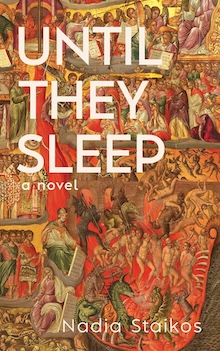
There’s no requirement to read Nadia Staikos’s debut novel Until They Sleep (Guernica Editions) when you yourself are sleepless, but that’s what happened to me, opening the book in the middle of the night and instantly falling into its world. The writing is lush and lively, sending readers to a remote village in Greece full of stubborn, hard-working, flawed characters. Staikos, a Canadian novelist and former editor for Chestnut Review, creates a vivid landscape for her main character Frona to navigate confusing longings, bodily changes, and religious beliefs that seem simple on the surface, but quickly become complex.
I chatted with Staikos about double binds, dreams, and writing through difficult relationships.
+
Brooke Randel: First of all, congrats on your debut novel! Starting in puberty and moving through Frona’s life, the book reveals Frona’s greatest worry: the idea of goodness. She longs for thick, lovely hair so her mother will notice her and they’ll be able to sell it as wigs, making her a good person for contributing to her family’s finances. But when hair grows elsewhere on her body, she feels immense regret for this earlier wish of hers and her lack of specificity. How could things go so wrong? Her desire for attention and touch transforms into a source of shame. Does the impossible pursuit of goodness belong uniquely to Frona and her highly religious world, or does it tap into something even more universal? Is it something that comes with having a body? How do you view the origins of this longing and shame?
Nadia Staikos: Thanks so much, Brooke. These are some of the exact questions I was wrestling with when I wrote the book, so you’ve really got my wheels spinning.
I’ll start here: I would like to think the pursuit of goodness is universal. But that idea, goodness, is a wildly variable target. It’s possible we’re all holding ourselves up against some sort of measuring stick, we just don’t all agree on the specifications of the stick. Maybe what’s most universal is that we all feel like we’re falling short in some way. Maybe I’m just naïve. I see what’s happening around the world, and it’s clear that not everyone is trying to do the right thing.
Frona is though, and she’s adept at deluding herself. It’s a way of trying to do what’s expected of her—what she feels is necessary to be a good person. Her battle is against desire. She’s been led to believe that acting on physical longing, that the physical longing itself, is wrong—feeling good can’t be good. I didn’t grow up in a religious household, and yet I didn’t manage to completely escape the ties between desire and shame. I’m not sure how to tease everything out and get to the root of it, but the impulse to examine these ideas fueled this book.
I don’t think that this struggle inherently comes with having a body, but society has certainly braided these threads together. When I was writing Until They Sleep, I was thinking about my paternal grandmother, and what things must have been like for her as a girl and then a woman in Greece in the early 1900s. Gender-related expectations have always made me feel so uncomfortable. I thought about the parallels that might have been experienced by someone like my grandmother, in a religious, highly patriarchal environment. What might she have been ashamed of? What expectations might have weighed on someone like her?
It’s fascinating that the idea of goodness is tied to location—in time, in place. It can feel so concrete, but we’re collectively making it up as we go. Frona wouldn’t have the same worries in 2025 Toronto. But, living where and when she did, she was held down under certain expectations. To me, she’s queer. Her sexuality falls outside of the box created by the society she lives in. She’s suffering because she doesn’t feel like she’s measuring up in terms of expectations. She feels othered—as though the way she’s living, who she is, is different than she “should be.” And, of course, who she is is absolutely fine—the reader can see that—but Frona doesn’t have anyone to reassure her. She doesn’t feel like there’s anyone she can confide in. It doesn’t feel safe.
BR: That lack of safety definitely comes through in the novel, and makes the reader feel for Frona. No matter our location or upbringing, it’s so relatable. Frona is confused by her sexuality, in part because she receives so little information from the adults around her. But before her wedding, her mother does give her one piece of wisdom: “Your job, always, is not to question your understanding.” How do you consider these ideas of innate bodily understanding versus clear cognitive understanding? Do you see them as conflicting forces for Frona? Can access to one be enough?
NS: I love the idea of bodily understanding, and I’d love to be in a place where I feel like I know how to trust my gut. It’s so easy to explain things away: Oh, that’s probably anxiety, or whatever. I think that’s why I put that in the book—that advice coming from her mother. I like the idea of somebody speaking with authority about innate understanding, of acknowledging that authority in someone else. Maybe I was comforting myself. See? This is something you can do. This is something we’re all built to do.
Equating innate bodily understanding with wishy-washy feelings and cognitive understanding with facts is unfair. That’s what Frona does, and she couldn’t be further off base. I think I was trying to drill that lesson into myself by writing about it: I want to learn to trust my feelings more, and to give them at least as much credence as I give my thoughts. A balance, rather than a hierarchy. There must be a lot of power in harnessing that—power to always be moving in the direction of some personal truth.
I like the irony of the situation with Frona and her mother. The mother is telling Frona never to question her understanding, but then she berates her daughter for stepping outside of the norm. I think that happens a lot: People try to pass on certain wisdom to their loved ones, but when it comes time for execution, it’s a lot more complicated. We’re all held to societal expectations—some of which are important and helpful, and some of which really aren’t.
I’m trying to figure out how the two forces play out for Frona. There’s so much conflict there. I switched things around from experiences I’ve had, where my body has told me that something is wrong, and I ignored it. I’ve talked myself around things, and I have given the benefit of the doubt, over and over again, when I shouldn’t have. I have been that delusional person—telling myself wishful stories to try to make them true. It works. One can be very good at convincing oneself, and Frona’s behaviour is not as far-fetched as it may seem. But Frona’s in the opposite situation than I’ve been in. Her body is telling her that something is right. That she has a loving husband, that she’s attracted to him, yet she uses logic to twist that into a negative thing. She thinks she has a clear understanding about how life works. Really, she ends up holding herself prisoner for most of her life. Thinking and logic can absolutely steer you wrong.
Thoughts aren’t facts. Feelings aren’t facts either. We need to figure out how to listen to both, how to get both working together. If your heart or your brain is in revolt, something is up. The danger is in letting one of them steamroll the other—it doesn’t work for Frona, and it’s certainly never worked for me. That’s what Frona’s mother could have explained, if she understood it herself: Inner conflict is useful, if it’s treated as an invitation. The inner conflict itself is understanding. It’s a signal that something isn’t right. It’s not the problem, it’s the beginning of an answer.
BR: That’s such an insightful answer, and such a hard insight to reach. It can be so elusive. But the idea of having these internal dilemmas and having the space to think of them as opportunities, or at least something other than problems, makes me think of the role that dreams play in the novel. Frona has a strong conviction that real events are actually dreams, while her daughter Galena takes actions in the real world to confirm her memories are not dreams. At the same time, as writers, we often receive the incredibly common advice to not write about dreams, perhaps because they are seen as too-easy plot devices. Did you hesitate to include dreams in the novel? What drew you to them and how did you decide the role they would play for these characters? (I love dreams, by the way.)
NS: There was no hesitation at all. I’ve always loved thinking about and talking about and trying to analyze dreams. I have no qualms breaking this particular writing “rule” (it’s been done masterfully in so many books, like Kaveh Akbar’s Martyr!), though I can’t honestly claim it was a decision I made. It’s just where my writing steered me. I was in a very unhealthy relationship, one that mercifully ended while I was writing this book, and I had a lot to work through. While really in the weeds of things, I’d sometimes have dreams where everything was fine. If only it were that easy. I’d wake up so disappointed by the harsh contrast of reality. Writing helped. So, I wrote Frona an escape route of sorts—a loophole to bypass at least some of her shame. Because we have no control over what we dream, right?
I’m drawn to that liminal space between wakefulness and sleep, and it was fun to write scenes that feel dreamlike. They might not actually be dreams, but the characters are having fleeting moments where it turns out that their grip on reality isn’t as strong as they thought. This dreamworld stuff is fitting, as many of the ideas for this book came to me right before drifting off to sleep. I’d shake myself awake to quickly write notes in my phone so I wouldn’t forget anything come morning. (I learned that lesson the hard way.)
BR: Funny when ideas come because it’s often when we least expect. I also want to ask about tone. Much of the longing in this novel is rendered through a careful attention to language: “voluptuous curving braids” for example, “almonds that would gently crunch between her teeth,” and “a pulsing that beat like a second heart, begging.” What was your approach to language in creating Frona’s world? Was this voice slowly refined over time or something that emerged well-formed from the beginning?
NS: When it comes to advancing a plot, I’m a very slow writer. The possibility of a blank page is overwhelming, and I’ve come up with all kinds of tricks to force myself to move forward with narratives. It’s so much easier to go back and revise words that are already there. By the time I finally finished what felt like a cohesive draft of Until They Sleep, going back to focus on the language felt like a reward. I love experimenting with word choice and tweaking sentences and rearranging paragraphs. There isn’t much that emerged well-formed—most of what’s in the book is the result of going back again and again, re-reading and re-wording. I wanted the tone to be very sensual—Frona is highly attuned to her senses. She’s a sponge, taking everything in however she can. I wanted the experience of reading the book to reflect how Frona experiences the world. I wanted to pull the reader right in.
+++
Nadia Staikos lives in Toronto with her two children. Her work has appeared in Barrelhouse, Lost Balloon, Montréal Writes, and elsewhere. Her debut novel, Until They Sleep, is available from Guernica Editions. Find her at nadiastaikos.com.
+
Brooke Randel is a writer, editor and associate creative director in Chicago. She is the author of Also Here: Love, Literacy, and the Legacy of the Holocaust. Her writing has been published in Hippocampus, Hypertext Magazine, Jewish Fiction, Split Lip Magazine, and elsewhere. Find more of her work at brookerandel.com.