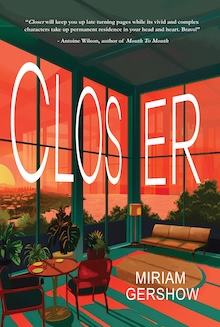
Miriam Gershow’s new novel, Closer (Regal House Publishing, June 2025) tracks the fallout from a racially charged incident at an Oregon high school. As students, teachers, counselors and families relate their experience of the consequences of racial intimidation, friendships and loyalties splinter and regroup, marriages fray, and more tragedy looms. The plot is fast paced and timely, but equally compelling is the way the novel is structured through deeply relatable character studies. Each of Gershow’s characters have much more going on in their lives besides the main story line. Oregon ArtsWatch describes Closer’s cast as characters who “…connect and boomerang and reconnect, like a ball of elastic being wound ever more closely…[the novel is] fresh and compelling, funny and sad, a book the reader will not easily forget.” Closer’s honest look at the motivations and actions of teens, their parents and their teachers makes this a novel of complicated relationships to match the complicated dynamics of harassment and racial divisions.
+
Laura Hulthen Thomas: Miriam, your novel is fast paced and full of drama, but also connects with the characters in deeply personal and authentic ways. We journey through the novel with Lark, Stephanie, and Woody as our main storytellers, with Derek and other characters also chiming in to tell their parts of the story. I was so compelled by the full depiction of people in their family and professional roles roles that I came to feel that the novel’s true plot was about how these characters, both the adults and the young people, grapple with complicated relationships and duties of care to family and to community. When you were writing Closer, did you make a conscious choice to structure the plot around deep dives into character?
Miriam Gershow: I wouldn’t say it was a conscious choice as much as my intuitive starting point. I always begin with character. A story has legs if I can get inside a character and walk through their world, fully inhabiting it and writing from there. I’m not writing from an outline or a thematic idea. I’m immersing myself into characters and exploring what comes of that. Sometimes what comes is a dead-end. That’s the cost of this approach. For Closer, though, I was lucky enough to have three characters – and more! – whose worlds really opened for me. Long before I had the plot figured out, I had these personalities that compelled me. “Characters grappling with complicated relationships” is my entire mojo as a writer! And a reader too, if I’m honest.
LHT: Closer’s cast of characters includes people of many ethnic backgrounds and faiths, neurodivergent people, and every age group from high school students to elderly folks facing life-changing illnesses. As a writer, how do you prepare to inhabit and portray perspectives different than your own?
MG: Prepare is an interesting word here. In a lot of ways I didn’t prepare for these perspectives, just as I didn’t prepare for the story. I have what I think of as a zero draft where I’m discovering the story for myself. No one but me is going to see the zero draft (or honestly the zero drafts). I muck around in there for as long as I need to before I have a first draft I’m comfortable sending out to readers for feedback. Often, when I’m sending out a “first draft,” that’s easily the fourth or fifth version of the story.

In the zero draft of Closer, I discovered this Black student, Baz, who is central to the story. One of the point-of-view characters turned out to be his mother, Stefanie. By the end of that zero draft, I felt wedded to these characters. If I was telling the story of a community – and that’s what Closer boils down to – then these characters are necessarily a part of that community. I write from a place of deep empathy, so often I can imagine what a character unlike myself is going through, such as a high school student or an elderly woman. But empathy can only take me so far. Once the story of Closer emerges, I felt like: okay if this is the story that I, a white lady, want to tell, I have a lot of responsibility–and a lot of work–ahead of me.
So much of this work boiled down to a profound listening. I started by listening to writers of color. In Alexander Chee’s “How To Unlearn Everything,” he asks three questions of white authors writing the other: Why do you want to write from this point of view? Because I want these voices to be part of this fictional community (which bears a strong resemblance to my real life community of Eugene OR). The alternative was to exclude this point of view or minimize it, which did not feel like an option. Do you read writers from this community currently? Yes, and I will read more. Why do you want to tell this story? Ultimately, it’s the same story I am always telling: how people want desperately to be close to each other, often get it wrong, try again, and hope (against hope?) to get closer. I immersed myself in Black writers, mostly Black women writers: Danielle Evans, Toni Morrison, Jesmyn Ward, Tayari Jones, Brit Bennett, Nafissa Thompson-Spires as a start. Once I had a first draft, I gave it to Black readers and readers of color to tell me what I got right and, more importantly, what I got wrong. I revised and revised to these notes.
It was a similar process in writing the non-verbal autistic adult character, Nathan, Baz’s brother. Imagining only got me so far. I emailed with non-verbal autistic adults about their experiences in early adulthood, about their communication patterns, and about their relationships to their families. Those conversations shaped Nathan’s story arc profoundly between the zero draft and the published book.
LHT: To linger on Baz for a moment, neither he nor Livvy, the kids at the heart of the incident that sets the novel in motion, get their own POV chapters to tell their piece of the story. How did you decide who would get a voice in this novel and who would only be depicted through others’ points of view?
MG: This was an intuitive structural choice to start. I knew I wanted Livvy to be central to the story but only seen through other character’s eyes. I decided the same about Baz early on. Their story has been told a million times in a million different ways: star-crossed lovers. What interested me more was all the peripheral characters and how this one incident that brought Livvy and Baz together – two stupid white boys taunting Baz in the school library – would ripple out and out into their lives in unexpected ways. Insofar as this is a novel about a community, following these other characters felt like nestling into the corners of the community rather than sticking with the central players of all the drama at West High School. The side characters are always more interesting to me than the main!
LHT: Since my extended family is currently navigating care for a relative with dementia, I particularly admired the novel’s detailed and heartbreaking accounts of caregiving. Not only is Stephanie Baz’s mother, the young man targeted by the racial incident; she is also mother to the severely autistic Nathan, and a long-distance manager of her elderly mother’s descent into dementia. Stephanie’s attempts to locate a Medicaid bed in a memory care facility for her mom are nothing short of harrowing. And the ongoing challenges of caring for a young adult with severe autism, and the hard choices the family must make late in the novel, are equally anguishing. Why did you choose to make one character, Stephanie, the locus of so many complicated circumstances?

MG: This is closely related to writing the other. I knew from the start that Stefanie’s character was deeply, almost reflexively skeptical of Livvy, Baz’s white girlfriend and the character who so much of the story revolves around. But I didn’t want Stefanie to be positioned as the antagonist. I wanted her skepticism to be understandable and rooted in circumstance. Near the end of the book, just before she finally speaks her resentment directly to Livvy – and to perilous result – I wrote this line: [Stefanie had] always known her family would have a season like this, assailed and imperiled, hammered from all directions. I knew the season had to overtax Stefanie and push her to her limits in order for her resentment and distrust of Livvy make sense. I was sandwich generation for a stretch of years—taking care of my dying father while raising my young son—and I know how fraying it was.
Side note: I hope the raising of Nathan doesn’t come off as challenging. Stefanie is among her happiest when in a room alone with Nathan. But the systems around raising a young adult with a disability can hobble her. As does the idea of letting that young adult live his life independent of her.
LHT: To change gears a bit, although Woody and Susan’s affair will end up having serious consequences, the early days of the relationship unfold with refreshing realism. Woody, who considers himself “a stand-up guy”, finds it extraordinarily easy to betray his wife and his own professional ethics to pursue this relationship. Woody’s “easy” attitude is mirrored in the descriptions of the affair, in which the sex is very much “warts and all”—pimply backs, sagging butts, and goofy, cringe worthy but love-struck pillow talk (or in some cases, backseat of the car talk). It’s a middle-aged affair with a strong undertow of adolescence. Can you talk more generally about the role of betrayal in Closer and how the novel upends some of the moral assumptions we associate with affairs and transgressions?
MG: I am always interested in the fissures in relationships. To me the moments of betrayal are where everything comes alive between characters. That’s where all the heat is. There are loads of betrayals in here, whether it’s a teenage girl tossing aside her best friend for her new boyfriend, or a husband not telling his wife about information he’s shared with their son, or yes, a man cheating on his wife. I agree that Woody is so adolescent in his behavior. Part of the reason I’ve long been fixated on high school as subject matter (see: my first novel, The Local News and several stories in my collection, Survival Tips) is because I’m convinced the forever-adolescent exists in all of us. Adults are awkward, self-involved, and full of hubris, just like the average teenager.
As for moral assumptions, I’m not interested in morality tales. I’m interested in deep dives into a character’s behavior and writing with empathy first. Everyone’s a hero of their own story, Woody included. And that’s a large part of his downfall. Readers have strong reactions to him. I’ve had more than one: “I loved this book and hated Woody.” But just like we all have an adolescent in us, I think we all have some Woody in us: convinced of our goodness and rightness even when we make less than stellar choices. Is there anything more human than rationalizing our bad acts?
LHT: Are you working on a new novel or story project?
MG: I am! I’ve returned to Horace, Oregon – this is the first time I’ve returned to one of my fictional settings – and I’m telling the story of dual staff and resident rebellions at an assisted living facility. I’m writing it in oral history form, and I have a sticky note on my computer keeping track all the many, many characters. It takes place ten years after Closer, and it’s possible a few of the side side characters make an appearance.
+++
Miriam Gershow is the author of Closer (Regal House), Survival Tips: Stories (Propeller Books), and The Local News (Spiegel & Grau). Miriam’s stories appear in The Georgia Review, Gulf Coast and Black Warrior Review, among other journals. Her creative nonfiction is featured in Salon and Craft Literary among others. She is the recipient of a Fiction Fellowship from the Wisconsin Institute for Creative Writing, an Oregon Literary Fellowship, an Independent Publisher Book Award, and a Pencraft Award, and is a two-time finalist for the Oregon Book Awards’ Ken Kesey Award for Fiction. She is the organizer of 100 Notable Small Press Books, a curated list of the year’s recommended titles from independent publishers.
+
Laura Hulthen Thomas is a teaching professor of fiction and creative nonfiction at the University of Michigan’s Residential College in Ann Arbor. Her short fiction and essays have appeared in Witness, Epiphany, The Cimarron Review, failbetter, and others. Her short story collection, States of Motion (Wayne State University Press, 2017) was a finalist for a Foreword Reviews Indie Award. Her novel, The Meaning of Fear, is forthcoming in Spring 2026.