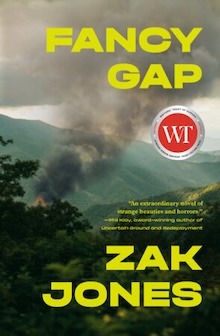
When I first encountered Zak Jones’ writing, crammed into the attic of a Toronto dive bar for a poetry reading, his work expanded the small space into something like the Appalachian foothills I remembered lingering in throughout my own growing up back in the United States. I was not surprised to learn afterward that Jones and I share an American point of origin, both now living in Canada with one eye turned ever backwards to the strange place that raised us. This coincidence of psychogeography drew me to Jones’ work, where I found, conversely, a voice and style emanating intentionality, driven down the page by an investigative energy that summons up a setting in perfect image not by asking “what,” but “why.” Whether holding it in interrogation or communion, Jones’ prose seethes with a sense of place, a command of all the extrasensory minutiae that make a landscape into a setting and a setting into a fulsome character. This quality of place as character in Jones’ writing is explored fully in his electrifying debut novel, Fancy Gap, which follows the tragedy of a family spread thin over the Appalachian country in Virginia, North Carolina, and West Virginia, left vulnerable to the converging forces of resurgent white nationalism and uniquely American religious fervor.
The novel’s characters exist in constant conversation with the places where they find themselves stuck or stopping by or settling in against a siege, real or imagined. In the deep mountains, the family’s charismatic grandmother, Grace, builds her own heaven among the ashes of so many American dreams while her daughter, Jane, remains trapped in the foothills of western North Carolina, living with cancer and her own community’s constant judgement. Into this dichotomy of peaks and valleys, deliverance and damnation, Jane’s sons, Dalton and Messiah, introduce the element of motion that expands the novel into an epic. Messiah, perhaps fittingly, ascends from the foothills to the mountaintop, following the path of so many impressionable young men who find themselves in the lowlands looking upward, wondering why. Dalton, on the other hand, sprawls across Appalachia in a tragic odyssey, the hero “other than honourably” discharged from the frontlines and put up against a myth he cannot match. In the suburban lowlands, among the fog-capped mountains, at the bottom of valleys gouged out by excavators, the places Fancy Gap takes us, both malignant and divine, leap out and demand to be addressed.
+
Jack O’Grady: How did you consider the role of place in informing or affecting the representation and arcs of all the novel’s various characters?
Zak Jones: I have a philosophy of craft and also a philosophy of person that informs the characterization in everything that I write and in much of what I read, too, because so much of what a reader sees is informed not just by what they know but also what is presented to them contextually and in the text, in the diegesis. And so in the process of characterization, there’s two phases; there’s initial and then ongoing. And I believe that in the initial phase of characterization as you’re writing, much of what you present to the reader and much of what you present to the story as a character, as a variable in the plot or in the cocktail of situations and circumstances that come to make a story, is carte blanche. You can come up with any kind of character that you’d like. That being said, you have to make a decision about how they’re going to relate to the place and the context of their environment, be it social environment, their class environment, what they see and take on. And some of that has already developed, you know, from the get-go.
JO: This relationship really crystallized for me with a line in the character Messiah’s story. It’s when he’s up in Fancy Gap on the mountain, and you have this moment where we’re starting to see a change in him and there’s this very rich description of the full place, the environment but also the way people live in it, and then there’s this line: “Messiah, watched it all and let it become him.” So this process of a place becoming someone, of someone becoming a place, could you expand on that?
ZJ: We’ve got a kid in Messiah that’s from the deep south and has grown up ostensibly with exposure to very much of what we know universally to be the southern experience, the southern American experience. But then in the ongoing characterization, the development phase of it, he necessarily must be informed by what he sees, and some of that is quite particular. And so on the mountain, in this change in psychogeography from something more childhood-based and domestic and protected, he’s exposed to an unfiltered and unique blend of environmental factors. Very unique, not just to this story, but to rural American Appalachian life. Coded a certain way, obviously, there are variants of such, but this is the kind of wild, backwoods, free anarchy that is presented in so much popular media informing the way we see the Appalachian world. And what I was trying to get at here is that even to those who are from such a place, the characterization of Messiah here and this change allows us to see how someone’s thought processes and actions and then indeed persona may be informed by a quick exposure. It doesn’t take place over that long of a time, but a quick exposure to all that might have been hidden by a different kind of life, regardless of proximity. And so once he’s up there and it’s the real wild mountainside, to say Messiah watched it all and let it become him informs of course what he will then in turn become. He can’t be the Messiah at the end of the novel without exposure to the jagged edges of the wild mountainside and all that comes with it, part and parcel, the people, the fires, the crimes, the kind of unhinged evangelicism, the born-again Christianity, all of this is quite new to him. Although he may have hints of it growing up, it’s all new to him. And so I think that Messiah here is also functioning as a kind of liaison to the reader, that you may think you know but you don’t necessarily know. And once you do learn it comes to affect you.
JO: Did it change how you approached writing the role of place in the novel to know that you were writing about a part of the world that you, being from there, know very well, but that a lot of your readers in Canada might not know much about.
ZJ: Sometimes when you’re reading Appalachian literature, it’s presented as a homogeneous, or at least effectively homogeneous, kind of place. Psychogeographically it’s fungible. One narrative could take place in a different narrative’s setting. And one of the one of the things that I was trying to fight through in Fancy Gap was this kind of homogeneous presentation of place that is just so common in representations of Appalachia in Anglo-cultural production, whether it’s TV, movies, novels, short stories, etcetera. I didn’t want it to be fungible. And so I was hoping that there would be a profound shift from the foothill setting that Jane encompasses where things are quite organized and people go to church and people dress up and there is something that resembles community, whether it’s good or bad. And then there’s a different kind of community that exists on the mountainside and then there’s a different kind of community that exists in Dalton’s off-the-books, illegal work camp trailer park when he’s working for Freedom Industries, the coal processing people in West Virginia. And so not only do you have three different locales, but you have three different states. You have West Virginia with Dalton in those chapters, Virginia with Meadows of Dan and Fancy Gap and Buffalo Mountain, from Messiah’s perspective and Grace’s perspective. And then North Carolina, western North Carolina, the Piedmont foothills of the Appalachians from Jane’s experience. And although they’re all connected by certain strands of culture, music, religion, accent, values, problems, they all have different connotations.
JO: How did this work enlivening the particularities of different Appalachian regions affect what this novel has been able to do?
ZJ: When characters face down certain issues, they are particular to place. In the foothills of North Carolina, this community, although not that far from the coal mines of West Virginia, their concerns are not the immediate concerns of that different community. If they had an illegal worker concern, it would be something like agricultural workers, whereas in West Virginia they have union issues, they have pollution issues. The story becomes a kind of environmental critique simply given the fact that Dalton is there engaging with these microcultural issues particular to place. I think as a novel it allows a much broader and more diverse critique, but also discussion of the region at large. And so these particular places came to inform the story directly because what are these characters gonna do in these hyper-particular places that, you know, demand a kind of reaction from them. People often ask about how this novel factors into others, the one of which is top of mind is Demon Copperhead. Well my answer is I don’t know because I didn’t read it because I understood immediately that, if I read it, this was going to inform the story that I was telling. But even still I would imagine that whatever issues Demon and his friends and family struggle with are similar, for sure, to some of the characters in Fancy Gap. But needless to say, it’s still a different place. To my knowledge, Demon doesn’t have to participate in the poisoning of West Virginia’s rivers, for example. Every micro-place, every micro-environment has its own culture and concerns that are particular, and I think we owe it to the Appalachians, we owe it to every region and cultural background and historical background and class strata, to make those kinds of allowances and variations.
JO: You’ve mentioned the character of Dalton a few times, and Dalton is an interesting variable in the novel when I think about place. He’s the one who seems to go on almost a tour of all the microregions that this book is embroiled in. What motivated your decision to make this character the one to bridge the gaps, in a way, between these Appalachian communities?
ZJ: The easiest way to answer that is because Dalton, despite his flaws, of which there are many, is a very sympathetic character to me because not only in my life have I felt this kind of pressure to leave and to flee, but I’ve also felt the great defeat and the reverberations of defeat when you fail to get out. I’ve got a hunch that I’ve thought about American literature for quite a long time. It’s what I call the Get Out, where so much of American literature is premised on one simple urge: a calling to just get the hell out of whatever situation you find yourself in. I think that’s pretty simple. But sometimes the tension in American storytelling is formed not by where the character ends up, but where they end up in the failure not to go where they intended to go. The character may think that they’re leaving and they’re going to light out for the territory, so to speak, but reality steps in and where do they land? Well when the money runs out and your luck runs out and you fall backwards, as Dalton does, into a situation that seems like a stopgap, it’s very easy to get stuck. And I would say so much of American adult life in reality goes this exact way. I’ve got a plan, I’m gonna go to college, but where do I end up? In a trailer park in West Virginia. I’ve got a plan, I’m gonna join the army, it’s gonna launch me into the kind of class ascension fantasy that so many young people have when they enlist. And instead of touring the world, seeing a little bit of war, seeing a little bit of love and romance, coming back a hero, where do they end up? Well, they end up in a trailer park working at a coal processing plant in West Virginia. It happens every single day.
I understand that this isn’t romantic. There are certain elements of Dalton’s character and character progression and story that I think are classically modeled, and certainly his demeanor and disposition is modeled after Prince Hamlet’s, more so than anything else. He’s just someone who is unsuited to the monumental task before him. The monumental task before Dalton is to avenge his own honor, his idea of himself in his mother’s eyes, in his community’s eyes, and then finally in his brother’s eyes. When I was thinking about this character, I had a few rules in that he wouldn’t be saved by love, although tempted, and there wouldn’t be a kind of a Deus Ex Machina that just came and transported him. He would have to find it within himself to complete his task, and he is fundamentally unsuited to it. I know that to many readers he’s quite a disappointment because we have very romantic readers now, and I find it very difficult to defend a book without a hero. But he is a hero. He’s just a hero for our time.
JO: On Dalton’s “Odyssey,” so to speak, it all felt very intentional where he was brought to and where he stopped or became stuck. What motivated those choices? Why West Virginia? Why the work camp?
ZJ: I’ve read a lot of analysis that talks about West Virginia as a kind of colony within the metropole. Insofar as there’s massive amounts of resource extraction and they’re blowing the tops off mountains to get at natural gas and the people, the workers doing this aren’t in any way protected by the state, be it federal or the state of West Virginia, whatsoever. And it was important to me that Dalton goes there, just politically. People ask what does your book do? In some ways it’s just telling a story about that particular side of the kind of environmental ravaging of the beautiful Appalachians as we know them, as problematic as they are, to provide a counterbalance. It’s this specter that haunts the entire book where, sure, these people are acting crazy, but there’s crazy stuff being enacted upon the place in which they live. Would that not disrupt your mindset just to know that throughout Virginia and North Carolina and West Virginia the mountains, not just tops of mountains but whole vistas, are being eradicated for natural gas? So their place, their spiritual place, their psychological place, their lived-in place is being altered by modernity beyond all the other elements of the text. And that’s gotta be in there, too. So of course I wanted to show that.
JO: Thinking about the mountains, capital W “Wilderness” as a concept is often implicated in a lot of “God’s Country” narratives, the more white nationalist-charged romanticizations of rural life in America. How did the various political narratives that people spin around the kind of landscape that Fancy Gap is impact how you went about giving it a place and a character in the novel?
ZJ: There are traditions, historical, biblical, and literary traditions that I use to justify this very particular choice. Is it the case that right-wing Christian nationalist fundamentalism is kind of running rampant in the United States today? Yes. Has it been for quite some time? Absolutely. It’s a big part of the story of America. I set the book around 2008-2009 intentionally, pre-Trump, because a lot of this grassroots organizing was happening already. And how did I see this as making sense? Well, on the one hand, the wilderness across literature represents an escape. It represents a place outside of the cultural gaze that may limit the growth or propagation of extreme strains of religious thought. Historically, in the nineties in the United States you had white supremacist nationalist groups in Elohim City and elsewhere. Groups who were on the fringes of society and, in order to practice their kind of militant fundamentalist religion, they had to escape from the regular humdrum capitalist goings-on, the system as we know it. These kinds of places are out in the sticks on purpose because functionally they’re just not being looked at by the government. So it’s plausible, number one. Number two, there’s a literary tradition. Where can characters speak freely beyond the eyes of the church or the church community? Well in the woods. Where are truths told in American literature? Only in the woods.
And then these two facts are taken advantage of by Grace, who’s exceedingly knowledgeable in all of the above, obviously, to suit her purposes. She’s always weaving in different biblical and literary references to justify the end-times biblical argument that she’s preaching. I tried to emphasize if not insist upon this by citing Ezekiel in my epigraph. Ezekiel is commanded by God to prophesize to the mountains of Israel a message of hope and restoration, but at the same time of judgment and damnation of idolatrous systems of government and institutions. And so what do we have emanating and occurring from and within the mountains in Fancy Gap? Well, all of the above. Because it’s simply in the Bible, that’s enough for Grace to take and run with. Like all sorts of religious fundamentalist groups, their MO is for a local religious leader who is purposefully misreading a religious text to recruit impressionable young men and then funnel these primed-for-violence young men into something that becomes a militia. Now, I know that people think that this will never happen in the United States, even to the point where on some lists they listed my book as dystopian, as though this doesn’t occur. It’s exceptional, but it’s not unrealistic and the place of the wilderness, broadly speaking, contributes to what’s going on in the book. This can only happen in an area like this.
JO: Everything that this book has done successfully with place starts with how it feels to read it. How would you characterize your approach to setting a scene, deciding what details to include and what senses to bring to the reader?
ZJ: For me it’s as simple as this, we have very many powerful sensory tools. We take in like a million signals per minute and everything’s all very connected. So I’m interested in writing exercises where the author is engaged in an act of deep, deep noticing. This is a Marie Howe trick where, without metaphor and without fancy language, the trick is to train your mind to just capture something unique about what you’re looking at and pull it out in a simple sentence. For example, on my back porch the exhaust from the dry cleaners beneath my apartment is blowing on to the flowers from my wedding, hanging to dry. That evokes a certain mood, for sure. And you don’t need to know everything else just because what it is is what it is. That’s one trick in the immediate sense. But one thing that I think is much more powerful, especially when you’re writing a long narrative, is to depend on memory to set the stage and the setting and the place and the texture and the detail. Because you can’t remember everything that you see and you can’t remember everything that you hear, and you can’t remember everything that you smell and taste and touch. But if it’s exceptional, those details will stay with you.
And so if you’ve ever walked into a hot trailer baking in the sun with something in it that should not be in it, or that’s been in there for too long, the windows have been closed and there’s no fresh air, that kind of manufactured polystyrene siding leaching into the air. The smell of the hot plastic and cheap furniture and old coffee grounds and bananas left too long in the garbage hitting you all at once as soon as you open the fragile and rickety screen door. You’ll never forget that. And so if you’ve got a character walking into a nasty stuffy trailer then, sure enough, that’s how it’s gonna smell. And if you’ve ever been on the side of a mountain looking up at the sky, having a sort of psychedelic experience whether you’re on drugs or whether it’s just so beautiful and the light pollution is very low and there’s so much bleeding light from the stars that it really does look like a stain on black satin sheets. You’re always gonna remember that. And so it’s about putting memory into place rather than building a place from memory. But you’ve gotta see it to believe it. And then you gotta remember it so your readers believe it and hopefully remember it.
JO: Did you have any methods for summoning those memories back up or was it all just waiting to access?
ZJ: I found that the stories would take me to very comfortable wells, not comfortable insofar as I was very happy, but very well-worn memories that fit on just right. I didn’t have to break any new ones in really. I’ve never dumped toxic chemicals into water, but when I was in the army I had to do all kinds of unpleasant tasks that I didn’t like. So those things are quite fungible. You can evoke feelings from comparable memories even though the exact details aren’t really there. I have smelled dead bodies and I have been in stuffy trailers. I’ve never encountered a dead body in a stuffy trailer, but I imagine what I might think of it as being like. Every sensory setting is pulled directly from memory and I didn’t find myself reaching because all of these places were very real to me.
JO: Did you feel any difference in your relation to the memories and those places having dug so deep into them throughout the novel?
ZJ:No, fortunately or unfortunately, I always feel a little bit alienated from place no matter where I go. I’m very American-coded in Canada and people will always kind of clock that there’s something going on with me. And then it’s the same down there, anytime I’ve ever returned to Virginia or North Carolina or West Virginia for that matter, which is the only place I haven’t lived. I was in Maryland doing a poetry reading not too long ago and everyone there that I spoke with seemed to know immediately that I was not from there. And in a situation like that I’m definitely aware of my presence as a kind of spectator and a documentarian of sorts. So this breaks down whatever barrier I may have to accessing a place, where its details that make its reality rather than other sorts of nostalgia and maybe very personal memories that might be too hyper particular. I’m always taking mental notes because I always feel like I’m new everywhere I go.
+++
Zak Jones is the author of Fancy Gap, his first novel and a finalist for the Writers’ Trust Atwood-Gibson Fiction Prize. He is a writer and literary scholar who lives in Toronto. His short story, “So Much More to Say,” won the Writers’ Trust of Canada’s 2023 Bronwen Wallace Award for Emerging Writers, and his story, “Love Handles,” won the 2023 Norma Epstein National Award. Jones is currently a Ph.D. candidate at the University of Toronto studying veterans’ narratives in American Literature.
+
Jack O’Grady is a digital archivist and writer currently working in Hamilton, Ontario. His short stories have been published in Milk Bag, Masque & Spectacle, and other journals and zines around Canada and the United States. He was also a founding editor of the short-lived literary journal, The Downtime Review, and edited the scholarly research journal, The iJournal, during his time studying information systems at the University of Toronto.