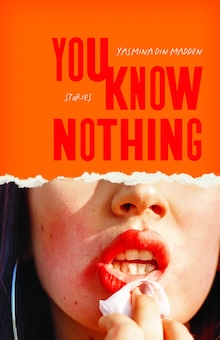
If you’re a fan of short fiction and flash fiction, there’s a good chance you’ve read one of Yasmina Din Madden’s gorgeous, funny, harrowing stories. For years, I have been eagerly waiting for Yasmina’s debut collection You Know Nothing (Curbstone Press). Yasmina and I first met at my first-ever AWP in Washington DC in 2017; I’ve been a huge fan of her work ever since. I’ve read many of these stories when they were first published, and some of them in draft form. None of that prepared me for the impact of seeing them come together in this stunning book. It’s brilliant, both sad and hilarious, sometimes brutal.
+
Kim Magowan: A number of these stories are about mothers who are a little monstrous–who throw knives at their children, literally gobble their babies up, alienate their children, drive their children away. There are also reluctant and ambivalent mothers. Some of my favorite stories feature women whom others might call “bad” mothers, because they have kids who misbehave, and I love how these women show up for and defend their children (especially their daughters) from teachers who think good little girls should be docile and rule-following. Tell me about any of your “bad” moms.
Yasmina Din Madden: I’m glad you like these ‘bad’ moms because I loved writing them. I also think these moms who fail in lots of different ways, who behave in sometimes monstrous ways, are simply complex human beings–good and bad and everything in between. Writing “Woman of Appetites” made me laugh, but the story also comes from a place of anger because I think our culture doesn’t like women who demonstrate strong desires, or maybe our culture only appreciates women with strong desires up until a certain point, and then she becomes “too much.” Also, when my son was a baby, I wanted to eat him up because he was utterly delectable in every way, so there’s that.
KM: One formal feature I love in this book is your use of first person plural narration, “we” narrators. It’s such an interesting POV, and it appears in quite a few of your stories, like “We Wonder,” and “X+ Y = Something.” What attracts you to first person plural? Is there a kind of story you think this POV tells particularly well?
YDM: I love first person plural. For me, there is something hypnotic about that repetition of we. Hypnotic, I think, because the first person plural narration depends on group think, and group think requires, to some degree, a kind of hypnosis. I’m currently working on a novel that uses a first person plural narration. The way certain groups come together and operate like a hive mind fascinates me. It’s funny because the two stories you mention focus on groups of young girls, a population ripe for group think. My novel is born from the story “We Wonder” but focuses on those young girls as high school students in 1994, and as women and mothers in 2024.
KM: You are the queen of titles! (Which makes me envious, because I suck at titles.) Tell me about the title for the collection (I LOVE it). How’d you come up with it? How does it “capture” your book?
YDM: I have never been the queen of anything, so ‘queen of titles’ is going on my CV. The title of the collection comes from a line of dialogue in the opening story “Splinter.” That story was originally published under the title “You Know Nothing.” When I was putting the collection together and thinking about titles, I kept going back to that story and that line. For me, it encapsulates so much of the tension many of these characters face—feeling unknowable, believing they know someone else in their entirety, believing someone doesn’t have the first clue about who they are, feeling someone close to them cannot be known. I wanted that title for the collection, so I stole it from my opening story and renamed the opener “Splinter.”
KM: I have a theory that all writers have particular subjects we can’t help writing about and keep returning to (I picture them like those memory islands in Inside Out that form personality). What are ten words that describe what You Know Nothing is about?
YDM: Great question. Grief, love, rage, joy, borders, body, family, unknowability, distance, fear.
KM: You asked me this question about my first book, so I’m turning it back on you! Is there a story in this collection that came especially easily or quickly? And what about its evil twin, a story that felt impossible from beginning to end?
YDM: “The De Facto Mother” came very quickly and I had fun writing it, which is not typically the case when I write. I am a slow writer, and I would not describe writing the majority of these stories as “fun” exactly. Evil Twin–probably “Rococo.” That one was a hard nut to crack, and I don’t think I actually cracked it. I still want to go back and rewrite parts of it.
KM: It is very hard to pick out a favorite story here — I love so many of these! But one story of yours that I especially admire is “At the Dog Park.” It’s got a lot of the elements you’re so good at. It’s funny; it’s about this loose, motley collection of strangers; the ending kills me. How did you come up with this story?
YDM: Umhhh, I’m freakish about my dog’s outings and I have spent a good deal of time — like way too much time — at dog parks. So really just observing people at the dog park, like a creep. Let’s be honest, there are a lot of weirdos at the dog park, and I am one of them. There are also a lot of people there who are so compassionate toward animals. The weirdness and compassion of the place and people just sparked a lot of ideas and character details, and I just ran with some of them.
KM: “Trimmed” is the most outrageous and over-the-top example of this, but quite a few of these stories feature body horror, particularly the problem of inhabiting a female body. I’m thinking of mutilation, but also the various “augmentations” and creepy sex. Even how so-called “natural” conditions like pregnancy are horrifying. Tell me what’s in your mind, writing these alarming bodies.
YDM: Hmmmm, that’s a good question. Culturally and historically, the female body has always been a site of contention — we want to legislate it, regulate it, restrict it, and critique it. I find some of this enraging and all of it endlessly interesting. I teach several literature and writing courses that spend time on l’ecriture feminine or corporeal writing, and I’m drawn to work that writes the body as a way to reclaim power or resist culturally constructed expectations or norms. Clearly, non-female bodies can also face challenges like a culture’s desire to legislate, restrict, or regulate it, but selfishly I’m primarily interested in the female body because I have one.
KM: You really nail your endings. What’s a favorite ending of yours here? Why are you proud of it? I remember you telling me you had a lot of trouble figuring out the ending of another favorite story of mine, “Rococo.” Why did that ending give you so much grief? Relatedly: why and how did you choose the book’s ending, your last story “Neighborhood Watch”?
YDM: Favorite ending: “At the Dog Park.” It just felt so right and organic to the story that it felt as if the ending wrote itself. I’m proud of it because I think the body of the story builds the foundation for that exact ending. I hate when endings feel forced, and hopefully this one reads as organic and necessary to readers as it did when I wrote it. Most difficult ending? Hands down “Rococo.” I’m still rewriting that ending in my head. I’m still not satisfied with it. I put “Neighborhood Watch” last in the book, because I wanted my mom to have the last word. The story is based on her and she was so dynamic and strong, fiery, smart, and complicated. She had such a distinctive voice, and I think I wanted that voice to be the last voice readers heard.
+++
Yasmina Din Madden is the author of the story collection You Know Nothing, Northwestern University Press, and her fiction and nonfiction have been published in Electric Literature, The Idaho Review, The Fairy Tale Review, and other journals. She is the winner of the Oxford Flash Prize, and she lives in Iowa and teaches creative writing and literature at Drake University.
+
Kim Magowan lives in San Francisco and teaches in the English Department of Mills College at Northeastern University. She is the author of the short story collection The Last Day (forthcoming in 2026), published by Moon City Press; Don’t Take This the Wrong Way (2025), co-authored with Michelle Ross, published by EastOver Press; the short story collection How Far I’ve Come (2022), published by Gold Wake Press; the novel The Light Source (2019), published by 7.13 Books; and the short story collection Undoing (2018), which won the 2017 Moon City Press Fiction Award. Her stories have been selected for Best Small Fictions and Wigleaf’s Top 50. She is the Editor-in-Chief and Fiction Editor of Pithead Chapel.