Tom Comitta is that rare thing: an experimental writer whose experiments have been worth the effort. Call it collage, assemblage, found text, or literary supercut, Comitta’s last major work, The Nature Book (Coffee House Press, 2023), wasn’t just the meeting point for hundreds of other authors’ sentences (though that it was) but an astonishingly seamless arrangement of them, sentences about rivers flowing into sentences about lakes and seas, trees and clouds, sunny skies and snowy ones.
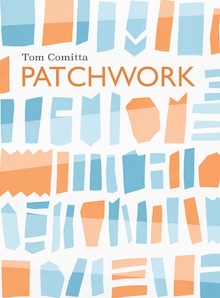
Comitta’s new novel, Patchwork (Coffee House Press, 2025), follows a similar gambit, leaning just as heavily on other writers’ words to tell its story. The difference between the books is mostly a matter of patterns, of schemes: where The Nature Book makes gradual sense of a series of humanless expanses, Patchwork hops from one style, conceit, or constraint to the next, all in the service of telling a very human adventure story, a heroic quest to return a stolen heirloom. Each chapter fashions both its own reason for finding the texts that make it up and the manner of arranging them. The result is a variety of methods, registers, and linguistic exploits worthy of Joyce. Appropriately, the first chapter consists entirely of the first sentences of other novels. Elsewhere, a chapter that takes place in a castle makes do with an assortment of castle descriptions, so that George R. R. Martin sidles up to Ann Radcliffe and Mervyn Peake. It’s a fantastical construction of a novel.
My interview with Tom, conducted via snail mail, amounts to its own taped-in patchwork of questions (including a couple of non-questions), and is less an exploration of craft than the person behind the craft. How does a writer like Tom Comitta come about? And how do we make more of them?
+
[Question] #1 – How did you become aware of your poetic vocation?
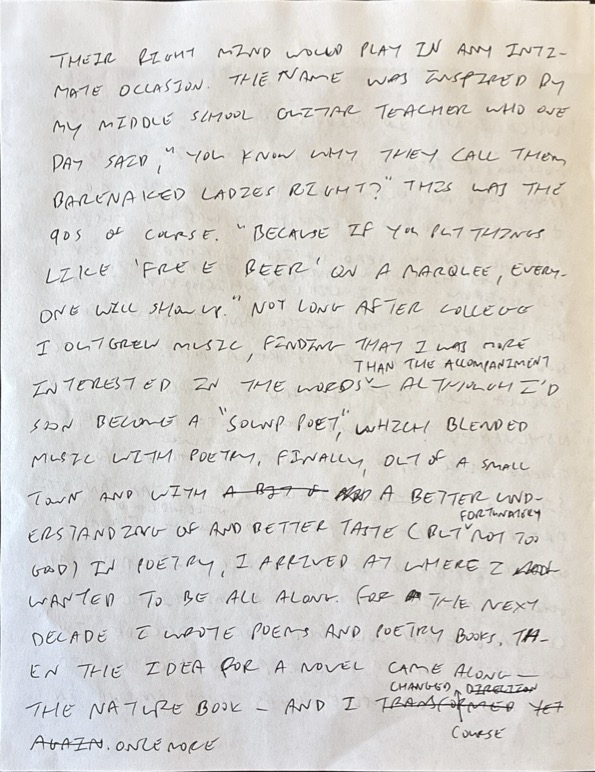
When I was in middle school I loved Jim Morrison’s poetry. I don’t know why. It was so opaque and not very good. But something about it captivated me. Perhaps it was his music echoing in my head while I read it or his energy that I liked. He was hot and mysterious. So there’s that. Whichever it may be, it got me to write. And I knew pretty soon that I wanted to be a poet. The only problem was that, living in small town Pennsylvania, there was nowhere to be a poet. There were open mics but they were all for music. So I decided picked up a guitar and started setting my poems to music notes and chords. I was a singer-songwriter/composer (it wasn’t all guitar music—some of it was highly produced and even collaged) for a decade. In college I formed a one person band called Sex Music and wrote songs that no one in their right mind would play in any intimate occasion. The name was inspired by my middle school guitar teacher who one day said, “You know why they call them Barenaked Ladies right?” That was the 90s of course. “Because if you put things like ‘free beer’ on a marquee, everyone will show up.” Not long after college I outgrew music, finding that I was more interested in the words than the accompaniment—although I’d soon become a “sound poet,” which blended music with poetry. Finally, out of a small town and with a bit of a better understanding of and better taste (but fortunately not too good) in poetry, I arrived at where I wanted to be all along. For the next decade I wrote poems and poetry books. Then the idea for a novel came along—The Nature Book—and I transformed changed direction course yet again. once more.
+
[Question] #2 – What was your first decisive literary act?
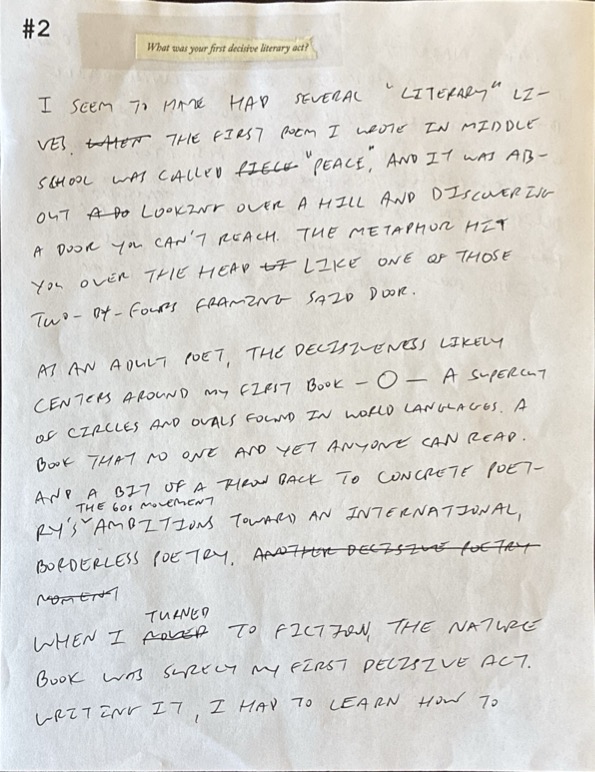
I seem to have had several “literary” lives. When The first poem I wrote in middle school was called piece “Peace,” and it was about a do looking out over a hill and discovering a door you can’t reach. The metaphor hit you over the head wi like one of those two-by-fours framing said door.
As an adult poet, the decisiveness likely centers on my first book—O—a supercut of circles and ovals found in world languages. A book that no one and yet anyone can read. And a bit of a throwback to Concrete Poetry’s [the 60s movement’s] ambitions toward an international borderless poetry. Another decisive poetry moment
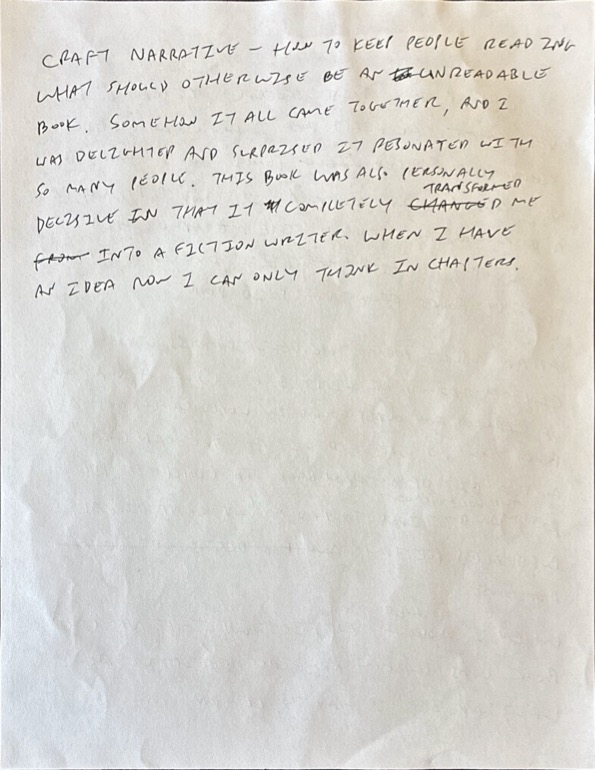
When I moved turned to fiction, The Nature Book was surely my first decisive act. Writing it , I had to learn how to craft narrative—how to keep people reading what should otherwise be an unreadable book. Somehow it all came together, and I was delighted and surprised it resonated with so many people. This book was also personally decisive in that it completely changed transformed me from into a fiction writer. When I have an idea now I can only think in chapters.
+
[Question] #3 – From that moment, did you not aspire to create a personal body of work?
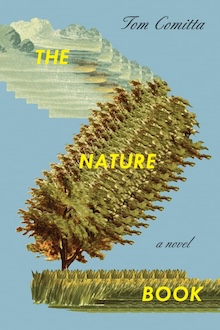
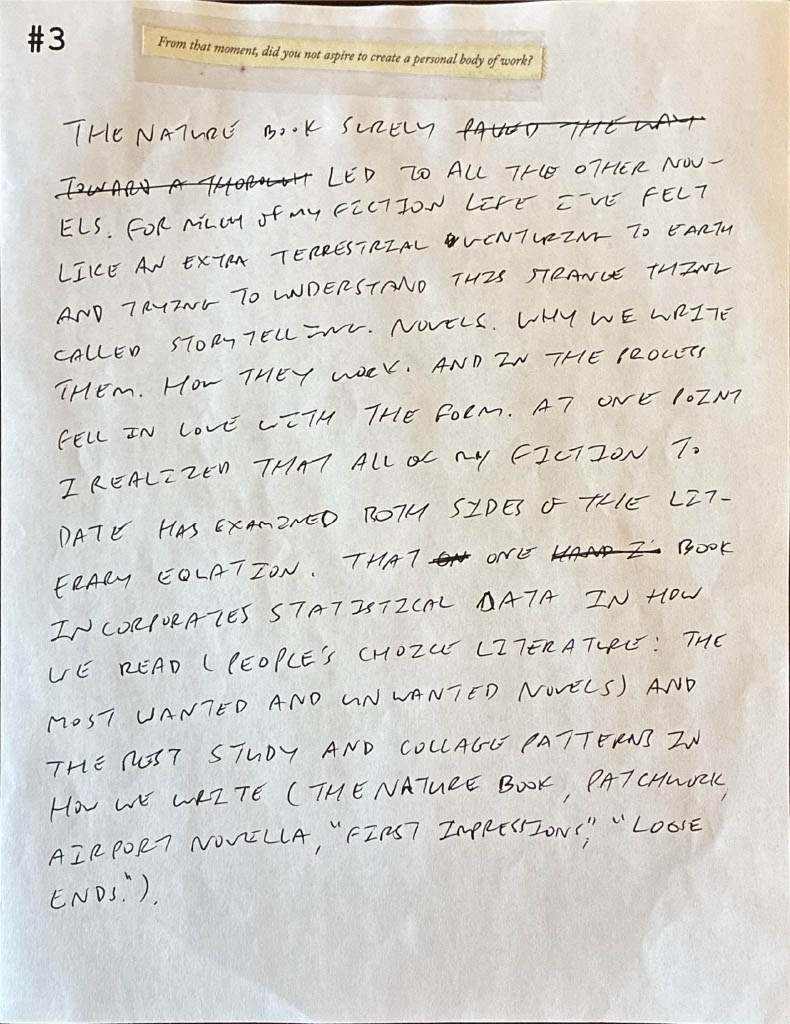
The Nature Book surely paved the way toward a thorough led to all the other novels. For much of my fiction life I’ve felt like an extra terrestrial venturing to Earth and trying to understand this strange thing called storytelling. Novels. Why we write them. How they work. And in the process fell in love with the form. At one point I realized that all of my fiction to date has examined both sides of the literary equation. That on one hand z book incorporates statistical data in how we read (People’s Choice Literature: The Most Wanted and Unwanted Novels) and the rest study and collage patters in how we write (The Nature Book, Patchwork, Airport Novella, “First Impressions,” “Loose Ends.”).
+
[Question] #4 – How have notions of idealism played into your creative process?
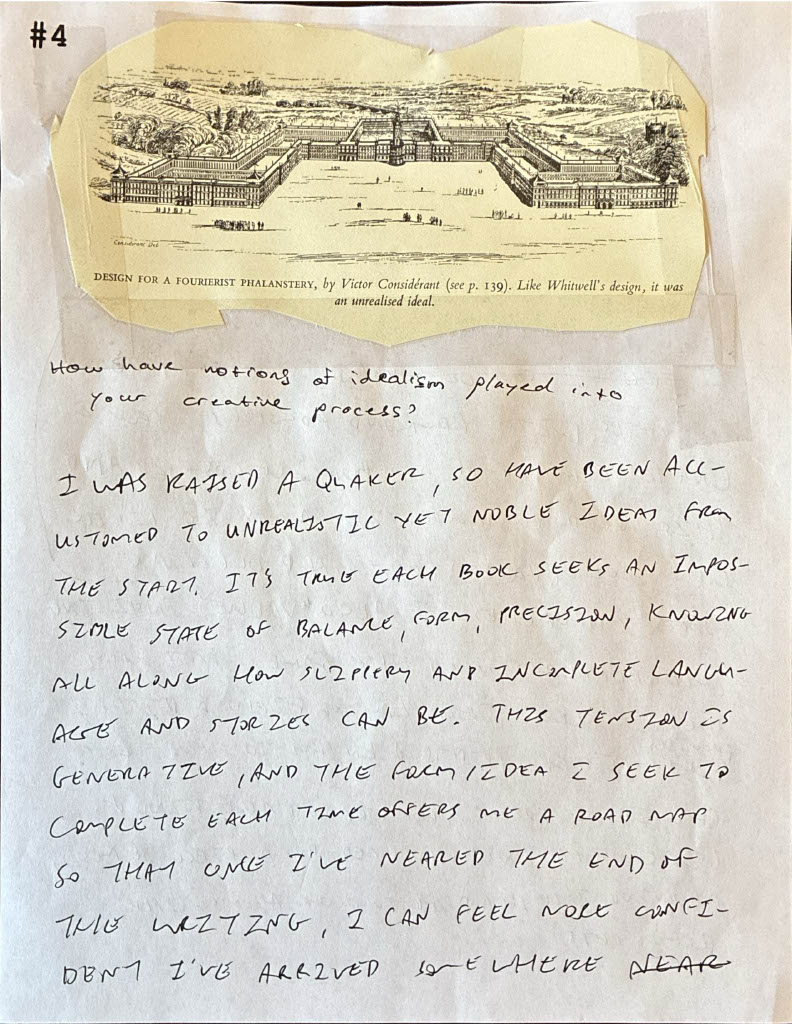
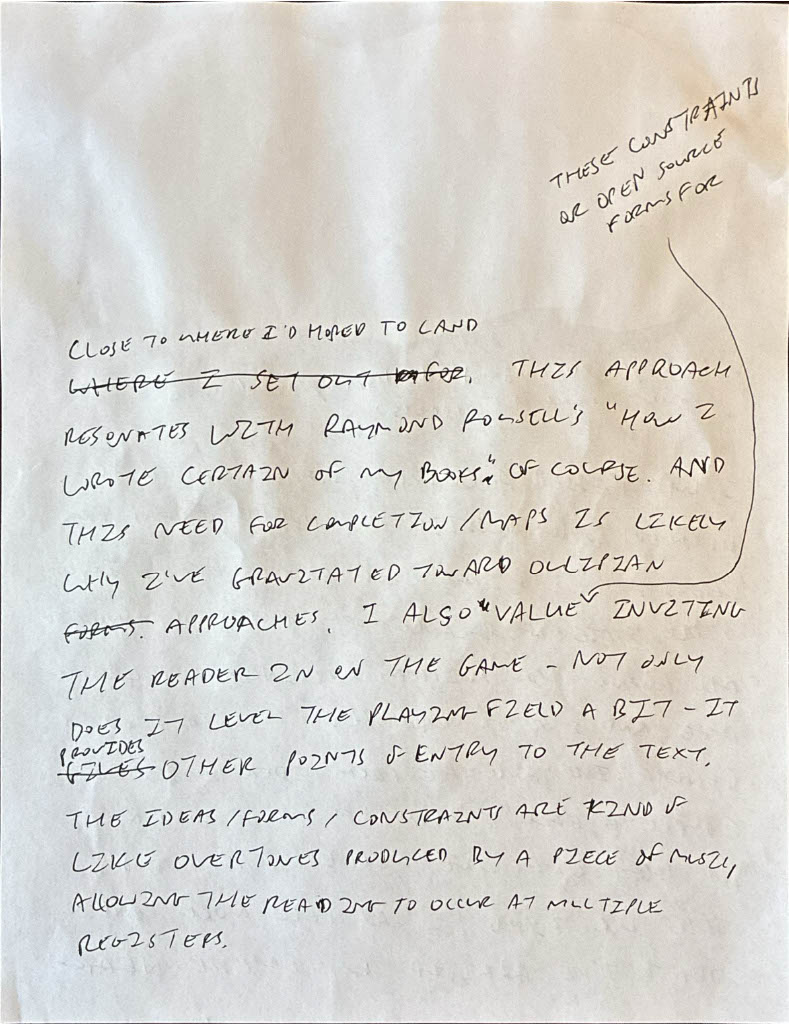
I was raised a Quaker, so have been accustomed to unrealistic yet noble ideas from the start. It’s true each book seeks an impossible state of balance, form, precision, knowing all along how slippery and incomplete language and stories can be. This tension is generative, and the form/idea I seek to complete each time offers me a road map so that once I’ve neared the end of the writing, I can feel more confident I’ve arrived somewhere near close to where I’d hoped to land.
Where I set out for This approach resonates with Raymond Rousell’s “How I Wrote Certain of My Books,” of course. And this need for completion/maps is likely why I’ve gravitated toward Oulipian forms. approaches. I also value these constraints or open source forms for inviting the reader in on the game. Not only does it level the playing field a bit—it gives provides other points of entry to the text.
The ideas/forms/constraints are kind of like overtones produced by a piece of music, allowing the reading to occur at multiple registers.
+
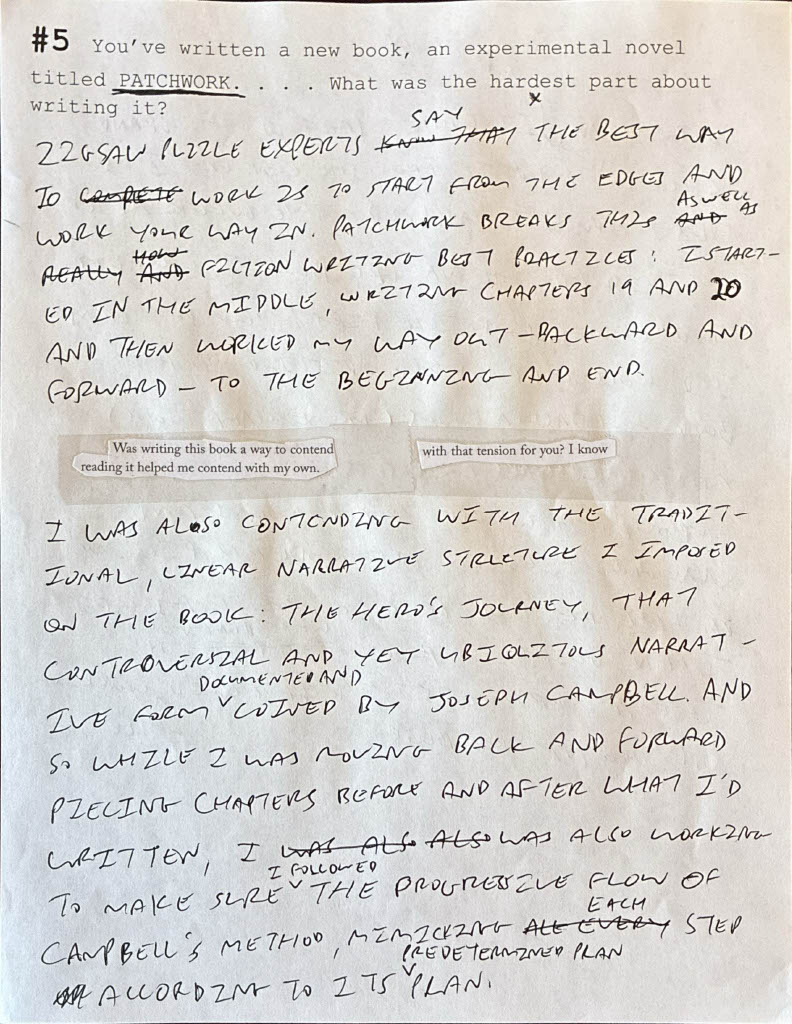
[Question] #5 – You’ve written a new book, an experimental novel titled PATCHWORK. . . . What was the hardest part about writing it?
Jigsaw puzzle experts know that say the best way to complete work is to start from the edges and work your way in. Patchwork breaks this and as well as really and how fiction writing best practices: I started in the middle, writing chapters 19 and 20 and then worked my way out—backward and forward—to the beginning and end.
Was writing this book a way to contend with that tension for you? I know reading it helped me contend with my own.
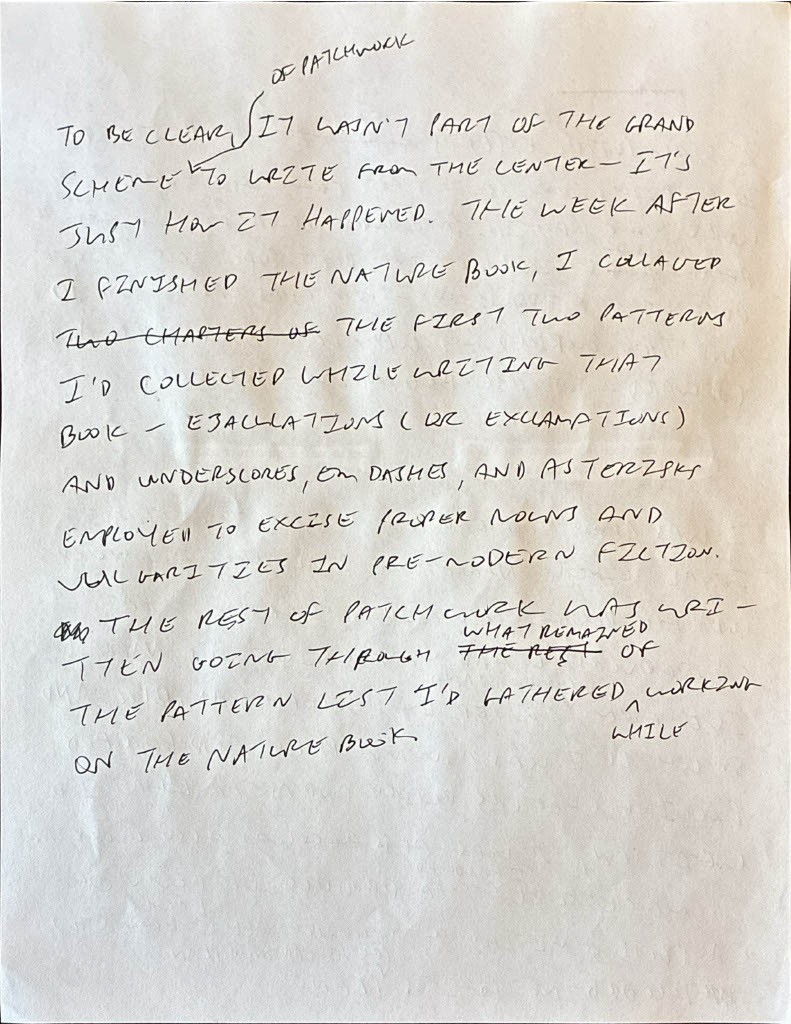
I was also contending with the traditional, linear narrative structure I imposed on the book: the Hero’s Journey, that controversial and yet ubiquitous narrative form documented and coined by Joseph Campbell. And so while I was moving back and forward piecing chapters before and after what I’d written, I was also also was also working to make sure I followed the progressive flow of Campbell’s method, mimicking all every each step according to its predetermined plan.
To be clear, it wasn’t part of the grand scheme of Patchwork to write from the center—it’s just how it happened. The week after I finished The Nature Book, I collaged two chapters of the first two patterns I’d collected while writing that book—ejaculations (or exclamations) and underscores, em dashes, and asterisks employed to excise proper nouns and vulgarities in pre-modern fiction. The rest of Patchwork was written going through the rest what remained of the pattern list I’d gathered while working on The Nature Book.
+
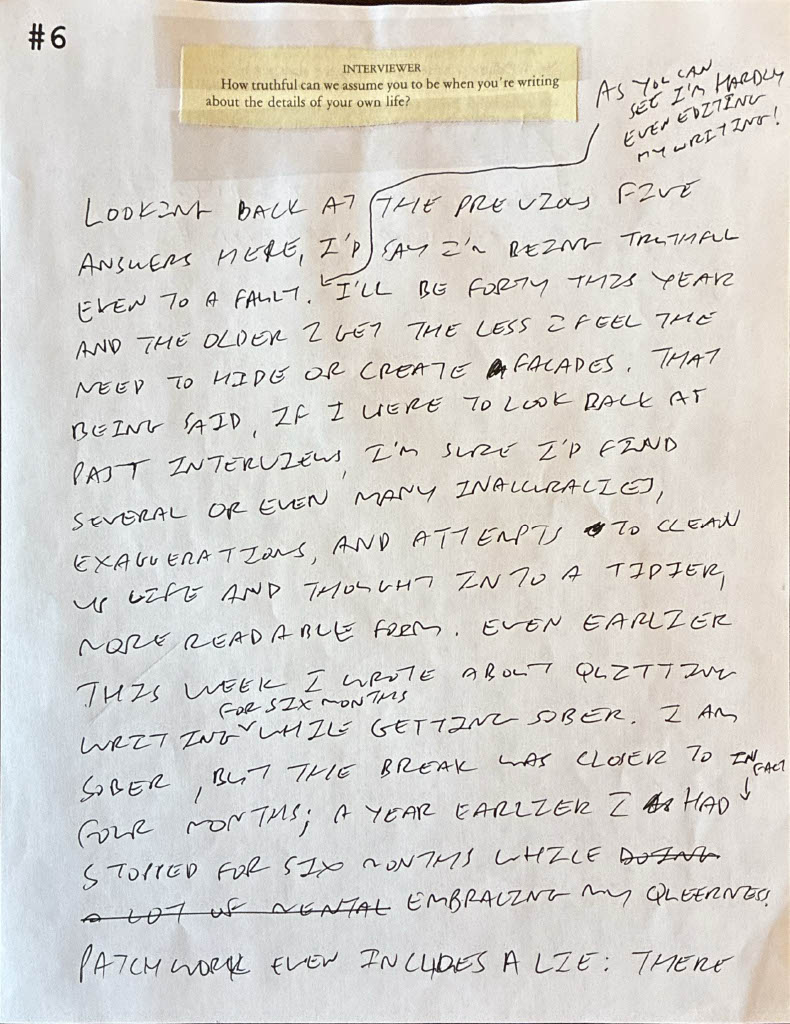
[Question] #6 – How truthful can we assume you to be when you’re writing about the details of your own life?
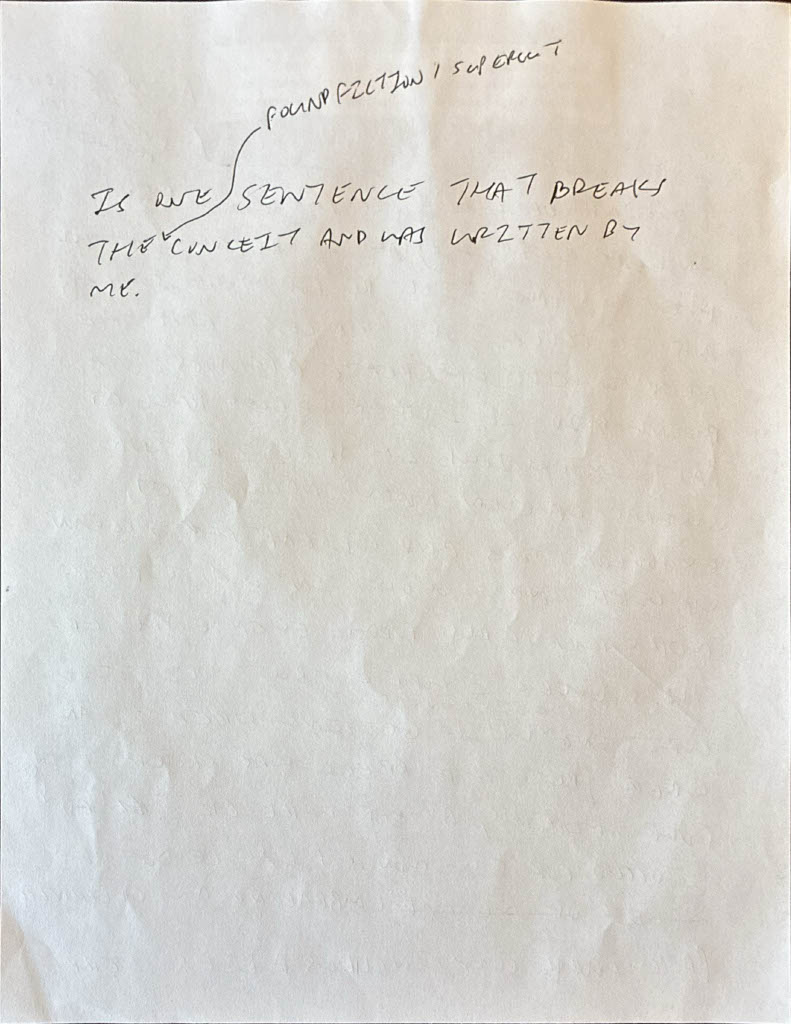
Looking back at the previous five answers here, I’d say I’m being truthful even to a fault. As you can see I’m hardly even editing my writing! I’ll be forty this year and the older I get the less I feel the need to hide or create facades. That being said, if I were to look back at past interviews, I’m sure I’d find several or even many inaccuracies, exaggerations, and attempts to clean up life and thought into a tidier, more readable form. Even earlier this week I wrote about quitting writing for six months while getting sober. I am sober, but the break was closer to four months; a year earlier I had in fact stopped for six months while doing a lot of mental embracing my queerness. Patchwork even includes a lie: there is one sentence that breaks the found fiction, supercut conceit and was written by me.
+
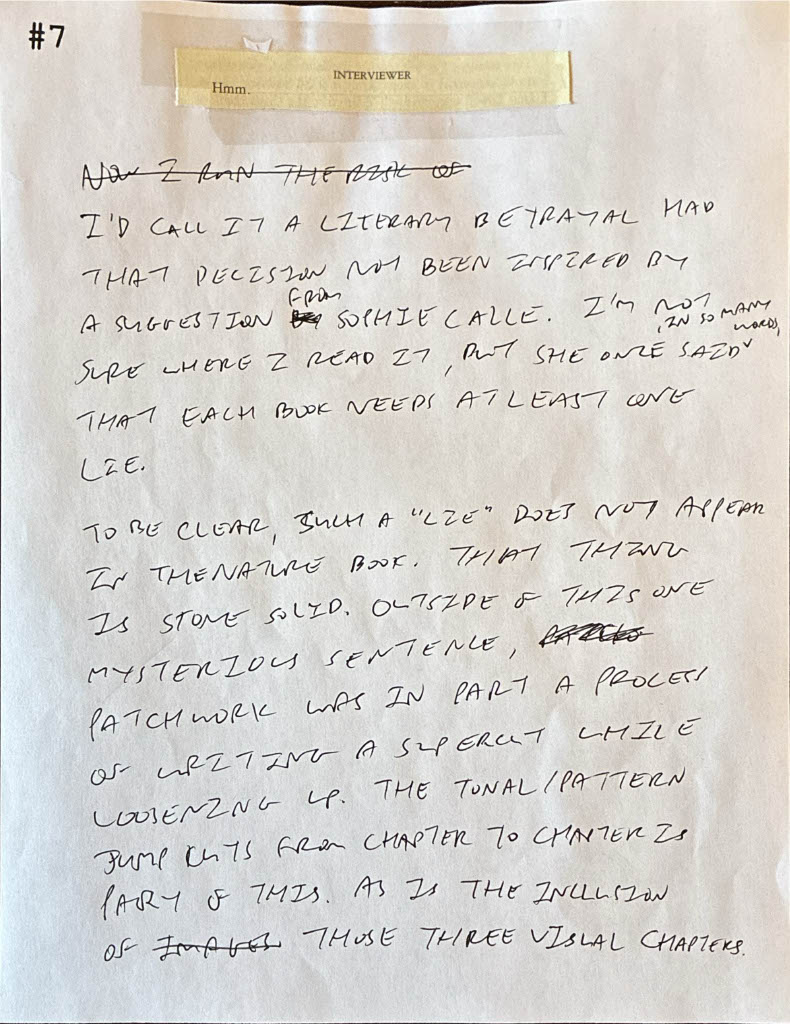
[Question] #7 – Hmm.
Now I run the risk of
I’d call it a literary betrayal had that decision not been inspired by a suggestion from Sophie Calle. I’m not sure where I read it, but she once said, in so many words, that each book needs at least one lie.
To be clear, such a “lie” does not appear in The Nature Book. That thing is stone solid. Outside of this one mysterious sentence, Patchwork was in part a process of writing a supercut while loosening up. The tonal/pattern jump cuts from chapter to chapter is part of this. As is the inclusion of images those three visual chapters.
+
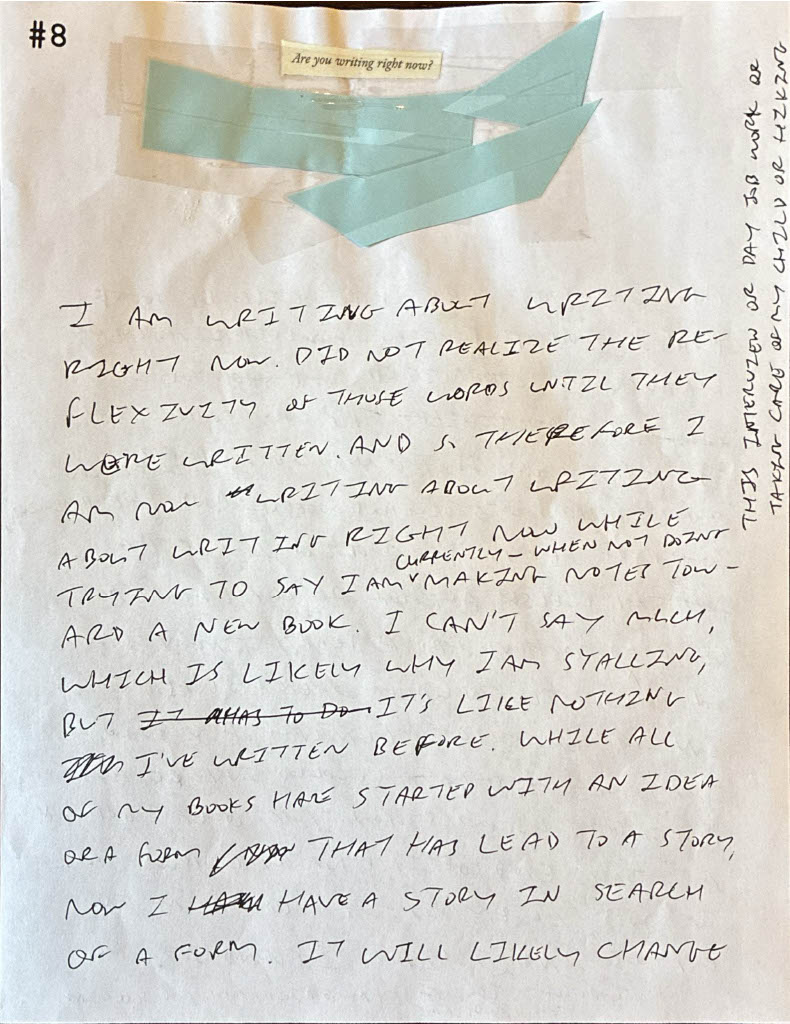
[Question] #8 – Are you writing right now?
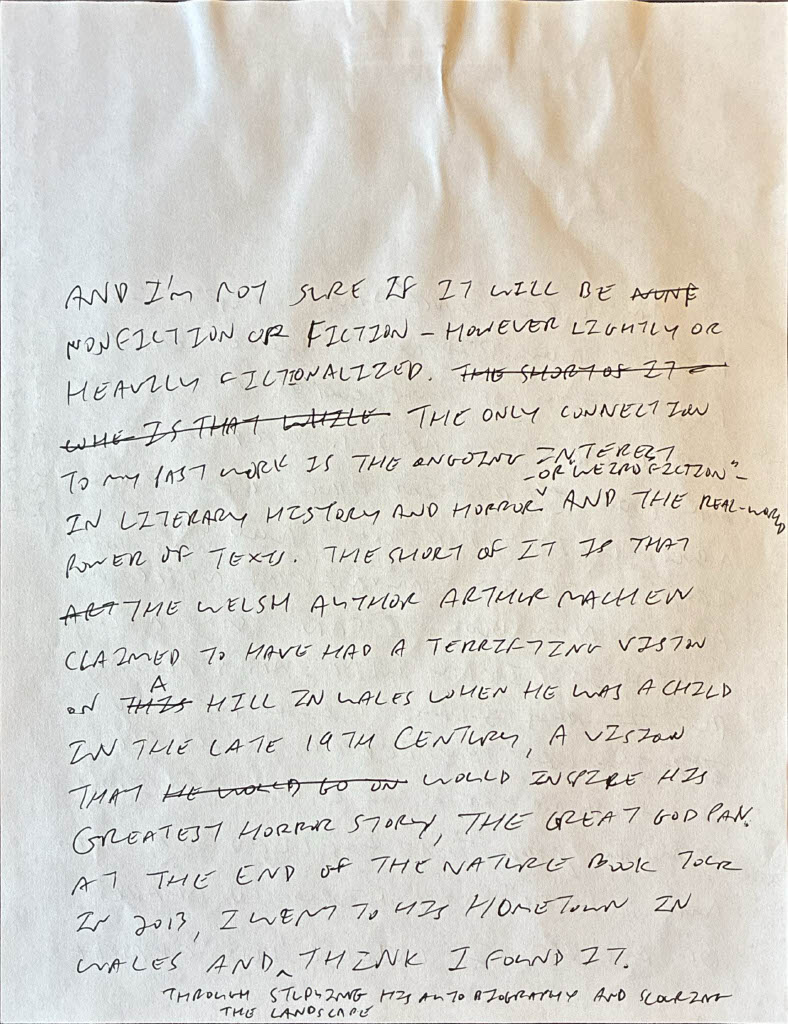
I am writing about writing right now. Did not realize the reflexivity of the words until they were written. And so therefore I am now writing about writing about writing right now while trying to say I am currently—when not doing this interview or day job or taking care of my child— making notes toward a new book. I can’t say much, which is likely why I am stalling, but it has to do it’s like nothing I’ve written before. While all of my books have started with an idea or a form that has lead to a story, now I have a story in search of a form. It will likely change, and I’m not sure if it will be nonf nonfiction or fiction—however lightly or heavily fictionalized. The short of it is that while The only connection to my past work is the ongoing interest in literary history and horror —or “weird fiction”— and the real-world power of texts. The short of it is that Art the Welsh author Arthur Machen claimed to have had a terrifying vision on this a hill in Wales when he was a child in the late 19th century, a vision that he would go on would inspire his greatest horror story, The Great God Pan. At the end of The Nature Book tour in 20213, I went to his hometown in Wales and through studying his autobiography and scouring the landscape think I found it.
+
[Question] #9 – That’s a little uncanny!
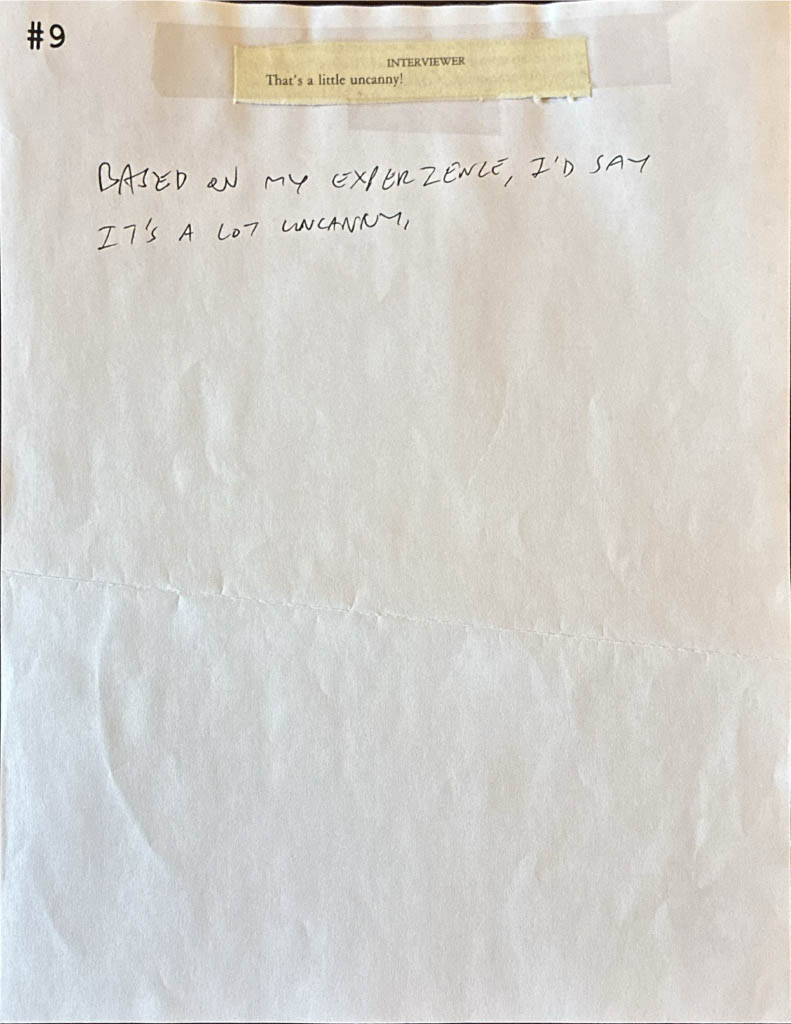
Based on my experience, I’d say it’s a lot uncanny.
+++
Tom Comitta is the author of The Nature Book (Coffee House Press) and People’s Choice Literature: The Most Wanted and Unwanted Novels (Columbia University Press). Their fiction and essays have appeared in WIRED, Literary Hub, Electric Literature, Los Angeles Review of Books, The Believer, and BOMB. Comitta works as a book designer and lives in Los Angeles with their partner, child, and pooch.
+
Eric Bies is the founding editor of Orange County Review of Books. His essays and reviews have appeared in World Literature Today, Asymptote, Open Letters Review, Rain Taxi, and Full Stop, among others.