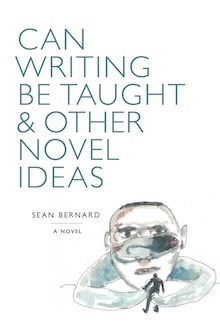
Sean Bernard’s Can Writing Be Taught & Other Novel Ideas (What Books Press, October 2026) is a metafictional reflection on reading, writing, loneliness, and the creation of meaning. It’s a strange ride through writing prompts that have words crossed out, summaries of other books, and an ever-shifting point-of-view. But despite the formal inventiveness, there’s a compelling narrative there, too—about a famous writer and the mystery she cultivates among her students.
Disclosure: A few years ago, Sean Bernard was the editor of my story collection. That made it extra fun talking with him about what it means to read when you’re also a writer, choose your own adventure stories, and the crafting of a narrative that is not quite pinned down.
+
Allison Wyss: Can we start with the structure of the book? Early on, it seems to be a writing student’s homework, so we get these unusual nonnarrative forms. Later, a more traditional storytelling style emerges.
Sean Bernard: So structure is fun. I wanted something that feels whole by the end, even though it is definitely not a straight line.
This was a book I worked on for a really long time. At one point it was well over six hundred pages of a “throw everything at the wall” manuscript. It had some bizarre structures. There was an iteration that was pretty bad—the structure was more imposed than the current one, which is more organic to the main themes.
AW: Is there anything from the bigger version you wish had stayed?
SB: No. I’m happy with this. As I was writing the whole thing, I understood I was going to have to make it make sense.
At one point it contained a 130-page choose your own adventure through literature. I wanted to preserve that because it was such a pain in the ass to write. So it’s on my website as a companion piece, but I didn’t want it to be a part of the book. It actually works better on the web than it did in book form because you click through or go backwards with the choices. But the book is much better by itself without those extraneous pieces.
AW: It just needed to wander and then come back?
SB: I remember talking to a student and describing my process for this. I said find something you’re having fun doing as a writer and run with it. Don’t worry about what it’s going to be.
But I finally whittled down all the other potential thematic things going on and made it this conversation between the two, an indirect conversation over time and space. So it was definitely not something that I started with or planned but I found it along the way.
AW: Can you explain what you mean by a conversation?
SB: I read it as the literary experience, not as the real-life experience, of a teacher and a student going back and forth. They also have a deeper relationship. They’ve been together romantically, lovingly, even as adversaries. I fundamentally read it as that indirect dialogue between the two. It’s not really a dialogue, more a series of one-sided exchanges.
AW: They’re not talking to each other directly.
SB: No. About each other. That’s how it means to me, especially with the forward and afterward and the way the student is replying to prompts, especially early on, and doing homework assignments and responding to readings. The final section pulls back the covers on their relationship, with one character looking with a bit more clarity than what’s been hinted at along the way.
AW: There’s a section that is summaries of other books.
SB: I wanted the frustration of a student reader kind of replying to this imposed assignment. So that’s the one thing. That fits the dynamic that’s going on.
But also it was fun. It’s part of the reading experience. The book is fundamentally about reading. And writing. Right? Two sides of the same coin.
Actually engaging with texts that people know gives a level of access and familiarity. But it’s also gamesy to not say what the books are. Most of them are pretty obvious. There’s one where I don’t even talk about the text of it.
And it’s letting the narrator of those sections get into a deeper personal trauma in a bleak way, the loss of somebody else.
AW: Did you worry about a reader who doesn’t know those other books?
SB: No, I didn’t worry. I hope it’s engaging on a line level, right? Those are intentionally very short sections. If a reader doesn’t like it, it’s over quick.
It also lets me celebrate books I really like and be critical of books I don’t like and to blur my own lines of liking and disliking, which is the reading experience, as it’s always changing. It’s self-indulgent, but I think it suits the story.
AW: Some feel a little snarky and some feel curious and some celebratory.
SB: I think the snark is part of the narrative point of view, actually. There’s one that is pretty dismissive of Outline by Rachel Cusk. And I absolutely adore that book. So that’s not Sean revealing his dislike of Rachel Cusk. I adore her trilogy, and the style she writes has as much an impact on the later sections of this book as anything else. It’s more suiting the story than my opinion.
AW: So, as a whole, what’s the book about?
SB: “About” is a tricky thing.
AW: It’s the worst!
SB: It’s about what it’s like to try to write something and what it’s like to read as a writer, which is a much more active reading experience. It’s also about what it’s like to live as a writer, say, in the last 25 years. It’s not a biography of that, but I think it kind of is.
Even in the last section where the narrator is talking about teaching. She’s talking about seeing herself depicted on the page. Talking about the writing process. I think it’s about reading, writing, and being a writer.
AW: I gasped at that moment when, for her, “I’m a writer” suddenly turns into “I’m being written about.” That moment feels really special.
But then we only get to circle it. We don’t get to see the book in which she is written about. And there are so many books that we circle, but we don’t get all the way to the book. And while we circle these books—both real and fictional, but especially fictional—there’s always this sense of “Wait, is this book I’m reading?”
SB: Some people will look at it and put it down. Hopefully, it lands with people. It’s very experiential.
AW: The different characters have a lot of anxiety about whether there is meaning in their writing.
There lurked for me the sense that writing was vain and empty, that all the words I’d ever write, maybe all the words ever written, would one day loosen and fall off their pages and float into nothing like dust.
Does the book have an answer to that worry?
SB: Um. I mean it’s there, right? I feel like the book itself is the assertion of writing and reading, even if there’s a lot of anxiety about it mattering. It’s there. I don’t even know if mattering matters.
AW: Here’s a passage that, to me, makes that case.
We’d almost begun to play—we’d gotten two sheets, and we had all wandered the house in search of evocative objects. But even as I gathered my objects I knew we were being at most half-serious, and it felt already that our game was more a humorous situation than real, and I wondered about the sincerity of gameplaying, if the way to best enjoy any game is to treat it meaningfully so that it has an edge of truth. A shade, as it were, of real pain. And then, as I always do, I wondered about life. And writing.
On the beach below, enormous rocks were turned on their edge. Immense rocks, whaledark, long and sidewise, their innards showing pressurized history. I followed a path down to the beach and stood beside one of the giant stones. I pressed my palm to its gritty surface, inhaling the almost fecal smell of it, the whole shore gathered in its grit, the rotted seaweed, the seagull-plucked crab carapaces. Grains of sand were lifted from the stone by a breeze, tumbling over my hand. A black bird hovered above the bluff’s edge, then dove down, out of sight.
Then the bird lifted again, hovering.
Then it dove again.
So we get the writer questioning the meaning of what she does and wondering if it matters. But then, as a different sort of answer, the book asserts itself by being beautiful, by saying, “Hey, here you go, it does matter, it does! Look at this beautiful object, these gorgeous words.”
SB: I like the way you said that. But yeah, I absolutely think so. Even at the very end, she’s feeling alone, unheard, unseen, isolated, alienated. But she’s like, “I can still write. I can still have a conversation with a pretend reader, and it’s not pretend because it’s on the page.” I feel like it is an assertion of value, of literature itself.
AW: That it exists and is beautiful.
SB: The anxiety that it doesn’t matter is normal and ordinary because it also doesn’t matter. It doesn’t matter. It matters if somebody reads it and get it and likes it, but you don’t know if this is going to happen. It’s not controllable.
AW: That connection of reader to writer when they get it, though—the book also seems to be about connection and maybe also about isolation.
SB: It’s funny. I was thinking about how many conversations with friends there are in the book. There’s a ton of loneliness and lonesomeness, particularly, but also a lot of nourishment found from friends, from others. I think that’s another aspect of the reading and writing experience. We all know this.
Reading is usually a very isolating, isolated, singular, specific experience. Yet it makes us feel connected to other people or to a larger whole, especially if there are other readers who have read the same book. What’s holding those things together is that kind of experience. In here it’s writing itself and reading itself.
I’m thinking of the sections where the narrator and his friend drive to San Diego to visit another friend. They were all part of this MFA cohort and they’re linked, literally, because they’re spending their day together, but they’re also linked together over time because they’re still remembering the assignments that they had from this old teacher. They don’t see her, they haven’t seen each other, but they’re still linked to each other.
The reading and writing experience is that kind of connection.
AW: We also learn that one of their assignments was to tell and act out a significant lie. My reading experience is to be on alert for that lie, so I don’t know what to trust. That slipperiness is fascinating.
SB: That might be me unintentionally putting my proclivities on the page, not wanting to be pinned down. Not even wanting the narrative to be pinned down. Slippery is a great word. There is so much motion. I want the two key characters to be fluid and shiftable, like protean.
So the narrator of the big long murder mystery novella in the middle is more or less the same narrator as the previous two sections and more or less the same person doing those book responses. But it’s not the exact same person. I hope the actual reader isn’t being like well, wait, this person is in a different relationship than they were before. Or this person wasn’t on a boat. But you kind of feel it’s the same character.
AW: I didn’t worry about if they’re the same person or not, because that didn’t feel like the point.
SB: It’s not like Pynchon. There’s no secret code.
AW: Some readers do that! They want to solve the puzzle.
SB: I put those readers in the book too!
AW: I felt like, well, it’s not just one person’s story here.
SB: To a certain point, when a character becomes overly ornate, a book becomes character driven and about the experience. I didn’t want it to be about a character or about a relationship. I wanted it to be about writing and reading and a kind of restlessness of those two things.
I do think that the teacher gets the first and the last word. For me, she’s the authority here. But the other person is the authority of all those other sections.
This goes back to the notion of their exchanging these indirect monologues—it’s like after years together, they’re now apart, far, far apart, like the only two people alive, stranded on two distant islands, and they each write these literary pieces—stories, essays, and all we see in the novel—and drop each one in a bottle, and send it bobbing on the sea. Some of the pieces make it to the other person stranded on their island, and they read it, and they write their own response. These are their calls and responses to each other. And since they’re writers who love writing, they call and respond through storytelling.
AW: My experience reading the book was also of a metafictional sort of distancing in the first portion. I was made very aware through the form and the playfulness that it was a constructed narrative. But later on, that falls away, and the story is much more traditionally immersive.
SB: I wanted the sections to be distinct but also logically connected or tonally or thematically connected. The stuff I took out was more jarring. Like forty pages in courier of government documents and testimony before congress. What’s left is more of a piece.
I wanted the longer novella, when the man with twins learns about his deceased professor and hears the reading of her will, to read quietly noir-ish, like a page turner, like normal literary fiction, with a little bit of attention at the center. Whereas the one where the structure is more strange and starts with the kid at the funeral—I don’t even know what it’s about, but I love it. It goes into the judge at the literary contest and the person who submitted is in the class and becomes the anonymous author that the students are obsessed with. I wanted that to be a heightened, weird, obsessive reader experience. I wanted that to be a different level of immersion than the more ordinary one.
AW: It’s following an idea, maybe, instead of following a person. You’re saying the characters couldn’t be too well-defined for that to work?
SB: In that one everything is a twist, a turn, a turn, a turn. It ends with a first-person narrator, suddenly, who has been telling the whole chapter and has been watching this other young woman. Then they’re both older and seeing this other program graduate. They’re lonely and drifting through this MFA town and haunted by books and by their writing experience.
That narrator’s voice and the story he tells doesn’t match up at all. It vaguely matches up with the “oh I wanted to be a writer when I was younger, but I couldn’t do it, so I became a high school teacher and met my wife.” Those two things don’t match in an expected way, but they match thematically. It’s still about a kind of yearning to be a writer even though it’s set aside.
But it is the same author or narrator—not me, but one of the two people in the relationship we learn more about in the final section. A struggling writer who is writing these things that we’re reading and trying to understand this hard relationship he’s been in.
It’s two relationships, really. One is with this this mentor and lover, but it’s also the earlier more defining relationship, the one whose toes she’s stepped on, which is his relationship with reading and writing itself.
I do feel like those middle five sections are authored by a character, who is not a character. But they are authored by the same person. Whereas the forward and afterward are authored by the other person.
She gets the intro. He gets to talk about writing, talk about her, throw her under the bus, complain about her assignments, kill her, make her obsessive and awful and terrible, but also she is still a genius. Then his story ends, and she comes back in and gets to clear the air. But none of that is a straight line. Those middle parts are one writer who is working out his frustration with this instructor he had.
AW: I can see that. It’s trippy. It’s wild.
SB: I just wanted a fun ride.
+++
Sean Bernard (https://anotherseanbernard.com/) directs the BA Creative Writing Program at the University of La Verne. His story collection Desert Sonorous was awarded the 2014 Juniper Prize, his novel Studies in the Hereafter was published in 2015 by Red Hen Press, and he’s the recipient of a prose fellowship from the National Endowment of the Arts. His second novel, Can Writing Be Taught & Other Novel Ideas, will be published by What Books in Fall 2026.
+
Allison Wyss (https://www.allisonwyss.com/) is the author of the short story collection, Splendid Anatomies (Veliz Books), which was a finalist for the Shirley Jackson Award. Her interviews have appeared in The Rumpus, Split Lip Magazine, Necessary Fiction, The Adroit, Heavy Feather Review, Rain Taxi, and the Brooklyn Rail. Her stories have appeared in Alaska Quarterly Review, Cincinnati Review, Wigleaf, and many other places.