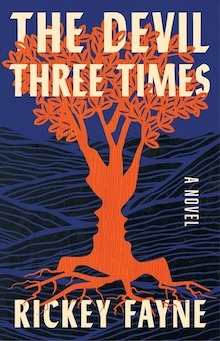
Rickey Fayne’s debut novel The Devil Three Times (Little, Brown and Company) is an ambitious and expansive tale. Spanning continents and incorporating the voices of eight generations of the Laurent family who all tell their own stories of love, struggle, and temptation, Fayne’s novel is a multigenerational transatlantic tale that takes place across centuries as well as earthly and heavenly realms. Fayne combines fable, folklore, history, humor, religion, scripture, and sermon in this masterpiece of storytelling, all while paying homage to African and African American storytelling traditions. In this novel, The Devil takes a protective interest in Yetunde, an enslaved woman, and their relationship impacts generations of her descendants through the twentieth century. Torn from her sister and abducted from her village during a Dahomey raid, Yetunde’s journey from the riverbanks of her African village to West Tennessee and from all that is familiar to all that is strange becomes the reader’s own. Her loss of home, family, safety, peace, and language compel her to forge her own power and use it in whatever ways she can to protect her new family. Her decisions are complicated and their ramifications are far reaching. Beginning both with the Devil exiled from heaven, and Yetunde severed from her family, The Devil Three Times explores the lengths to which one will go in the wake of soul splitting loss.
Fayne’s novel has been called Faustian, alluding to the trope of the devil meeting the desperate at the crossroads to bargain, but to simply call this novel Faustian reduces its scope and robs it of its artfulness. In most adaptations of the Faust tale, whether it be Marlowe, Goethe, or Mann, the devil is merely a supporting character whose bargain precipitates the protagonist’s downfall. In Fayne’s novel, The Devil takes center stage. If the novel is Faustian, then it is also Miltonic and Hurstonian. Just as John Milton brought the devil to life in Paradise Lost and made him such an attractive figure that too many readers agreed with him on where it was better to reign rather than serve, Fayne’s devil is equally eloquent, persuasive, and alive. Charming and witty, Fayne’s exiled angel made flesh walks freely, loves, and interacts, bringing new definitions to hell on earth. Lastly, the novel is Hurstonian through and through, with its love for Blackness, its celebration of folk, its calm acceptance of the natural and spiritual world at play, its ear for the rhythm and cadence of speech, and its love of the land from which culture is made.
+
AG: What’s the story of The Devil Three Times? When and where did the inspiration for this novel begin?
RF: I think the Devil got a raw deal. He questioned his father once and ended up damned for all eternity. Something about that never sat right with me and so in a lot of ways this book has been brewing since children’s church at Mt. Tipton C.M.E., but the actual writing of it began as a short story. The first story I ever tried to write was about a man living in Chicago who was haunted by his past in Tennessee. I spent years working on this story but no matter how much time I spent on it I just couldn’t make it live. Finally, a writer friend suggested that I try writing out the backstory for myself as a way to figure out how the story should end. I begin by trying to write about who he was before the events in the original story but as his time before Chicago began to fill out I became more and more interested in the people that shaped him. I thought it was writing that no one was ever going to see and so it came easier. I found myself writing further and further back into the past and it wasn’t long before I was more invested in the backstory than I was in whatever was happening with this man in the present. I’m not sure what exactly prompted me to try to write the short story the book grew out of but it’s pretty clear looking back that the final product owes a lot to my family, their lives, and the stories they told me. So the biggest inspiration for this novel is them. The characters don’t look much like anybody I knew growing up but a lot of what ended up going into the book was seeded by stories I heard and misheard growing up.
AG: Tell us a little about the research that went into its writing.
RF: Oddly enough, the research for this book started well before the writing of it. I’ve always had an interest in religion. I was very briefly a religious studies major in undergrad and then in grad school I did a lot of research for an unfinished dissertation on the politics of spirit possession in 20th century African American literature. So I had all these ideas about West African spiritual traditions and their influence on Black Christianity in the US that I wasn’t doing anything with and as I began to write they just started showing up. Sometimes I would look back at some of the books and notes I had from then but mostly I worked off what I remembered.
At some point, I purchased a book published in the ‘80s about the history of my hometown. Laurent, the fictional county in The Devil Three Times, is loosely based on Tipton County, where I grew up. I was so excited to find this book because I come from a really small town so I didn’t think anyone had ever bothered to write anything about it but the book was so passively racist that it was almost unreadable. I found myself writing against it more than anything else but there were some interesting tidbits (like how during the Civil War a band of Confederate deserters tricked all the white townspeople into taking up arms and meeting in the town square so no one would be home while they robbed their houses) that helped me get a feel for the town’s history.
AG: How has storytelling influenced your life? I don’t want to assume that you were raised in a house or culture of storytelling, but I would like to know from whence comes your love of storytelling. When you’re the listener, what do you believe makes for a good story? What do you listen for?
RF: My father was a storyteller in every sense of the word. He could make anything sound interesting. He would embellish now and then but the genius wasn’t in his embellishment, it was in knowing which details to emphasize. Having a sense for what would stick. Knowing just what the listener would picture. He also had a knack for voices and knew just what words to put into his characters’ mouths to make them feel real. Voice and detail are two lessons I learned from him and what I try to keep in mind as I write. You have to be able to see and hear a story otherwise it’s not real.
AG: What are the challenges of writing such a saga? How did you keep all your characters and generations straight while writing this novel?
RF: There’s a draft of The Devil Three Times where every single character mentioned has a chapter from their own perspective. There’s another draft that moves in reverse chronological order, and another that’s organized by “feel” where characters whose auras are similar colors are all grouped together regardless of when and where they lived. The biggest challenge for me was figuring out what order to put everything in and whose perspectives were worth keeping. At some point during the revision process, I took the one piece of advice that nearly everyone who was generous enough to read the book gave me and put everything in chronological order. But these other drafts taught me something valuable about the world of the book and how the characters fit together that nothing else would have.
AG: Why is West Tennessee the rich soil in which this novel is set?
RF: I could say that it’s because West Tennessee is what I know best and where my family has lived since at least 1870 but it’s also because there’s a rich history there that’s seldom talked about. The Chicksaw and Choctaw nations of what is now West Tennessee rebuffed white settlement of the region for decades after the Louisiana Purchase. When white settlers finally did make inroads, it was only with the help of Black interpreters who had been living among the Chickasaw for years that they were able to do so. Franklin, who appears early on in the book, is a nod to this history.
AG: This novel clearly has Zora Neale Hurston in mind, which is made clear when you pay tribute to her by referencing “using crooked sticks to hit straight licks” (246). Tell us what Zora Neale Hurston means to you and your novel.
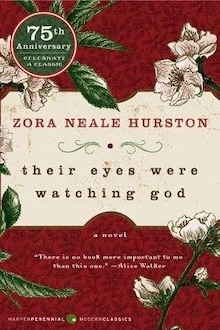
RF: Zora was the first writer to show me how poetry could be made of the way my parents and grandparents spoke, that their lives and beliefs and way of being in the world were worthy of study. I wasn’t one of those kids who always had their head in a book and it wasn’t until I read Their Eyes Were Watching God for a class my senior year of high school that I understood what fiction could mean and do. I don’t know who I would be or what I would think of where and who I came from if it had not been for Zora but I don’t think I would like that person very much.
AG: Any other literary heroes or godparents?
RF: Ralph Ellison, whose work I discovered around the same time as Zora Neale Hurston, Toni Morrison, for more reasons than I could possibly name, and Edward P. Jones. I also find myself rereading Faulkner and Flannery O’Connor but my feelings about them and their work are a little more complex.
AG: Your novel is deft at incorporating multiple and various forms. Did you encounter any resistance to finding it a home?
RF: Early on I got a lot of advice to shrink the scope of the book. I understood why people wanted me to do this and I could see how it would have worked (and maybe sold a bit better) but ultimately it wasn’t what I wanted to do. I wanted to tell a big story and I don’t think I would have been able to put my all into anything smaller.
AG: Any advice for the ambitious aspiring writer of fiction?
RF: Nothing to it but to do it.
+++
Rickey Fayne is a fiction writer from rural West Tennessee whose work has appeared in the New York Times, American Short Fiction, Guernica, The Sewanee Review, and The Kenyon Review, among other places. He has received support for his writing from Tin House, Community of Writers, Kimbilio, Sewanee, Bread Loaf, Yaddo, Willapa Bay, and MacDowell. The Devil Three Times was longlisted for the PEN/Hemingway Award for Debut Novel, shortlisted for The Center for Fiction 2025 First Novel Prize and the 2026 VCU Cabell First Novelist Award, and was a finalist for the PEN Open Book Award.
+
Amina Gautier is the author of the short story collections At-Risk, Now We Will Be Happy, The Loss of All Lost Things, and The Best That You Can Do. For her body of work she has received the PEN/MALAMUD Award for Excellence in the Short Story.