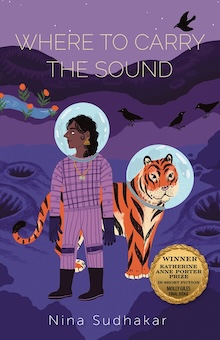
Nina Sudhakar’s debut short story collection Where to Carry the Sound, Winner of the Katherine Anne Porter Prize from University of North Texas Press, defies categorization. Making use of charts, lists, myths, and ranging from fables to folktales to oral histories to realism, the nine stories in Sudhakar’s collection depict women who find themselves in unexpected situations and unlikely places. Stories take place in India, in the United States, in Bandra, and in Queens, in villages and cities, in caves and speakeasies, in mythical forests and on the moon. Women are archaeologists, astronauts, bootleggers, perfumiers, photographers, and princesses—they make finds on digs, face landslides, hunt tigers, maintain lunar colonies, run speakeasies, and tend dead husbands. In these nine stories, women all find themselves in uncharted territory when their plans are altered by accident or whim and are called upon to make bold choices. An accident with a scooter keeps a photographer from completing her assignment, a woman writes her father after her mother’s death and receives an unexpected answer, a police officer raids a widow’s home to find an empty apartment. In “Come Tomorrow,” Diya returns to her grandmother’s village to take photographs for an NGO and is forced to interact with inhospitable locals who dislike strangers. In “Empires Have Been Destroyed” Ana and Mari, a widow and her daughter, brew and serve moonshine to make their living, depending upon the kindness and silence of neighbors and strangers. Stories offer a variety of civilizations and communities from the lunar colony in “Peak of the Eternal Light” to the cult community in “Bloom” whose villagers follow a larger-than-life leader and make an annual trek to witness a miracle. This collection explores the contours of absences, probes the boundaries of isolation, and calls attention to the fleeting nature of life. The women in these stories are loners, even when in partnership or in groups. In “Bloom” a group of women trapped in a landslide and left to their own ingenuity, cope with their fear by sharing stories, yet one girl still finds a way to maintain her own space in a dark, crowded cave. In “A Working Theory of Optical Illusions” a daughter learns her father’s identity upon her mother’s death. Rather than resenting the secrets her mother has kept, she rationalizes:
Having been raised in a communal culture, my mother knew there was no more valuable currency than a secret kept to and for yourself, away from the prying eyes and ears of acquaintances and relatives. I learned early on that details were to be carefully curated and life lived on a need-to-know basis. Sharing started with the self and emanated outward in concentric circles, to each other, to extended family, to friends, to strangers, and so on, in decreasing order of transparency. (60)
The impermanence that characterizes all nine stories is captured in “Peak of Eternal Light” where an astronaut has been sent to maintain a lunar colony, but colonization keeps getting delayed. With no family connections she is ideal for the job, but also lonely. As she eagerly awaits the arrival of another astronaut, her musing on her childhood friendships captures the fleeting nature of life: “In childhood you can have a best friend for an hour, for a day, for a month, and then you never see them again” (94). Though parents and children, grandparents and grandchildren, colleagues, and spouses routinely unite or reunite in this collection, Sudhakar’s protagonists live in their own private loneliness, using rituals, routines, and secrets to carve out isolated spaces for themselves. Secrets and silences permeate the collection as women excavate, explore, and preserve.
+
NF: What inspired the writing of this collection?
NS: The stories in this collection were written over the past decade or so. When I started, I had no idea I was writing a book. Since childhood, I’ve always loved hearing and telling stories, and that impulse never left me. In fact, it became strongest after I spent a different decade on another career path which, though I enjoyed many aspects of it, left me feeling I was neglecting a fundamental part of myself. After that hard-won epiphany, I reoriented myself toward writing and gave myself space to nurture the preoccupations that had been swirling in my brain for some time. That making of space birthed the stories in this collection. Writing, for me, is a way of working through my own experiences, particularly as a daughter of immigrants linked to many places at once. It feels paradoxically like I can be more honest approaching these issues at a slant, through the veil of fiction. In a more immediate sense, over the decade or so it took to put together this book, I lost all four of my grandparents and had two children. So that sense of lineage, of past and future, of what’s carried (or not) from generation to generation, was overwhelmingly salient. There’s something almost mystical in the way a story takes root for me: usually, there’s some seed (an image, a phrase, a news story) that takes stubborn root in my mind. I’m also a poet, and so much of that work just entails noticing, trying to stay attuned to the frequencies of the world around me. I feel like a magpie sometimes, a collector of scraps and bits of material that will get woven into something else. Sometimes, the notes I find later are almost comically nonsensical, and I think, “why did I write this down, why did I think this thought was worth saving?” But that’s part of the work, too. Parsing through why something speaks to me. Because if it does to me, there might be some emotional truth it evokes that could speak to others, too. I find that if I give those seeds time and space to grow, the story that takes shape usually ends up addressing the questions that are on my mind at the time. Like: how does someone who feels unrooted find belonging? How do we forge our own paths despite cultural pressures? How do we decide what to discard and what to keep from our own familial and cultural inheritances? All of this is another way of saying, I think it’s true of many writers—including me— that often, we are writing about the same themes over and over, coming at the subject in a different way each time. For me, the kernels that catch my eye are entry points that allow me into a way of trying to tell and retell a story to reach every facet of that experience.
NF: Did you originally compose Where to Carry the Sound as a collection? If so, what inspired your arrangement of the stories? If not, what did you consider when pulling together individual stories to form the collection?
NS: As mentioned above, I definitely did not compose this book as a collection. I simply wrote individual stories as they demanded to be written. About five years ago, after I’d amassed a number of them, I began to look more closely at the stories in connection to one another. I realized so many were circling around the same themes of memory, inheritance, and belonging. That’s when I felt they might potentially work together as a collection. The composition of the collection changed many times after that point, though. I swapped stories in and out and wrote new ones I ended up including. I was really going for a sense of balance in the composition, thinking about the overall emotional journey I was taking a reader on. I knew I wanted to start with a sense of intrigue and mystery so that a reader would not be surprised by the emergence of more surreal and speculative elements that are also a part of this collection. And I knew that I wanted to end on a note of hope, so that even as the collection takes the reader to darker and more despairing places, that would not be where the book ends. In between those bookends, I worked to create variation based on things like different stories’ POVs and whether the stories were formally experimental or not. I thought of the process in the way I imagine a musician might think about putting together an album. Of course, each piece needs to stand alone because folks might dip in and out, listening/reading to some and not others. But attention also needs to be paid to the whole, to emotional highs and lows. Some pieces are singles, getting airplay elsewhere (like the previously published stories in a collection), so maybe those go earlier in the sequence. Some will be deeper cuts (like previously unpublished, rawer work), so maybe those go later in the collection, after you’ve already earned a reader’s trust. Separately, I also wrote the first and last lines of every story on index cards and used that to help me arrange them, physically shuffling them around. I wanted to think specifically about the notes I was beginning and ending each story on and how a reader might experience that progression.
NF: Your collection blends fabulist, realist, and speculative elements. “Bloom” features a character recounting a fairy tale (which the narrator overhears), while “Pillow Book of the Dead Prince’s Intended” is a fairy tale. What inspired you to create a fairy tale and what are the challenges of writing one?
NS: Growing up, I was always the kid reading in the corner, and I was probably reading fairy tales or myths or science fiction or fantasy. There’s definitely something in there about feeling like an outsider and reading myself an escape route to somewhere I could experience magic or power. It’s also true that I didn’t fully see myself in a lot of the works I read at that time.
Simultaneously, I also grew up with my maternal grandmother as one of the primary storytellers in my life. When we’d visit her and spend summers in India I remember always asking her to tell me stories, and she knew so many of them, an incredible number of myths and folktales and also stories about our own family. I used to also devour these Indian comic books that retold legends and folk tales. And while I did see people who looked like me in some of those stories, many had religious underpinnings or were infused with cultural expectations that felt distant from my own experience. So I suppose the simple, selfish answer is that I was interested in writing in the register of myth, in blending surreal, speculative, and folklore/oral tradition elements into my work, because I wanted to write the stories I wish I’d had growing up. I wanted stories I could have seen myself in, where answers weren’t handed to me, secular myths and grey area fairy tales and unspoken morals you divine for yourself. And I wanted to pay homage to my own experience, laced with legend and superstition, because the stories I was told, however fantastical, felt as real to me as any others, and what others might deem magic was simply a part of the fabric of my life. In terms of challenges, one element of writing these fairy tales mirrors, I suppose, a tension in my own life between coming from a collectivist culture but growing up in an individualist one. Fairy tales and folklore are, at their core, collective forms of storytelling: they often derive from oral tradition, passed down and across over and over, and they often express some value or belief shared by the group that created and retells them. And though the tales can often feel static, they of course change with every retelling; they’re as prone to revision as our own memories, and they of course are shaped by the person telling them. So what I was concerned about in my own tellings were the endings. I wanted to push back against a feeling of finality, of resolution, of “happily ever after.” I haven’t experienced things ever winding up so neatly. So I wanted my characters to feel a sense of resolve instead of resolution. I wanted them to find some personal reserve of strength, of decision-making power that would carry them on past our view of what their endings should look like.
NF: “Peak of Eternal Light” looks past the present moment to imagine an ecologically and environmentally bleak global future. What are the challenges or joys of writing beyond the moment in which we live? How hard is it for a writer to look into the future?
NS: If I’m being honest, I certainly don’t find it easy to look into the future in an emotional sense. This is because I find it hard to live in the present, which I know is connected to all the ills of the past, which I know is also connected to the ills of the future. It is easy to feel powerless in the face of violent, entrenched systemic forces and to become mired in despair and grief.
That said, I find writing about the future a necessary exercise. Thinking — or dreaming — about the future is a necessary exercise for all of us. We need to imagine what the world might look like in the future, for better or worse, because that’s how we figure out the things we need to change now. And there are many, many futures. That’s where I find joy: in envisioning possible futures. I also need to find joy in my imagining because I’m raising children who will live in that future with all the other beings currently growing up on this earth. I want a better world for all of us, even if it doesn’t arrive soon enough for me to live in it. Part of imagining the future is trying to draw a straight line from destructive policies of the present to their natural conclusion in the future. And that part is not hard in a predictive sense; there are many brilliant researchers and advocates out there right now sounding alarms about global issues we must address before certain outcomes occur in the future. “The Peak of Eternal Light” was inspired in part by the fact that that are currently days on which smog and pollution reach such unprecedented levels in Indian cities that it is dangerous to be outside. The hard part is building that future world and inhabiting it. I’ve always admired science fiction and loved reading it for this aspect: that it takes you to a world ostensibly far from our own only to show you something critical and fundamental about the one we currently live in. The future feels far away, like a later problem, and that makes it dismissible for those focused on the power and money they can amass in the present. But I think it’s deeply important to make the future feel real, so that we can figure out even one tiny action we can take in the present to pull us a millimeter closer to an alternative future we’d rather inhabit.
NF: Whereas “Peak of the Eternal Light” is set in an imagined future, “Empires Have Been Destroyed” takes place after 1949 but before 1960, during Prohibition post-independence India, a period which precedes your own lifetime. Talk a little about the historical research that guides this story.
NS: Since this historical period did indeed precede my own (and grandparents who lived through it were no longer around to ask about it), I focused my historical research on trying to imagine, as much as possible, what it might have felt like to live during that period. I read articles and sections of books about that Prohibition period and spent a lot of time looking at old photographs depicting the period. At the same time, I fully recognized that as someone who didn’t live through that period, I would be limited in my ability to fully capture what it was actually like. I tried to keep the story intimate and personal, more like a character study of a mother and daughter with the historical period as context. That’s also why I chose to write this story in the way that I did, as an imagined oral history, a story that might be passed from person to person, like an urban legend. I knew I was imagining this period from a distance, so I wanted to incorporate that level of distance into the story itself. In that way, any inaccuracies would be part of the form, just as stories change when passed on, akin to a game of Telephone. I was attempting to capture a feeling, an emotional truth, rather than trying to present a record of historical facts.
NF: Why are secrets and ghosts and ghosts of secrets so important to the women in these stories?
NS: In my experience, coming from a collectivist culture meant that people are very often in your business, ready to comment on your choices—and even if they’re not, you may still feel compelled to perform or conform to certain collective expectations, and often those expectations fall particularly heavily on women’s shoulders. In that context, holding anything back for yourself feels like a tremendous source of power. Because you’re holding those things close to protect them, so they won’t be subjected to others’ eyes. In that way, a secret can be empowering, a way of keeping safe a true and vulnerable part of yourself. Separately, secrets can also be a form of currency, a form of power that’s held over you. If there are certain things that can’t be talked about in your family, subjects that are avoided, issues that can’t be addressed directly, this can feel disempowering. It can feel like someone is taking away your ability to make sense of an experience, or imposing their own narrative onto it rather than letting you make your own. And sometimes the secrets can linger, their ghosts hanging on from generation to generation. The secret becomes an inheritance, a thing you carry around. I think that’s why secrets feature so prominently in these stories—I was interested in exploring both of these aspects, the empowering and disempowering aspects, and very literally taking control of the narrative by writing the story.
NF: What did writing this collection teach you about yourself as a writer?
NS: One thing writing this collection taught me is that there’s a direct link between the type of fiction I love reading and the type of fiction I love writing. Perhaps that’s an obvious revelation, but for whatever reason it stayed with me after it became clear. I love reading works that experiment with form, that incorporate surreal and speculative elements, that also have a sense of play about them. And surprise, all of those aspects ended up in this collection. I had (have!) a bit of imposter syndrome in which I was afraid of even trying to put myself in the company of works I loved. But what kept bringing me back to the page, what felt fun, was the trying. Each story felt like a puzzle I was solving where I wanted to achieve some harmony between the story I wanted to tell and how I wanted to tell it. It felt liberating leaning into weirdness after many formative years (and years after that) spent trying to force myself to fit into different boxes. One of the last stories I added to this collection was “Marigolds,” which incorporates “choose your own adventure”-style elements. As I was writing it, I was literally asking myself, “can I do this?” but the joy I get as a writer comes from pushing past that fear and seeing what’s beyond it.
NF: Any advice for writers working on their first book?
NS: Write the book you want to read, the one you wish existed. Certainly one might have commercial concerns to consider… but I’d save that for later. For the first draft, at least, let yourself feel joy and follow your preoccupations, the rabbit holes you fall down, and let those all find their way into the work. I think if you love what you’re writing and are excited by it, ultimately that comes across to a reader. I also think that’s what makes work beautifully human: a book (or any piece of art) is a record, an archive of the things that specifically consumed their individual maker. In a world that’s becoming increasingly filled with AI slop, that characteristic feels essential. On a more practical level, I think writing toward what preoccupies you also makes it easier to finish writing a book, which is its own challenge—something has to bring you back to the page, again and again.
+++
Nina Sudhakar is a writer, poet, and lawyer based in Chicago. She is the author of Where to Carry the Sound (winner of the 2024 Katherine Anne Porter Prize in Short Fiction and a 2024 Foreword INDIES Award) and two poetry chapbooks, Matriarchetypes and Embodiments. She serves as Dispatches Editor & Book Reviews Editor for The Common and as a Board Member of the Chicago Poetry Center. For more, please see www.ninasudhakar.com.
+
Amina Gautier is the author of the four short story collections At-Risk, Now We Will Be Happy, The Loss of All Lost Things, and The Best That You Can Do. For her body of work, she has received The Chicago Public Library Foundation’s 21st Century Award, the PEN/MALAMUD Award for Excellence in the Short Story, and the Blackwell Prize.