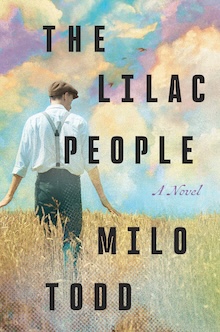
Milo Todd‘s novel, The Lilac People (Counterpoint Press), a national best-seller, was named a Stonewall Honor Book and an American Library Association Notable Book. The Lilac People is the story of a trans man and his girlfriend who are ripped from their best lives by the ascent of Hitler, the Holocaust, and the subsequent liberation by the Allies that turned into just another persecution for queer and trans folks. It’s a feat of both research and imagination.
Milo and I talked about that research, as well as fascism, dumplings, and the function of white space in a manuscript.
+
Aiden Grace Smith: Hi, Milo! I’m so glad we get to chat about all things writing.
Milo Todd: Me, too! Thank you for the invite to do so.
A: Notably, Shelf Awareness wrote that you “made an enormous contribution to historical fiction.” The thing that struck me most about this book is how astonishingly well-researched it is. What was that process like?
M: Thank you! Yeah, the research process was rough. Not only was the subject matter heavy—and believe it or not, I pulled back considerably in the book—but finding it was also often a slog. As you can imagine, much of the primary sources were destroyed, whether intentionally to erase oppressive wrongdoing or accidentally through the passage of time and a lack of mindful archiving. On top of that, little of what survives today has been translated into English. When I started hitting walls with English-translated sources, I realized I needed to learn German. That wasn’t in the original plan—I was so naïve; I laugh about it now—but I’d gotten so far into my research that I needed to see it through. So I learned German. I’m still not fluent and I haven’t practiced it for several months now, but I studied the language for three years or so.
A: First of all, I’m incredibly impressed. If I had to learn another language to write a novel I….simply would not lol. But obviously I’m glad you did! Yeah, though: I’m not surprised to hear you say you pulled back on some aspects of the darkness in the novel. One of the striking things about The Lilac People is that it is hopeful. Was that a hard decision to make?
M: I struggled with that decision for a while—the pulling back, not the hopefulness. I wanted to portray things in all their severity because I wanted to honor what people went through at the time. To me, the only thing worse than suffering in unimaginable ways was nobody knowing you’d suffered in unimaginable ways. But I also knew that this stuff was so intense that plenty of peoples’ brains would understandably shut down when exposed to it. It’s called “unimaginable” for a reason, you know? So I knew pulling back—and it turned out, pulling back considerably—was the only way to go. I was disappointed in myself with this decision for a while, though, because, I don’t know—people actually went through those things, but we can’t even hear about them? It just didn’t sit right with me. But I also eventually made my peace with the fact that if I couldn’t get readers to pick up the book or they otherwise would shut down halfway through, what good would that do to help uncover and preserve the memory of these people? I told myself that even if most folks wouldn’t know the worst of what I’d learned, at least they would know the gist. And that was still something.
A: What was your favorite part of writing The Lilac People?
M: The fun scenes in the Weimar sections, especially the Eldorado scene early in the book and the New Year’s party scene later on. The whole “queer joy” thing was just fun to put on the page, especially knowing how accurate it all was. There really is queer joy to be found throughout our histories and cultures. It’s just harder to find since those realities were a huge threat to oppressive persons and were consequently erased or never catalogued. But when I find one, it’s precious to me.
A: Yes! Before the Nazis, Berlin during the Weimar Republic famously had queer magazines and journals, the Institute for Sexual Science, and 100 or more queer and trans clubs and bars. If you were living in Berlin at that time, what do you think you’d have been up to?
M: I love this question! I’ve never been asked this before.
But I would’ve definitely just stayed home. I’m not a clubber or a partier, and too many people can tire me. I’m an indoor queer. I feel based on who I am in our modern age, I would’ve likely been someone helping produce said magazines or plan said parties and events. I’d be running things behind the scenes, but you’d rarely see much of me.
Then again, we all would be different in different contexts and times. Who knows? Maybe I would’ve been running around like Gert.
And now I have to ask: What do you think you would’ve been up to?
A: Oh, Milo! You know where I would have been! I would have been at the Eldorado, dancing and looking dapper… and other verbs and adjectives. But I would also have been submitting my little stories to your magazine!
M: That sounds exactly like what you’d do! And my magazine would’ve definitely published your stories.
A: I don’t even want to ask this next question, but I think so many people are thinking about what came next then, and what might come next now. You and I are both trans, and we can’t ignore the fact that these are terrifying times for all kinds of folks: immigrants, Black people and people of color, religious minorities, disabled folks, anyone who depends on government services, and LGBTQ+ folks. Among the first things to happen after the inauguration was the signing of executive orders that the then-chair of the Equal Employment Opportunity Commission described as a plan to “erase the existence of trans people.” What parallels do you see, and not see, between the time period in which The Lilac People takes place and now?
M: I could go on about this for hours (and, in fact, have), but I’ll try to put it simply: Many of the sentiments of the current United States government regarding marginalized identities are similar or otherwise parallel to those of Nazi Germany. The manner in which they carry such sentiments out, however, are often different. This is an important distinction to note and is largely due to the fact that our two countries/time periods aren’t the same on a foundational level.
For example, both entities want(ed) to eradicate trans people. But while Nazi Germany was pulling their own citizens out of their beds to either murder them or put them in concentration camps simply for being trans, the current US government hasn’t done that. Because they can’t. On a foundational level. So instead, they’re trying to eradicate trans people by restricting as much of their visibility (e.g. book and drag show bans), physical health (e.g. healthcare access and violent smear campaigns), and mobility (e.g. passports and public bathrooms) as they can. It’s the difference between “this person doesn’t exist anymore” and “this person doesn’t ‘exist’ anymore,” but the person in both scenarios is still no longer existing in the broad sense of the word.
I’m speaking about all this in a general manner, of course, but for anyone reading out there, I currently have a free, online course called “Modern United States vs Nazi Germany: A Comparison Guide for Wellbeing,” which does a deep dive into all sorts of comparisons. I recorded it in June of 2025. Admittedly plenty has happened since then, but so far my predictions are panning out. (Not that I’m so great. It’s just based on years of research.)
Oh, and a fun fact back to what I said earlier about the modern US and Nazi Germany holding a lot of the same sentiments: Hitler got a lot of his inspiration by studying how the US historically treated its marginalized people, such as the Trail of Tears and Jim Crow. With a healthy sense of US history in mind, it isn’t surprising the US is in such an oppressive calamity right now. It’s here because it never left. It’s just that now white people, cis people, rich people, etc., are finally feeling the effects themselves. To them, it’s a horrifying new chapter in America. To the rest of us, it’s Tuesday.
A: It shouldn’t be a surprise to folks that Hitler and the Nazi party took inspiration, tactics, and ideas from the US. I will say that currently, people are being pulled out of cars and illegally detained because of how they look. And while this is, in fact, not unprecedented in the history of the US, it is the most frightened I’ve been for myself, my neighbors, and my students in my lifetime.
How are you doing, given *waves hand around*? What makes you hopeful? What makes you happy?
M: It’s definitely frightening right now, that’s for sure. But I firmly believe that all this is happening because we’re at the tail end of an extinction burst. I break all that down in the course I mentioned. The burst is getting wilder and wilder faster and faster as we get closer to its end. Imagine a cat thrashing around when it believes it’s in mortal danger. As scary and overwhelming as all this violence and whiplash is, I remind myself that it’s actually a good sign. If the cat didn’t feel so threatened, it wouldn’t be acting like this. All this chaos doesn’t mean the cat is winning. It means it’s losing. And it knows it.And once this burst is finally over—meaning that those in power have finally lost their grip and more and more people start waking up—we’ll have the opportunity to take a breath, start repairing some of the damage, and (hopefully) work together to finally eradicate some of the historical problems that have since bubbled up to the surface during this burst. We’ve got a lot of work and repair ahead of us, no doubt, but in the meantime, we’ve all got to do what we can to get as many of us to that point as possible.
But to your actual question, haha, plenty of things help me keep my head in my everyday life. One thing is I do what I can to help other folks out so we can all weather this. Another is meeting so many supportive readers, which has been much appreciated since the book came out. I otherwise just like being a homebody; reading, writing, playing video games, doing jigsaw puzzles, that sort of thing.
A: Yes! All of that is so important. We can protest, and help our neighbors, engage in direct action, and resist, but we need to maintain joy. Reading, writing, dancing, games, food, friends. You don’t stay home all the time, either; I hope this isn’t a breach of your privacy, but I happen to know you are very good at folding dumplings for a dumpling party.
M: That was my first time, too! It was fun.
A: I know that the idea of joy as resistance isn’t new to anyone, but I wanted to talk about it because I want the writing community, which sometimes has a tendency to be exclusionary, scarcity-minded, or snarky, to think explicitly about ways we can support each other, create community, and build each other up.
I might have been the messy trans drinking martinis and taking home randos from the Eldorado had I been alive in Weimar Germany, but I still would have been an earnest queer.
M: Absolutely. The writing community has its shenanigans, and sometimes they seem to lash out or be catty simply because they want to knock someone else down a peg. This is bad enough in general, but it feels particularly cruel when writers of a given marginalized community are going after others in that same community. Whenever someone has done that to me, I remind myself that it’s likely coming from a place of insecurity ultimately not related to me. Still stings, though. Like, what’d I do? I’m just over here minding my own business eating Froot Loops.
To any writers out there reading this, especially from marginalized communities: support each other. Lift each other up. When one of our books gets published, it’s a win for all of us. When one of our books sells well or wins an award or whatever, it’s a win for all of us. Publishers will want to pick up more books like it; more mainstream readers will become better acquainted with our lives and stories. We become human.
If you liked a book, tell people about it. Reach out to the author and let them know you enjoyed it. If you didn’t like a book, just don’t say anything about it and move along. Avoid the “hot take” teardown trend. If you “lose” an award against another author, congratulate them. If you “win” an award against other authors, give them a shoutout. Be someone’s in-convo partner for their own book launch. Get at least a couple chapters into the books of other people on your panel so you can tell them, “I only started it recently, but I love how you XYZ.” There’s so many things we can do.
Be a good literary citizen. Be a good person. We could all use more of that in our lives.
A: This isn’t the first novel you’ve written. What was different about writing this one? Do you always spend this much time on research?
M: The Lilac People was definitely the hardest novel I’ve ever written, mostly for the reasons I mentioned earlier. It was never intended to be my debut, and I swore after finishing it that I’d never take on a project this ambitious ever again. I didn’t know what I was getting into back when I’d started; and if I’d known, I probably wouldn’t have taken it on. Researching nearly nonexistent information in a language I didn’t know? Yeah okay.
That said, I always go full tilt with my research for any of my works, which are primarily trans and/or queer historical fiction. I just normally go for topics that are a bit more accessible. It’s awesome that so many people have since started researching and discussing queer and trans history of the Weimar Republic and WWII, but ten years ago when I’d started researching, that wasn’t the case.
I also felt more pressure with this novel. I needed to get it right. Of course, I do my best to make sure all of my works are historically accurate, but if I got The Lilac People wrong, it felt particularly egregious to me. I didn’t want to dishonor their memory, the real people who experienced these things, but have since been rendered faceless, nameless, and forgotten.
A: What is one question you wish people would ask you about The Lilac People or your life as a writer?
M: This is a classic marginalized writer problem, but I wish more folks would ask me about craft. Most of what I get are questions about identity, marginalization, and other related matters. My unscientific guesstimate of questions received over the past year is: 50% identity/politics, 40% research, and 10% craft.
For the record, I don’t mind people asking me such questions, especially in our current political climate. I’m happy to answer them. Truly. But I grappled with the craft component just as much as I did the research and identity components, so it’d be cool to talk about it more often. (Or maybe I’m a decent researcher, but a poor writer, and everyone’s just trying to be polite?)
A: It’s definitely that, Milo. I am known for my politeness. Lol.
Which craft element did you struggle with? Or feel really good about?
M: I deliberately play with white space in two places in the book in opposing ways, meant to juxtapose one another. Also, I have a deliberate lack of contractions within the narration, meant to mimic German speech patterns. These were some craft components I meticulously put together and was, admittedly, quite proud of. But I don’t believe anybody has ever noticed them. Or, at least, nobody has ever asked me about them. (Or again, maybe I did a bad job. Who knows!)
A: That is fascinating. I think the lack of contractions is something that readers probably experience subconsciously because you did a good job with that. I mean, I didn’t necessarily notice it, but I’m sure it affected the feel of the narrative. I think it’s really cool that you did that! I’m so interested in how the language in which we think creates the meanings we make. Like, in some languages there are not gendered pronouns, which, wow. I also had a trans student say to me that he would probably identify as nonbinary except that he thinks in Spanish, and he basically said “everything in Spanish is gendered; the table is gendered. I can’t imagine not using gendered pronouns for myself.”
M: Oh that’s fascinating! Yeah, gender and other components across languages is a whole journey. And thanks for the compliment about the contractions! Let’s go with that theory, hahaha.
A: Tell me more about the white space.
M: You asked for it! So the two places I play with it is the chapter I call “Karl’s monologue” (if you know, you know) and the burst of short radio broadcasts right after Hitler is appointed chancellor. I know you know this already, but for anyone out there who’s unfamiliar, white space is paragraph breaks, scene breaks, chapter breaks, etc. That tiny square of blank page where you’ve indented a new paragraph? That’s white space. The huge swatch of blank page at the end of a chapter? Also white space.
Basically, white space lets a reader’s brain breathe a moment, giving them the opportunity to process what they just read. The more white space on the page, the more figurative oxygen the reader’s brain gets and the more opportunity they have to linger and process before continuing reading. Usually, this is processed quickly and subconsciously in your brain. A little blip on the radar. You don’t even notice you’re doing it. But with those two sections I mentioned in The Lilac People, I wondered…what if you did?
For Karl’s monologue, I provided no white space. No paragraph breaks, nothing. And everything he utters is in single, clipped sentences. I don’t even give the reader commas. The lack of white space was intended to make the reader feel like there’s no oxygen; that they can’t breathe until Karl has finished his story. Karl suffered and now the reader is going to suffer just hearing about it. The chapter’s only a few pages, but it’s an intense few pages.
For the radio broadcasts, I did the opposite. Instead of too little oxygen, I provided too much. Each radio broadcast declares just one awful thing at a time that Hitler did to the queer and trans communities. Each declaration was also only a few sentences long and had their own page each, meaning there was a ton of white space left on each of those pages. And to keep reading, you had to turn the page. Knowing full well that what might be behind it was another, even worse declaration. Your brain is given plenty of time between pages to ruminate and dread.
For both parts, I wanted to give readers a taste of feeling those feelings rather than just reading about them. It was important to me that The Lilac People not be a book that could be read, put down, and quickly forgotten. I didn’t want these people used simply for entertainment value and then forgotten all over again. If I could get readers to feel even just a little uncomfortable, then this history would be harder to shake.
Anyway, yeah, I thought a lot about those two sections in particular. Maybe I put too much stock into white space. I don’t know. We’ve all got our thing.
A: What are you working on now? What’s next?
M: Late 1600s Atlantic pirates and 1800s Midwest freak shows. Both of them are trans/queer historical fiction. The first one I’m currently cleaning up after publishers didn’t want it several years back, and the other I’ve recently started researching. That’s all I’ll say for now because who knows if either will get picked up. But they’re what I’m most interested in right now.
Anyway, it was awesome talking with you, Aiden! Thank you for asking such great questions and hearing all my thoughts. I really appreciate your support of The Lilac People and for being an all-around cool person!
A: Thank you! This was fun! And I can’t wait to read your (presumably gay) pirates and freaks.
+++
Milo Todd is a Massachusetts Cultural Council grantee and a Lambda Literary Fellow. His work has appeared in Slice Magazine and elsewhere. He is co–editor in chief of Foglifter and teaches creative writing to queer and trans adults.
+
Aiden Grace Smith’s first novel, Palais Royale, is available from Engine Books. Their collection of stories, Adulterous Generation, was published by Queen’s Ferry Press, and their collection, Wanting, was published by Rose Metal Press as part of the book A Peculiar Feeling of Restlessness. Aiden’s other work was recently anthologized in the Norton Anthology New Micro, and has also appeared in Maudlin House, The Baltimore Review, (mac)ro(mic), Juked, Fifth Wednesday, Litro, Brilliant Flash Fiction, Beyond Queer Words, and Best of the Net among many other journals and anthologies. They are a reader for Fractured Lit. Aiden is trans and queer, and also publishes under the name Amy L. Clark. They teach creative writing, literature, and academic writing.