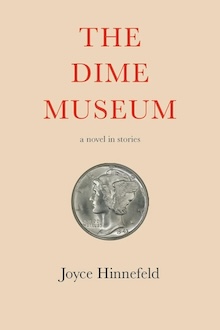
Joyce Hinnefeld and Gene Garber met in another century, when Hinnefeld was an English/Creative Writing Ph.D. student at the University at Albany. She took Garber’s fiction workshop along with an independent study on narrative theory, and when it was time to find a advisor for her dissertation, a novel, she mustered the courage to ask him. It took courage not because she was afraid of him—just in awe of his wide-ranging intellect and his wildly creative and experimental fiction (his much admired, Goyen Prize-winning book The Historian: Six Fantasies of the American Experience, was published during Hinnefeld’s time at Albany).
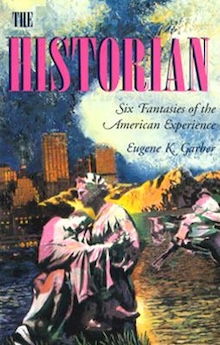
They’ve remained in contact for the thirty years since that time, reading and commenting on each other’s work through the years, and also sharing various joys and struggles via email and during occasional visits in Albany. Garber was one of the first readers of several of the stories/chapters in Hinnefeld’s forthcoming novel in stories, The Dime Museum (Unbridled Books). This interview addresses that work in its entirety.
+
Gene Garber: Did you know early on that the title story “The Dime Museum” would be the source story for all of the other stories?
Joyce Hinnefeld: That story was originally titled “The Bogus Man,” and my memory is that I wrote it after writing the opening story, “L’acqua Alta.” In “L’acqua Alta” I was interested in exploring what it would mean to be a left-leaning, young white American male abroad, particularly in Italy, where this character (Charlie)’s tattoos and obvious privilege—along with the fact that he carries around a copy of Ezra Pound’s Cantos—make him a magnet for members of the neo-fascist group Casa Pound.
My research into Pound’s own younger life led me to the very short teaching gig he had at Wabash College in Indiana (the state where I was born and spent the first 22 years of my life), before he left for Europe. I came across a brief account of a young woman, a member of a traveling vaudeville troupe, who was rescued by Pound as she wondered around the town of Wabash in the middle of a snowstorm, having missed the last train out of town. That’s how Maude, the “bogus man” male impersonator at the center of the title story, came into being.
The final stories/chapters of The Dime Museum (with the exception of the coda) are set in Philadelphia, where I based the fictional pharmaceutical company that is the source of Charlie’s wealth, and where Charlie’s college girlfriend Min is a nurse during the terrifying early months of the Covid pandemic. Charlie’s presence in northern Italy at that same difficult time raised other narrative possibilities, of course.
GG: Why did you decide to have the two stories placed in Venice serve as the bookends of the novel?
JH: I opened with “L’acqua Alta” because I thought a more contemporary, and also a funny, story would be a good way to capture readers’ attention; I hoped that two questions about Charlie would draw readers in and keep them engaged. First, where did his wealth come from? And second, will he and Min find their way back to each other? I should note, too, that Charlie is in Venice because his mother’s boyfriend has arranged for him a free room in a palazzo-turned-art collective—but also, at least in part, because Ezra Pound lived there for a time with his mistress Olga Rudge.

The idea for the “Coda” came to me quite late in the process of writing and shaping the book. But when it occurred to me that Stefan, the violinist and Casa Pound proponent from Prague who torments Charlie in “L’acqua Alta,” should appear again, that final story/chapter almost seemed to write itself. Stefan was a character I wanted to understand better, because he is like so many young men throughout the world who, for various reasons—some of which I understand better than others—have been making a turn to the far right in recent years. I guess the hint of a possible change in Stefan’s thinking was my gesture of hope, for the future of the U.S. and the world.
GG: There are a number of threads that run throughout the novel. Two important ones are the appearances or references to Ezra Pound and the two eccentric art museums: the Barnes Museum and the Gulbenkian. The accounts of them are fascinating. How do they serve to tie certain themes of the novel together?
JH: My earliest ideas about this book were centered on larger-than-life figures from the worlds of twentieth-century American art, literature, and culture (Pound, Wallace Stevens, Albert Barnes), and notably on the mostly invisible women who made these men’s lives and careers possible. My first visit to see the Barnes collection happened back when it was still housed in the original mansion on Philadelphia’s Main Line; that visit was memorable for the vast variety of the collection and its unusual arrangement, of course, but also for the arcane process of acquiring tickets—and the practically private viewing those tickets allowed. I’ve since been to the new (as of 2012) Barnes Museum several times; it’s a beautiful, expensive, and more traditional museum and, as many have noted (most recently Blake Gopnik in his fine biography The Maverick’s Museum: Albert Barnes and His American Dream), not perfectly in keeping with Barnes’s vision for his collection.
I fell in love with the Gulbenkian Museum during a trip to Lisbon with my husband Jim and daughter Anna in 2019. It houses an amazing and varied collection—Flemish and French tapestries, Eastern Islamic and Armenian art, illuminated manuscripts, jewels designed by Rene Lalique, and a variety of sculptures, including the one by Denys Pierre Puech that gives the story “Winged Serpent Seizing an Adolescent” its title. That sculpture holds a particular interest for the story’s main character, Tess, who sees interesting connections between the collectors Albert Barnes and Calouste Gulbenkian—connections that, unfortunately, she lacks the confidence to expand upon in writing once her former art history professor mocks the very idea. Both Pound and these two art collectors/collections provided avenues for exploring one of the book’s major themes: the suppressing of various people and voices by louder, more prominent twentieth century American figures.
GG: An obvious strength of the novel is its vivid and insightful portrayal of characters, always treated with compassion even if unadmirable. Did you sometimes know people like these, or are they totally fictional?
You also share with the reader remarkably empathetic relationships with your characters, many of whom are failures—at least by the standards of our culture. Would you care to extract from this some statements, even if provisional, about the connections between humans and their environments or their placements within history or any other relationships you might like to venture?
JH: The characters are totally fictional, though I will say that Charlie and Min are, in certain ways, inspired by students I’ve taught through the years. And while Mary Stinson, Charlie and Min’s college professor, has lived a life quite different from my own, I would say that she and I share a similar righteous feminist rage. When I couldn’t figure out what to do with monologues that I kept trying to write in the voices of Laura Leggett Barnes (wife of Albert Barnes) and Elsie Kachel Stevens (wife of Wallace Stevens), I assigned the writing of those monologues to the sometimes embittered, sometimes ecstatic (about the work of women poets, for instance) adjunct faculty member Mary Stinson. She’s a character who’s not entirely likeable but one who, I hope, will inspire warmth and recognition in readers.
As I ponder your question about empathy for perceived failures in the book, several characters come to mind—certainly Maude, and her “pretend grandson” Tom; these two characters, while probably “failures” by most social standards, are perhaps the dearest ones in the book to me. Both have a bone-deep antipathy toward figures of wealth and status, a product of their personal histories but also of their own capacities for empathy. And then there’s Liliane Milford, the character at the center of “A Mind of Winter” (yes, the title of a Stevens poem). Liliane is wounded by her mother’s emotional anguish, by the fact that she is not physically attractive, by being overlooked, really unseen, by everyone in her family. She is also a product of a mid twentieth century American education, and so a believer in notions of racial superiority, duly inherited wealth and class status, and the possibility of eradicating homosexuality, among other warping ideas.
I struggled a bit with empathy for Liliane; this was one of those moments when I was grateful for the wise editorial guidance of Fred Ramey at Unbridled Books. Working with Fred has reminded me of your thoughtful and erudite written responses (often two to three single-spaced pages!) to our stories in that first fiction workshop I took with you at Albany, Gene—always kind but clear, firm, pushing us to aim higher and do better. For which I’ll always be grateful.
+++
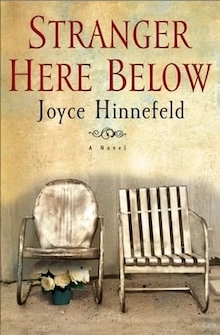
Joyce Hinnefeld is the author of the short story collections Tell Me Everything and The Beauty of Their Youth, the novels In Hovering Flight and Stranger Here Below, and the novel in stories The Dime Museum. She is a Program Facilitator for Shining Light, an organization that provides programming in U.S. prisons; an Emeritus Professor of English at Moravian University in Bethlehem, PA; and the founder of the Moravian Writers’ Conference. See www.joycehinnefeld.com.
+
Eugene Garber is the author of seven books of fiction, two of which won national awards: Metaphysical Tales; The Historian. His short stories have been anthologized in Best American Short Stories, the Sewanee Review Centennial Anthology, The Paris Review Anthology, and The Norton Anthology of Contemporary Fiction (1988 edition). He is Professor Emeritus from the University at Albany. Find him at www.eugenekgarber.com