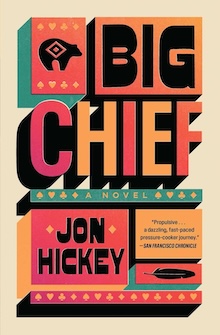
Jon Hickey’s debut novel Big Chief (Simon & Schuster) tackles political corruption and family ruptures on the Passage Rouge reservation in the Northwoods of Wisconsin where Mack Beck, a reservation president who looks the part with “that long hair, that immovable mountain mass, the beadwork medallions and satin ribbon shirts” (15-16), but is only a figurehead, lets his power go to his head. Once a family man who directed the reservation’s elder outreach program, Mack now lives large in a casino hotel suite and drives the biggest truck in town and is always surrounded by an entourage of yes men. Fighting to keep the power to which he has grown accustomed and secure his reelection, he and his right-hand man, Mitchell Caddo, sling mud at their opponent, Gloria Hawkins. Told in first person by Mitchell, a lawyer with an elite education who has returned to the reservation where he has never truly felt he’s belonged, readers witness Mitchell’s emotional struggle to maneuver in Mack’s shadow and define his identity on the reservation and his own place in the community. The brains and savvy behind the figurehead, Mitchell is pulled in different directions as his allegiances, ethics, and loyalties all come under fire. Big Chief features a bevy of characters— from tribal medicine men to police chiefs, and council treasurers—with differing perspectives on how the reservation should be best run, who gets to officially be on the tribal rolls, and who ‘belongs.’ The threat of disenrollment and banishment from the reservation hovers, and as allegiances die, merge, or shift, the threat becomes pervasive. But, as Mitchell explains, the practice is nothing new: “…it’s not like we invented banishment—the tribe banished people from the village since time immemorial, and if you look at it with some admittedly warped logic, you could argue it’s a traditional practice” (66). Told over the span of one week, Jon Hickey’s Big Chief depicts political machinations and corruption run amok, and cultural, familial, political, and romantic allegiances that are more complicated than they initially appear.
Amina Gautier spoke to Jon Hickey about the inspiration for his debut novel.
+
Amina Gautier: What inspired Big Chief?
Jon Hickey: Big Chief comes from a longtime fascination with how political power works on reservations, mainly from the reservation where my people are from, but also in first nations throughout North America. While the tribal presidents and council members of these nations often use this power for good, this is also power that can be easily abused. Not exactly groundbreaking stuff, but more of a testament to how these issues are inherent in the system.
More than that, I found that the best expression of my estrangement from that community was through talking about the politics. I’ve lived off-reservation my whole life, but Lac du Flambeau has always had an outsized importance to me and my family. It’s the place where we all return over time, yet when I go back, I often feel like a stranger, or an interloper, even though I’m a citizen of that nation. It’s a constant push and pull. I’ve often written about the uneasy relationship I have with the reservation, but nothing truly clicked until I looked at it through a political lens.
AG: Talk a little about the choice to write this novel in first person and from one character’s point of view. Were there ever drafts that included any other voices?
JH: Big Chief was always in first person. I never really questioned it or tried second or third. It sounded right to my ear that this book about identity and estrangement would be confined to one voice. I found that first-person perspective can feel claustrophobic over the course of 300-something pages, and I felt that fit the major tensions of the book.
AG: Why is Mitchell Caddo the perfect narrator for Big Chief?
JH: Mitch is the narrator mainly because he’s an outsider-insider, or an insider-outsider. He’s a citizen of the Passage Rouge Nation, he and his family have history there, and in his relatively short time on the reservation, he’s attuned to the undercurrents of the community. He knows the names, the families, the structures of power, yet he is also outwardly coded as an outsider. He doesn’t talk with the rez accent, he separates himself from the lifelong rez-dwellers in crucial ways, and he’s often caught off-guard by things that don’t surprise locals.
More than that, the point of the book is to follow someone who is feeling a void—in this case, a spiritual void that Mitch and other characters fill with politics, to their detriment. That spiritual void afflicts nearly everyone in the book, and each character has their own ways of dealing with it. I thought that Mitch’s mixture of familiarity and estrangement to Passage Rouge would yield the best insights.
AG: Gloria Hawkins seems like the perfect foil to go up against Mack. How did you come up with her?
JH: Gloria’s a composite of a lot of compassionate, politically talented people I’ve admired. She’s the antithesis of Mitch and Mack—she’s competent, has decades of experience in politics and activism, and has a grander, richer vision of the future of the nation. That said, I wanted to explore the more human, relatable side of a character such as that, to show more complicated motivations on her part.
She and Layla also provided a necessary counterpart to Mitch and Mack’s toxic masculinity. I didn’t set out to write a book about gender dynamics, matriarchy vs. patriarchy. It just naturally arose as a central theme, and the story just insisted on a character like Gloria.
AG: Creating a fictional reservation must require both imagination and significant research. How did you create Passage Rouge?
JH: Passage Rouge resembles places in Northern Wisconsin that I was already familiar with. My mother’s family is from Lac du Flambeau, or Waswagoning in Anishinaabemowin, and I drew from my memories and impressions of that specific place. There are a few other nations in the area, such as Bad River, Menominee, and Oneida, where we’d go to powwows or to visit family. I also lived in Minnesota for much of my childhood, and we’d visit White Earth, Red Lake, or go even further to Pine Ridge. My family and I have worked within the Little Earth community in Minneapolis, as well, which has its own political dynamic but in an urban setting. So much of the research was based on observations, but some of the inspiration for Big Chief came from reading about political developments.
I didn’t want Big Chief to be a roman à clef of things that happened in any one place, or to portray any specific person, so fictionalizing the setting was essential for freedom of movement. The real challenge was delving into the vast wilderness of Indian law and familiarizing myself with the various legal gray areas and the case law that defines it. I’m not a lawyer. I became a writer so I wouldn’t have to read through legal jargon, and I found myself poring over briefs, trying to get a handle on it and mostly failing, but for the purposes of the book, having that background knowledge and history of legal cases in Indian Country helped me figure out the plot.
AG: Let’s talk a little bit about chronology. Your novel takes place over the course of one week. What are the challenges and joys of telling a story over such short span of time? For example, how did doing so influence your sense of pacing and/or buildup of conflict?
JH: The book used to be so much longer! The first draft was close to 450 pages, structured as a linear rise and fall sort of story about a talented young politician who loses his way. It was interspersed with short chapters about his reelection, which were in present tense (unlike the rest of the book). After completing the draft, I realized so much of it felt like backstory, and any urgency that was there was coming from those short chapters. I ended up cutting everything that occurred before the election, and I was left with the bones of a dynamic, present-tense story that felt kinetic and lean.
The challenge was finding ways to reincorporate the past without bogging down the tension throughout the rest of the book. I found the balance through trial and error, in many, many drafts, so my memory of the actual process is rather murky. I was still adding things back in pass pages before it went to print. The tricky part about adding things I’d cut was doing so in a way that wouldn’t bog down the forward momentum. I got through this by listening to the word processor read it aloud to me, noting whenever my mind would wander, which was a sign that it was getting too heavy.
AG: Who are two or three of your literary heroes? Why?
JH: Let’s start with James Welch: I just participated in the James Welch Native Writers Festival in Montana, which was fantastic, and dedicated to the author. His books Winter in the Blood and the Death of Jim Loney are ones I reread every couple of years. They blend a poetic sensibility with devastating irony that I’ve always admired, that voice has always felt true to me and my own experience.
Ralph Ellison is another—Invisible Man is full of that same irony, but more than that, I could read Invisible Man as a sort of literary Rosetta Stone, pointing me to other works that I found as enlightening (or not). There’s always the sense that the novel is teeming with meaning and allusions, and I happen to think that’s the fun part of writing.
AG: Any advice for aspiring fiction writers completing their first books?
JH: I always say that it’s important to remember that making any sort of art is a collaboration. If you publish a book, you work with an agent, an editor, a copy editor, marketing and publicity people, etc., and finally, the reader, hopefully many of them. Collaboration requires give and take, humility, a willingness to understand the truth that even though you are the author and the decision-maker, you must allow other people into the process at some point. It’s an act of communication, and what’s the point if your message gets muddled by your own ego?
+++
Jon Hickey (https://www.jonvhickey.com/) is a member of the Lac du Flambeau Band of Chippewa Indians (Anishinaabe). He earned an MFA from Cornell University and was a Stegner Fellow at Stanford University. His work has appeared in Virginia Quarterly Review, Gulf Coast, and the Massachusetts Review, among others. He lives in San Francisco with his wife and two sons.
+
Amina Gautier (https://aminagautier.wordpress.com/) is the author of the short story collections At-Risk, Now We Will Be Happy, The Loss of All Lost Things, and The Best That You Can Do. For her body of work she has received the PEN/MALAMUD Award for Excellence in the Short Story.