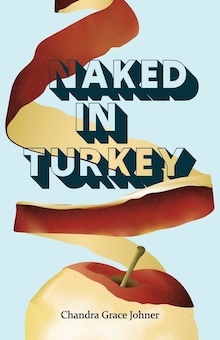
As a lover of the retelling of history to promote the female gaze and/or reshape a less sexist heroine, and of travel writing in general, I picked up Chandra Grace Johner’s debut collection Naked in Turkey (AOS Publishing). Blending what is said to be fiction (though after talking to the author, I see some non-fiction elements) and fantasy, Johner has created the perfect companion to any solo trip to Eurasia as well as a wonderful “woman becoming” collection. Prior to reading this fiction novel, I had only read Johner’s poetry (I am a poet myself). I am always interested in an artist who writes across genres, so I reached out to Johner to pick her brain a bit about this book, what inspired her writing journey, and how she ended up Naked in Turkey.
+
Rachel Turney: Tell us briefly about your collection, Naked in Turkey, which beautifully combines fiction and fable. What inspired you to bring those two ideas together?
Chandra Grace Johner: This book began as two separate projects that merged into one. The first was a travel journal I intended to adapt into a collection of short non-fiction, or maybe autofiction, while the second was a collection of folktales from my travels. Eventually the collection of short pieces became a novel and as I began formal research on Turkish folklore, I discovered The Dede Korkut, a collection of tales regarded as the Turkish Brothers’ Grimm.
The Dede Korkut, which translates into “the scary grandfather”, took me down the proverbial rabbit hole with the area’s lore and mythology. The stories could be traced back hundreds of years with various origins throughout the Mediterranean and Asia. And as I peeled back each layer of each story, and of the tales I’d recorded during my journeys, the layers of Naked in Turkey started to deposit themselves. Ultimately, the fiction project and the folklore project melded in my mind into this strange hybrid–totally unlike anything I’d originally planned, yet somehow exactly the story I needed to tell.
RT: What do you hope readers will take from this collection? For me, I felt there were many elements designed for the empowerment of women, especially young women.
CGJ: This is a book about stories: how they are shaped, by whom, and for what reason. It examines the stories of women as living things continually shifting based on perspective and power. We believe the stories we’re told and none more so than the stories we’re told about ourselves. My big ask of the audience is to at least revisit your own personal history and see where others authored your tale. Did their contributions serve you? Or does their version of your story serve them? How much could you gain by seizing control of your own narrative? You deserve to be the main character of your own life.
If I could take my ask one step further, I’d implore everyone to revisit the narratives they have heard about women–historically, politically, etc.–and peel back the layers. Use the book as a map, if you will, and pick a place to begin to explore. Whether it’s Amazons or Ada of Caria, you’ll be amazed at what you discover. And don’t stop there. Look up Grace O’Malley, Jeanne de Clisson, and Ching Shih, or dig into Kyoto University’s work with the Onna-bushi of Senbon Matsubara. And while this story shares the journey of a woman who happily begins to figure all this out while young, it’s never too late for anyone of any age to seize the pen and edit, re-write, and continue to write their own story.
RT: What is your connection with Turkey?
CGJ: In 2004/2005, I lived in Izmir, Turkey with my husband. As he hadn’t had the opportunity as a boy to travel much throughout his birth country, we spent a lot of time exploring wherever and whenever we could. It was a ‘golden time’ with a lot of adventures, misadventures, and really just the stuff for good living and great writing. We were able to travel the Dodecanese, as well, and it was a really magical time. I often look back and wonder in disbelief at some of the things that happened on those journeys.
It was my first time outside of North America, and I was on my own a lot of the time once my husband started working, though we took regular sojourns when we could. As a fairly solitary creature by nature, I was very comfortable navigating this new world alone and it felt closer to home than home ever did, even though I could only ever be a perpetual outsider. It was a unique perspective and experience to have.
RT: Given your background, the reader has to wonder how much of this book is actually based on real events vs. fiction. What can you reveal about that?
CGJ: I don’t want to reveal much about that. We often never know where the line between fiction and reality exists. That’s the power of legend and lore. People’s personal lore is no different. Some people will recognize certain aspects or events or people in the book as part of my personal lore, but then there is also a lot I never previously shared about my experiences, as well. I think it’s best to leave it at that. I do appreciate that question though.
RT: Tell us about your interest in fable and storytelling.
CGJ: I’ve always considered myself a reader first and foremost. Fable informs and inspires a lot of what we read as children–it certainly did for me. As you grow up, you expect to leave those stories behind, but as I continued to read, I kept travelling back to the fabular, to the fairytales, folktales, myths, and legends of childhood. They showed up in my favourite fantasy, horror, sci-fi, comic, manga, and literary stories. Whether those stories were on the page or on the screen, fable, folklore, and fairytale permeated the narratives and I felt compelled to get to the bottom of their prevalence and relevance.
Why do we keep telling the same stories over and over? Maybe new generations need new iterations of old tales. Maybe sometimes it is that simple. But, more often, it is much more complex. Fable and storytelling are powerful rhetorical tools because they scratch a deep and universal itch in our brains. The deeper you go into the layers of storytelling, the more it becomes about who controls the prevailing version of the story and their intent. And more often than not, it is about the power of controlling belief. Nothing grates my nerves more than people saying literature, film, and television aren’t political. Everything is. Language is political, story is political, and they can be used to influence our perceptions of others and of ourselves.
RT: What is your favorite piece of folklore included in the book?
CGJ: A very difficult question. The tales in the book are so important to Avalyn’s story. We can see similarities between her and these folkloric women, so they aid in suggestions of character and backstory. They feed into the emotions of the plot and Ava’s progression of experiences, and much more. But I have to say it is ultimately the story of Ayşe that shaped the idea of the book. I initially discovered Ayşe while living in Turkey and immediately was drawn to her story. It was so different and compelling. I was told a much simpler version at that time, but would dream about her nonetheless. When I revisited Turkey in 2010, I came across the story again when visiting Bodrum and this version was much more elaborate. When I began my research on The Dede Korkut and other folkloric representations in Turkey, I looked extensively for retellings of her tale, but it was conspicuously absent for a story that seemed so well known in that part of the coast.
Her story really strikes the core of what women’s narratives are and can do. What if girls and women were told more stories like Ayşe’s? Stories that told them this is not how you merely survive, but thrive in a world that won’t necessarily take care of you or extend any empathy when misfortune hits? Not just told to avoid storms, or skip sailing altogether and stay landlocked, but instead shown that it’s possible to weather anything that comes their way?
RT: If you could travel to another country and learn about their lore, where would it be?
CGJ: Not just one!! But if I had to choose just one, I would pack my bags and head to Japan tomorrow. I’m fascinated by their death lore, their monsters, spirits, and tricksters, and much more. I’m a fan of how legends are told, as style and structure can vary greatly from the western tradition. Kishōtenketsu is something I like to work with. It originated in folktales, fairytales, and legends, and is a four-act narrative structure that emphasizes development, contrast, and revelation over conflict.
It unhinges the traditional western narrative structure in favour of prioritizing atmosphere and worldbuilding over problems and resolutions, focussing on emotional or philosophical shifts rather than battles or confrontations. Contrast is used to reframe tension, unlike western storytelling models that escalate tension, and harmony, revelation, and integration are valued over more traditional resolutions like victory and conquest. Kishōtenketsu definitely informed the structure of Naked in Turkey.
RT: You also work in poetry. Indeed, your book has many lines that read like poems. Any plans for a poetry collection in the future?
CGJ: I began assembling a collection last year, which was temporarily shelved so I could focus on completing the book last autumn. Folklore and fable figure largely in my poetry, as well, though the tone is generally darker than the optimism of the book. The optimism of my prose as a body of work tends to come from writing as an act of service, whereas the more pensive and often moody tone of my poetry tends to be a product of writing for my own self. So I’ve always been surprised by how engaged readers and editors have been with it, and feel very fortunate that it resonates, because years ago, I never would’ve conceived of publishing a collection. I look forward to getting back to it after focusing on the book and some other short fiction/non-fiction projects for so long.
RT: I am intrigued to see what you could bring to a poetry collection! I hope we see that book in the future too! Congratulations on your debut fiction book Naked in Turkey!
+++
Chandra Grace Johner is a Canadian writer who completed her MLitt in Creative Writing with the University of Glasgow. Her debut book, Naked in Turkey, is available from AOS Publishing. You can find more of her work in FLEET, From Glasgow to Saturn, Sybil Journal, Livina Press, Midnight Ink, and Feral.
+
Rachel Turney, Ed.D. is an educator and artist located in Denver, Colorado. Rachel is on staff at Bare Back Magazine and is a reader for The Los Angeles Review. Rachel is a poetry mentor for AWP. She runs the popular online reading series Poetry (in Brief). Her debut book, Record Player Life (the b-side), is available with The Poetry Lighthouse. Website: turneytalks.com Instagram: @turneytalks