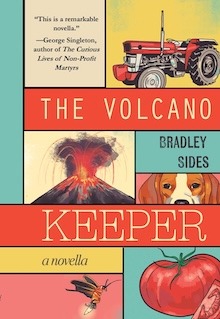
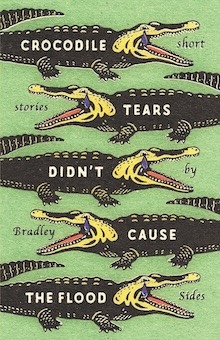
I first met Bradley Sides at the Southern Festival of Books in Nashville, Tennessee, where he was showcasing his short story collection Crocodile Tears Didn’t Cause the Flood (Montag Press, 2024). We soon discovered our shared loves of magic in fiction and southern literature, and Bradley impressed me with his generous spirit. Those same themes–magic, the South, and deep generosity–also distinguish Bradley’s new novella, The Volcano Keeper (Regal House Publishing, 2026). I was honored to interview him by email about this new book, its place-based genesis, and time-sickness.
+
Marguerite Sheffer: The premise of The Volcano Keeper–a volcano emerging suddenly from the ground in rural Alabama in the 1960s, with even more magical undertones–stretched my imagination from the beginning. What draws you to absurdity, magic, surrealism in fiction? What does it let you do?
Bradley Sides: Oh, I love me some magic. I’ve always been a “what if” kind of person, and that kind of mindset worked in my favor as a kid, living on a farm. We had this huge pond out back, and it was pretty filthy most of the time. I’d stand at the edge and look at it. Algae would just be sloshing and bugs would be swarming, and every once in a while, a bubble would rise to the surface. What if a monster lived under there and dragged me under? I’d think stuff like that, and I’d edge closer, kind of tempting it. That was just how I was, and it’s still how I am. I was born loving magic and believing in possibilities.
And, you know, I think that’s really what magic does for me in my writing too. It lets me believe that anything is possible, and that freedom lets me get to the truth of what I’m exploring.
MS: I’ve been conditioned by years of media-consumption to be expecting the other shoe to drop for happy, loving characters: to be ready for a villain or something sinister to jump-scare me. But The Volcano Keeper challenges my assumptions about conflict and tension in fiction (and in life!) What are your thoughts on stories and conflict, and worldview?
BS: Same! I was actually talking about this topic the other day–how I realized not too long ago that I don’t think I see my relatively quiet life very much on television.
All lives have conflict, right? I mean, we die. We lose jobs. We worry about money. We fuss. We all face these kinds of things, but–and this is a big thing for me–we also love, forgive, and continue on. I wanted to give life to a story that captured ordinary conflicts and also showed how problems and difficult situations don’t necessarily have to change us. I tried to capture the reality of quiet lives with The Volcano Keeper, and I hope I did just that.
MS: The Alabama landscape and the family central to The Volcano Keeper are portrayed with such meticulousness and care. How did you find these characters and the lived-in details?
BS: Thank you, Maggie. I appreciate you saying that. To be honest, I kind of did some time traveling back home. These characters are not my family. This world is not the one I grew up in. But it does share the spirit of those people and places. Everything I include here–from gardens to farm animals to fishing–is something that has played a part in my own life. Even the volcano. I couldn’t write this book until I visited Mount Rainier. Once I got home, I had that central image as well. I wrote what I know.
MS: The Volcano Keeper is one of two books I’ve loved recently that have a volcano erupting on the cover (the other is Forever Egg by Tierney Oberhammer, forthcoming in March 2027). Readers know before diving in that that volcano is going to blow. How does this affect how you lay out the narrative, and where you take the story? Or where our attention goes?

BS: The cover for Forever Egg is one of my favorites of recent memory! I can’t wait to read it. The eruption reveal was something I never questioned. I knew it had to happen, and I knew I wanted readers to know that from early on. I also knew that I needed some narrative investment, right? If we know the volcano is going to erupt, we need something on a narrative level that makes us want to turn the page. The answer, for me, was why. I needed a big why, and that was my key for developing the movement of the story. I wanted the book to feel like a puzzle. Readers have the pieces, and the full thing can be completed once that why reveals itself. At least mostly.
The Volcano Keeper is still a Bradley Sides book, and I like some ambiguity, so I add in a little dash of that special ingredient as the ending approaches just to keep that attention and curiosity building.
MS: I know you first as an author of short fiction. How did you transition from shorter stories to a novel? What was surprising as you did?
BS: I’ll be honest, I’m still trying to figure out if I fully did. Haha! I think of this book as a kind of novella-in-vignettes, so I’m still kind of working in that short fiction space. Sort of. Mostly. Maybe?
I’m always reading stories. I love short work. I continued to be impressed by the form, even by stories that I’ve read over and over again. As I began writing, I was wondering how in the world I could tell The Volcano Keeper in a way that I wanted to–but also in a way that was right for the story itself. The answer was found by getting out of my own way.

I went back to some of my favorite books and writers. I’m thinking of Margaret Renkl’s Late Migrations and Daniel Wallace’s Big Fish. I’m thinking of poets like Wendell Berry, Jesse Graves, and Aimee Nezhukumatathil. These writers capture so much beauty and truth in such small spaces.
My book is longer than a traditional story. Much longer. But it also has that feeling and shape that is me. And I think I am most surprised that I could tell Charlie’s story in a way that felt right for me and also right for the story as a whole. I’m so pleased with this book. I feel weird admitting that, but I am.
MS: This novel had me thinking of stasis and catastrophe, transformation, grief, holding on and letting go. For you, what were some of the big ideas and inspirations behind this tale? What does the short novel or novella let you do?
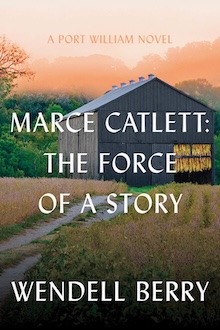
BS: I know I just mentioned him, but I’m a big Wendell Berry person. Arguably, he shaped my writing more than anyone. He has this really beautiful line in his last novel, Marce Catlett. He writes, “As he has come to know, Andy’s grief for the things that are lost affirms his love for them, as even the loss of them affirms the bounty by which they once existed, for in this world grief goes hand in hand with gratitude.” That idea of grief and gratitude fitting together so perfectly points to how The Volcano Keeper was formed.
I loved my grandparents so dearly. They were kind and joyful, and they were equally giving of encouragement and support. I spent countless hours with them, and throughout my life, they gave me all they had. And I was (mostly) away when they died.
For the longest time, I felt such guilt and grief for not being present, but I’m at a place now where I feel such gratitude in having had the privilege to know them and to love them—and for them to have loved me. This book worked because I was finally able to process these complex feelings. Understanding my own grief helped me write Charlie’s.
The novella gave me the space to expand the richness (and bigness) of a complex life. I couldn’t go as deeply as I wanted to go if I were trying to tell Charlie’s story in a shorter form.
MS: At times, the story almost felt like a folk-tale to me; like something from a simpler time: perhaps due to the setting in time and place. There is something precious at the heart of this story that I worry we’ve lost, or is harder to find in 2026. What drew you to the 1960s-70s setting?
BS: Being timesick really. It was Silas House who I first heard use this term, and I was like yep–timesickness-that’s what it is I was experiencing.
In my day job, I am an English professor, and all of my people are having constant conversations about what all of this tech, including AI and social media, means and what it’s taking away from us. For this book, I wanted to just escape the current age of technology and go back to a different time. No computers. No phones. I wanted to have characters who search for four-leaf clovers and catch minnows. I miss those days of my own 80s/90s childhood, when life seemed a little quieter.
Obviously, the 60s and 70s had problems of their own, especially in Alabama, but technology is just so damn exhausting, and I needed a world to escape it all for a while.
MS: We are both southern writers (and you are a champion of Southern writers!). What does being a Southern writer mean to you?
BS: I love this question. There’s a wonderful piece by Brittany Howard at Oxford American called “The South Just Has a Thang.” She goes on to note how that Southern “thang is hard to describe.” There’s so much truth to what she says. Like, sure, I guess being in Alabama and writing about Alabama life places me as a Southern writer, but there’s also a feeling. A thang, as Brittany says. And I’ll take it a little further and borrow a word from my students to fully answer you: Being a Southern writer is a vibe. And, to me, that vibe is a mix of easiness, breeziness, quietness and a certain impossible-to-fully-describe “thang”.
MS: What should I be asking that I haven’t, yet? (and what is your answer).
BS: Several early readers have told me how much they appreciated how I write about my dog, Mollie, in The Volcano Keeper’s acknowledgments—and how they just moved from crying at the end of the book to crying again with the paragraph about her. Haha! Folks want to know how she’s doing, so I’ll note that she’s great. She has been hunting chipmunks for years, and she finally caught one last week. I should also note that Mollie is a 6-pound toy poodle.
I also get lots of interest in cows because there is one on the back cover. My dental hygienist was chatting with me the other day about how she used to show cows at local fairs, and I got to tell all of my stories about my own cow-showing days. Folks find it fascinating how I bathed cows and brushed them and everything else. That care was part of it.
I grew up on a farm, so I have many animal stories. Many!
MS: What is next for you as a writer?
BS:I go through spells when I work on nothing for months and months, and then, suddenly, all of these ideas start coming, and I’m just all over the place.
I’ve finished some new stories, and the publisher of my first story collection recently closed. It seems like the perfect time to do a “new & selected” book, so that’s my main focus right now. I’m editing and tinkering.
I’ve also been experimenting with poetry, and I have an idea for a new novella that’s a story expansion. We’ll see how it all goes. Fingers crossed!
+++
Bradley Sides is the author of two previous short story collections, Those Fantastic Lives and Crocodile Tears Didn’t Cause the Flood, a 2024 Book of the Year finalist at Southern Literary Review. His writing has been featured at, among other venues, Chapter 16, Electric Literature, LeVar Burton Reads, Los Angeles Review of Books, The Millions, The Rumpus, and Southern Review of Books, where he also serves as the host of “The Southern Summer Book Club.” He lives with his wife in Madison, Alabama, and teaches writing and literature at Calhoun Community College. His latest book is The Volcano Keeper.
+
Marguerite Sheffer’s debut short story collection, The Man in the Banana Trees, won the Iowa Short Fiction Award and was a Finalist for the PEN America Robert W. Bingham Prize. Her stories appear in Asimov’s Science Fiction, Epiphany, BOMB, The Cosmic Background, and LitHub, among other venues. She is a founding member of Third Lantern Lit, a New Orleans writing collective, and a member of the Water Collaborative’s Brackish Artist Collective. She teaches design thinking and speculative fiction as tools for social change at Tulane University, and is working on a novel.