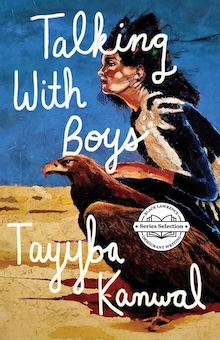
I had the pleasure of meeting Tayyba Kanwal almost two summers ago in an online workshop on poetic forms led by Jai Chakrabarti and hosted by A Public Space. When the class ended, several of us wanted to keep the energy going. We’ve continued to meet over Zoom from our separate corners of the United States, and I’ve been counting my lucky stars ever since. Not only is Tayyba’s work a pleasure to read, but her incisive feedback and intuitive judgment about how short fiction works have bettered every piece I’ve submitted. The skill and craft integral to each story in her debut collection, Talking with Boys (Black Lawrence Press), was no surprise when I recently read it for the first time. (The collection was already in production when our group began.) But nothing short of experiencing the stories could have prepared me for the incredible ingenuity of each character, the way these wily and wise people create their lives—against impossible obligations and societal strictures.
Tayyba and I talked about Tex-Mex nachos, tape-string, and how a bird flew out of the book.
MH: What I always love about short story collections, and Talking with Boys in particular, is the range, the diversity, of the larger world created. When encountering a collection of disparate stories, the reader expects these tentacles, if you will. But your stories are interconnected, giving these characters a verticality, a rootedness, and that combined with the vastness is a joy to read. Your characters’ lives span across stories. In one we encounter a woman talking her new daughter-in-law out of her union; a hundred pages later we discover how this same woman lost the first union she desired. In the title story, we witness a mother embittered by her daughter’s intention to marry outside their faith; two stories later we’re immersed in the anxiety of that mother’s early life, the great risk she took to elude indentured servitude for herself and others. This warp and weft occurs again and again; how do you see this tight tapestry working thematically?
TK: The characters in these stories are people who were each born with their own proclivities, molded by their environment as well as by others they’ve loved, hated, feared or admired; they’ve been shaped by their socioeconomic and political circumstances. Migrations across oceans, or even just movement from small town to big city, or from one’s mother’s hut to the village elder’s mansion, test each of them in a new way, revealing their essential selves to us more clearly, but also allowing us to watch them evolve as people. Meeting these characters across decades and places allows us to see them as the complex individuals they are, with intersectional identities. I did not want these stories to treat these characters’ Muslim identity or Pakistani origin as a curiosity or singular lens. Instead I hoped these aspects of their identity would operate as just another thread in this tapestry. The pleasure of writing recurring characters in this linked collection has been that my understanding of them was complicated further each time they showed up and made themselves known as an older or younger version of their earlier selves.
MH: Their lives are held within the edges of this one fabric, constrained if you will, but finding their own vibrant threads to compose a life—except for Zoya, whose life is still ahead of her by the book’s close. She might extend—is already extending—past these edges.
TK: Zoya is a second-generation immigrant, just like Amal. They are perhaps the most spiritually American of my characters, both having been born in the US, but also instinctually drawing heavily on the broader social fabric around them more than other characters. Opening and closing the collection with their stories, their joy in making their own way in this country of their birth, defining and making their own home, felt natural and symbolic. Zoya chooses to stay in the country of her birth despite dire circumstances, even as her mother returns to Pakistan. She chooses to carry on the thread of migration that began in a village outside Lahore and holds as precious the soil she is naturally rooted in. She does make that phone call to her mother back in Pakistan though.
MH: Yes, there are long-distance calls, and long distances travelled. You take us from a BMW convertible on I-59 through Houston to a train station in Sianapur by Lahore, a place I couldn’t find precisely on a map. And that’s only the first two stories—we still have 13 to go! Given your roots in Lahore, Dubai, and, for several decades now, the United States, that reach would be natural for you. But by putting stakes down in each of these places, tracing the characters’ lives and families and friends back and forth, these far-flung places form a single matrix. And isn’t that how many of us are walking about this Earth, holding multiple geographies in us?
TK: Sianapur has been fun to write—it’s a made-up town, with an ironic pun in Urdu embedded in its name. “Siana” means “wise”; we’ll let the reader judge if the inhabitants deserve their town. Multiple geographies underlie contemporary ways of living. Decades of physical migration across continents, and also near-ubiquitous access to the internet and social media, have created a world where culture is not bound by borders. When I was last in Lahore, my mother’s housekeeper told me one evening that my sister-in-law was having Tex-Mex nachos for dinner because her cook had not only found the recipe on TikTok, but then posted her preparation on there.
MH: Did you always know you wanted to write, even as a young child, or did you come to this work later?
TK: Admittedly, yes. Always writing. But what a circuitous path to becoming the writer I hoped to be. Those in-between decades of other lives lived have given me the fodder I needed for what I have to say now. I am grateful for the times I was not writing. The simmering, the becoming, has been important.
MH: Oh, I want to hear about those other lives!
TK: The heady days of managing technology implementations, as a woman, during the dot-com boom of the late 1990s and the aughts; a quarter century of motherhood; juggling close family relationships across three continents; navigating the peculiarities and joys of work in the nonprofit arts sector; sitting with the work of other writers as an editor. All of this has complicated my story prism, each new facet adding a new angle, sometimes twisting my view in peculiar ways.
MH: The story “Mehr,” whose final pages land almost midway through the collection, seemed literally to uncage something before my eyes. I’m not sure I can convey the reading experience, short of saying I felt a bird fly loose from the book. It was truly remarkable. Talk about how that image of Mehr’s transformation came to you.
TK: Mehr—nothing as cathartic for a teen girl as an “I-told-you-so moment.” Her father should have known better. A well-meaning, protective, loving man, with little control or imagination. So, she is a bird then, she is a defiant girl. If she is going to be hidden, she will reemerge as something else. She is quintessentially every woman in this collection, living in the world she has available to her, but on her own terms, with her own freedom.
MH: I needed to create a chart to track these characters throughout the book. Did you use visual aids as you wrote the book?
TK: When I began to realize that my stories were interconnected, I promised myself to stay true to the short story form and write each one entirely independent of the others. There is a power in a short story that would dissipate if it relied on any understanding beyond its immediate container. Later, when the stories were all written, I did have on my hands quite a tangle. That’s when the sticky notes came out, and the date tags, including birth dates, and character tags, and place tags, and tape, and string. This collection was a crime-scene investigation for a while. And yes, close revision to make sure every movement added up and no twelve-year olds were having babies. At that point, I also got quite a kick out of writing into the stories little nuggets of scenes from prior stories, but from this new time and place.
MH: Was it a temptation for you to expand these linked stories into a novel? I’m curious how a writer resists that pull or, rather, insists on this form.
TK: Not really. I deeply enjoy the short story form—it comes to me more naturally than any other. I am working on a novel, or two—what a different beast to work through. With these stories, I knew the quiet place my characters would find in their grappling with some question. How they got there was the game of the story. The world of each story is, I hope, rich with possibilities. But it didn’t interest me to wander down other pathways, to dissipate the pressure inherent in the quest at hand.
MH: I would love to hear any thoughts you have on the state of the short story today. I read recently that the Big Five published only 20 collections in 2025. This saddens me about a form I love.
TK: All I can say, anecdotally, is that everyone I meet loves short stories and finds them accessible and more practically readable than committing to a long novel. This has been told to me from both people in the literary world and also casual readers. Do I think this is a chicken and egg problem? Perhaps. If we’re not publishing short story collections, of course people are not reading them. It does surprise me when I hear the short story form dismissed as somehow simpler than or inferior relative to the novel. To me that is the equivalent of dismissing poetry. They cannot be compared.
MH: Your answer gives me hope. What exemplars of the form from the Emirates or Pakistan or the US have inspired you?
TK: This could be an essay unto itself, but to sweep a broad brush, a lot of translated and world literature has fed my writing. If I’m forced to mention certain writers, though not necessarily writing in the short story form, I’ll have to say Mohammed Hanif, Yoko Ogawa, Gabriel Garcia Marquez, Ottessa Moshfegh, Brian Evenson, Paul Lynch, Adania Shibli. The list is long and it feels odd to stop here. Influences find unexpected pathways into one’s art.
MH: Some of the pieces tell a recent story using an old form, for example “The Renaming of Tooti Sadak.” Another, “Mailee and the Saint of Horses,” invokes an ancient text, The Potters’ Book. The religious story of Hajar is referenced in “Telling Tales.” Are there others I’ve missed? And were they familiar to you or did you uncover any during research?
TK: This feeling of an old form is primarily manifested through the particular narratorial voice that began to speak with each of these stories as they came to me. One must trust the spirit that speaks the tale. Sometimes, even with a more contemporary tale, we need to hear from an older soul. “The Renaming of Tooti Sadak” is set in 1989, but the land remembers these townspeople, their ancestors clambered these very trees, and this knowing that comes through in the voice of the narrator makes the townspeople’s ungrateful squabbling all the more ironic. What befalls these people, what they bring upon themselves, is being watched by the ages. The ancient text that “Mailee and the Saint of Horses” invokes also becomes, at some meta-level, the soundscape of the story, the way it rings in our ears. In “Telling Tales,” Hajar, whose story is told in the Quran—the soul-tired mother of prophet Ibrahim’s son—lives spiritually in Shireen, the young woman who dedicates herself, even gives up her honor, to raise her younger sister. What text should we memorialize Shireen in? The Quranic stories I’m familiar with, as well as the cadences of the Quran, having memorized long passages as a child. The Potters’ Book I stumbled upon, much to my delight, during my research into pottery in Pakistan for “Mailee and the Saint of Horses.” I wrote it as a tribute to the Pakistani folktale of two potters in love, Sohni Mahiwal. But I didn’t want to write a retelling or a fractured fairytale. So I dove in to see what more there was to the world within that folktale.
MH: Mothers are featured prominently in these stories, and motherhood might be a good place to discuss how your characters transcend their traditional roles within cultural constraints—a core theme of the collection. In the United States, we might call this “making do.” Your mothers “make do” with incredible creativity.
TK: This was a discovery I made about these mothers as I wrote these stories. I have always wondered, growing up, how all the women around me were winning at “making do.” I have to admit I didn’t have clarity on this before I sat with these women and walked in their fictional shoes. And I saw then how smart they were about optimizing for what was most important to them. You love your children, so you might stay in a suboptimal marriage (though, don’t let that man get you down—you’ve got friends). You want that education, so you strike a deal with your mother-in-law. But most fascinating to me was the realization that a powerful way to pull these deals off is to use the system against itself. Amal, the protagonist of the first story in this collection, gets married to escape her oppressive father’s home—but to marry her off is exactly what her family would have imposed on her. She just pulls it off on her terms. Staying in community, too, is a survival tactic, a smart use of a safety net.
MH: In the first story, Zeba says to Amal: “I have no plans to be your mother. Neither of us needs that.” And in “A Shade for the Window,” Haroon’s mother says to him about a prospective wife: “As God is my witness, I’ll treat your wife well, and she will not need another mother.” What does this mean culturally or specifically to you, needing or not needing a mother?
TK: The idea of mother in the cultural landscape of this book sits at the intersection of the poetic and the hallowed. You cannot reject or replace your mother. How can you reject an idea and an institution? I grew up with the regular admonition that maa ke kadmon talay jannat hai: Heaven is to be found at the feet of your mother. So much so that Haroon, in “A Shade for the Window,” is doomed to forever be a son, and not a lover, when those two come into conflict.
MH: Wow, that expression is revelatory. In “Little Mother,” the point of view is second person—this seemed like another way of escaping those constraints. How do you see it?
TK: This kind of second person, really a “dissociative first person,” is a way of stepping not only beyond constraints, but outside of yourself, a desperate psychological distance from the trauma that is re-lived by the telling you are doing. The violence inflicted on Little Mother had to be spoken of by herself or else it would become trauma-porn. Too, her fierce resolve to keep for herself the biggest prize from her oppressors had to be spoken of by her, or we would not triumphantly ride her madness with her.
MH: This is a robust number of stories for a collection, but I always like to know what might have been left off. Were there others you edited out?
TK: There were two. These, too, were connected to the current set. But they went too far back in time, carried a lyricism not echoed elsewhere, and wandered into a subculture too different to hold the compactness of the web woven by these stories that already span 75 years. Those stories are both set in the Shahi Mohallah of the Walled City of Lahore, currently Lahore’s red light district, but what was the cultural heart of dance and music and poetry since the 15th century. I theorize that colonization, the coming of the English language stripped out the poetry and left only the flesh trade behind. But I am no historian. I make up a lot of things.
MH: And we’re grateful for that! How does your family of origin and extended family perceive your work as a writer, and this debut specifically?
TK: My wonderful family is thrilled, so pleased by the reality of these stories, despite a good amount of magic that carries those realities. There was no bigger worry for me than that these stories would not speak to them. Nothing here is recognizable as any individual or incident from the family’s history (a remarkable feat, I assure you). But if there have been inspirations, they have made the stories ring true to them. They like the landscapes, the layer of Urdu beneath it all.
MH: Tell me about the cover. Those bold brushstrokes beautifully convey the strength and vitality of your characters.
TK: It was so important to me that the woman on my cover not be demure. In fact, she is a little mad. She is beautiful but not pretty. She is intense, unafraid, as is her familiar, the golden eagle, the most ubiquitous bird of prey in the Northern Hemisphere. I am so grateful to Jan-Frits Obers, a Brazilian artist, who imbued this canvas not only with bold colors, but embedded earthy materials in the paint, and agreed to lend this incredible image to Talking with Boys.
+++
Tayyba Kanwal is a Pakistani-American writer, managing editor at Conjunctions, and associate fiction editor at Cutleaf Journal. An absconded mathematician and technologist, she is literary director at Inprint. She holds an MFA from the University of Houston Creative Writing Program where she was an Inprint C. Glenn Cambor Fellow, and an MS in Mathematics from the University of Oregon.
+
Margaret Hutton is the author of the novel If You Leave. Her fiction has appeared in such journals as The Sun and The South Carolina Review, and her essays can be found in Memoir Land and The Rumpus. She graduated with honors in creative writing from UNC-Chapel Hill and holds an MFA from George Mason University. A native North Carolinian and former environmental reporter, she now divides her time between the Washington, DC, area and her art studio in Chester County, Pennsylvania. If You Leave is her debut novel.