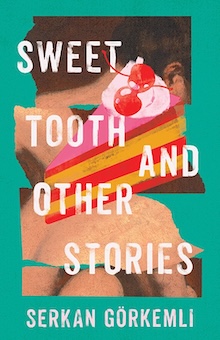
Serkan Görkemli’s debut short story collection Sweet Tooth and Other Stories (University Press of Kentucky, 2024) follows the lives of queer characters whose paths intersect at various times and in various locales across the Turkish countryside. The collection, which depicts queer identity formation in a Muslim-majority country undergoing a sociopolitical transformation from “military-backed secularism” to an Islamist state, expands notions of queer representation and queer literacies which have been largely focused on the west. From childhood friendships that blossom in neighborhoods and schools, to chance encounters between activists, clubgoers, neighbors, roommates, and sex workers that take unexpected turns at college orientations, clubs, marches, and museums, Sweet Tooth takes readers all over Türkiye. The nine stories follow protagonists whose childhoods take place in Çorlu, “a small city known for manufacturing and commerce” but whose later adult lives see them settling in Antalya, Çannakale, Izmir, Ortaköy and Istanbul (not Constantinople), marking their moves from a small conservative community where their queer expression subjects them to communal gossip and social ostracism to larger cities where their sexual expression subjects them to discrimination, unemployment, and violence.
Arranged chronologically, the nine linked stories begin in 1989 and continue through 2019, following Hasan, Nazli, Cenk, and Gökhan, whose lives intersect as neighbors (Gökhan and Nazli), schoolmates (Gökhan and Hasan), and relatives (Nazli and Cenk). From the first story, “Webbed,” in which a family has returned to Türkiye in 1989 after being victims of ethnic cleansing and forced migration which saw Muslims and Turks expelled from Bulgaria, through to the last story, “Ingénue,” in which a performer can’t wear drag in public without being brutalized, histories of ethnic, political, religious, and sexual persecution inform the backdrop of these stories. The aptly titled story, “Pride,” follows Cenk, a rich, sheltered, recent college graduate who goes through the motions of dating women to appease his mother, a closeted lesbian, who warns him “Remember, once people see you a certain way, there is no going back” (99). We see his privilege challenged when he accompanies an older man to a Pride march and then a gay club, which is subjected to a police raid: “Cenk breathed with difficulty, and his temples throbbed. He coughed a few times as his eyes watered, tears rolling down his cheeks like glass beads. He rubbed his eyes with his shirtsleeve as he looked toward the stairs. The exit was clogged with people. He looked around in panic, scanning the club’s walls for an emergency exit. There was none” (93).
With a light hand, Görkemli shows the ways his characters’ journeys of self-definition and sexual expression are impacted or obstructed by familial, political, and religious intolerance as well as physical and social retribution. From Hasan, a sex worker who believes that an LGBTQ+ organization’s “meetings took the fun out of being gay, with their earnest talk about rights and whatnot” but attends because “there were free condoms and food” (71), to Nazli, who, once treated like a pariah, has become “a woman like a government” and a person from whom people “sought counsel about matters of importance,” Görkemli’s characters evolve, though not always for the better. Following them over a span of thirty years, readers witness some characters who grow comfortable in freely expressing their sexual identities, and others who maintain closeted identities, some who are estranged from their parents, and others who are supported by them, but all whose quests for acceptance, love, and self-determination are intensely personal, and fully complex.
+
Amina Gautier: What’s this collection’s origin story? How did Sweet Tooth come to be?
Serkan Görkemli: I grew up watching queer celebrities on television in the 80s and had a few gay friends and classmates in college in the 90s in Türkiye, but I didn’t come out myself until after I came to the US in 1998 for graduate school, so I was interested in queerness and its different manifestations. The evolving interpersonal, familial, societal, and cross-cultural dynamics of coming out as LGBTQ+ are complex and can be bittersweet depending on the person and context, so I tried to convey that in my collection of stories.
As for the literary form, teaching a short story survey and appreciation course at the University of Connecticut in Stamford for many years inspired me to write short stories. “Sweet Tooth,” the title story, was the first story I wrote, and I named the collection after it because I wanted to convey that knowing, and becoming comfortable with, who you are is one of the greatest, sweetest gifts in life.
AG: Although this collection circles around four interconnected characters, the collection seems to truly belong to Gökhan. When did you know that this would be his book or that he would be the central protagonist?
SG: Gӧkhan was the main character of the story “Sweet Tooth,” and I wrote the rest of the stories as stand-alone pieces. When I started looking at all nine stories as a collection, I realized they had a similar spirit and that it felt natural and appropriate to connect them all. “Sweet Tooth” had the catchiest title, so it became the title story and Gӧkhan the central character. The fact that most of the stories had a main or a secondary male character also made it easier to make that change and write him into each story or reference him as relevant to a given story.
AG: Although Gökhan is the central protagonist, Sweet Tooth has a cast of recurring characters who each have their own progressive arcs. This makes me wonder if you ever imagined Sweet Tooth as a novel, or if you always intended it to be a linked collection. What informed your decision to shape the manuscript as linked stories and what compels you to return to a character about whom you’ve already written?
SG: I didn’t imagine the book as a novel or even a linked collection at the very beginning. But I did hear later, during the Association of Writers & Writing Programs (AWP) Conference, that short-story collections are hard to sell, unless you’re also working on a novel or it’s a linked collection. Ultimately, I think linking stories helped both strengthen the book and its arc and place it with a publisher.
Returning to Gökhan and other characters in later stories was interesting and challenging, in a good way, because it was an opportunity for me as a writer to revisit and deepen them as people who evolve throughout the course of the book through their choices and experiences. Such revisitations also added a layer of nostalgia, like looking at past and present selves and contemplating life as a tremendous journey that’s unfolding.
AG: In this collection, Turkish words are interspersed with English ones, Gökhan struggles to understand phrases he overhears and Hasan struggles to communicate with Adam in English. Tell us why terminology and language are so important to you and these stories.
SG: Language mediates our sense of identity, so my characters’ struggle for identity also involves language and the conceptual and communal possibilities that language offers. Early in the book, Gökhan grapples with old—Turkish—versus new—English—terminology that conveys competing cross-generational and cultural hierarchies of gender and sexuality. His future liberation depends on other people’s views expressed and enacted through their words. As such, human language is essentially performative and can ensnare us in individual, social, communal, and national fantasies about who we are and what we should be doing with our lives. The story of Adam and Hasan in “Runway” is about such fantasies they express and enact through their different languages, literally and figuratively, and what happens when those fantasies clash or are found to be hollow. I’ve been told by a few readers that “Runway” has such a sad ending, which is true. But in addition to that sentiment, I’d like to think that disillusionment regarding the performative nature of language and of people is also the point because it can lead to growth.
AG: This collection makes numerous references to Atatürk, along with subtle allusions to the Republic of Türkiye’s evolution from secularist to Islamist, which may be lost on non-Turkish readers who are unfamiliar with the Republic of Türkiye’s history. What are the challenges of seamlessly incorporating historical or political information into fiction without letting the research take over?
SG: There’s a lot of history there, so the challenge is how to resist the temptation to tell too much or worse, lecture. My process sometimes involves overwriting history and politics into the story and then strategically diffusing it throughout and/or editing out some or most of that information from the perspective of the character or the narrator. So, it depends on who they are and how much they can know and say without disrupting the rhythm of storytelling. I also remind myself that there’s a wealth of information online for readers who wish to know more, and it’s not necessary as a storyteller to tell everything.
AG: Speaking of non-Turkish readers, tell us a little about the significance of the period from the late 80s to the 2010s, which you chose to frame the stories in the collection.
SG: That thirty-year period of neo-liberalization and globalization in Türkiye corresponds to the arrival of Euro-American representations of LGBTQ+ identities through global media and the formation of queer communities and advocacy organizations there. Unfortunately, nationalist, conservative backlash accompanies queer visibility, as has also happened in the US, so that setting is central to the characters’ sense of possibilities, as well as limitations, regarding their identities and existence. As a binational writer, I’m mindful of the two different yet in some ways similar national contexts regarding LGBTQ+ issues, so that framing is also a product of that binational awareness.
AG: In “Pride,” readers get both Cenk and Nazli’s POVs, and this story is the only one to feature more than one narrative point of view, to include a point of view character who identifies as a woman, and to include POVs from multiple generations. Why was it important for you to include Nazli’s adult voice and perspective in your collection?
SG: Nazlı plays an important role in Gӧkhan’s dawning self-awareness in the earlier story “Big Sister,” but her survival as a woman and a lesbian in a patriarchal society isn’t easy in that story and later in the book. When she became a recurring character in the later story “Pride,” I needed to convey her journey since “Big Sister.” By the time we meet her again in “Pride,” she has found a way to exist that feels comfortable within the status quo. Her son, however, challenges her status quo, and to maintain her place in society and keep him and herself safe, she must desensitize herself to her own pain and her child’s pain. The change in perspective from hers to his conveys the widening gap between them, and their alienation is the price she pays for security. Intergenerational conflict is an important theme because how it’s handled can potentially make or break the parent-child bond and relationship.
AG: You’re an academic scholar as well as a fiction writer. How does your scholarly inquiry inform your fiction, and how does writing fiction inform your scholarship and criticism?
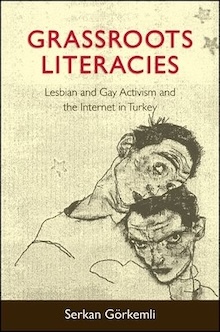
SG: My scholarly inquiry while writing my first, academic book, Grassroots Literacies: Lesbian and Gay Activism and the Internet in Turkey, focused on the globalization of Euro-American queer identities through traditional and digital media and college-student activism in the Turkish context. That cross-cultural and historical perspective as filtered through characters’ perspectives and experiences provided the framework for my collection of short stories. As an interesting aside to the question of fiction versus academic writing and criticism, I have recently published two short pieces of creative nonfiction. I believe creative nonfiction can provide a bridge between creative writing and academic writing; the vivid style of writing in fiction, and all forms of creative writing, can energize academic prose, which is a form of nonfiction that tends to have a more rigid style, by helping to better engage readers and motivate them to keep reading.
AG: What was the most challenging aspect of completing your short story collection?
SG: Learning how to write and publish in a new genre, short stories in this case, is a lengthy, recursive process. The other challenging aspect is handling rejection, which is simply a part of becoming and being a writer. Practicing patience and being in community with fellow writers has helped me cope with these challenges.
AG: Any advice for writers working on their first books?
SG: Read exhaustively in the genre in which you’re writing, establish a writing routine that works for you, develop a supportive writing community, and keep learning about the craft of writing and the business of publishing, because there will always be so much to learn across all career stages. And finally, write about what matters most to you, lean into it and make the best of it within your specific circumstances, whatever they may be, because in the end, it’ll be worth your while as a person and a writer.
+++
Serkan Görkemli is a professor of English at the University of Connecticut and teaches writing and literature at the Stamford campus. He is the author of two books: Sweet Tooth and Other Stories (University Press of Kentucky, 2024; 2024 Foreword INDIES Book of the Year Awards silver winner in LGBTQ+ fiction and finalist in short stories, and 2025 Housatonic Book Awards finalist in fiction) and Grassroots Literacies: Lesbian and Gay Activism and the Internet in Turkey (SUNY Press, 2014; 2015 Lavender Rhetorics Book Award winner). Originally from Türkiye, he has a Ph.D. in English from Purdue University.
+
Amina Gautier is the author of the short story collections At-Risk, Now We Will Be Happy, The Loss of All Lost Things, and The Best That You Can Do. For her body of work, she has been awarded the Blackwell Prize, the Chicago Public Library Foundation’s 21st Century Award, and the Pen/Malamud Award for Excellence in the Short Story.