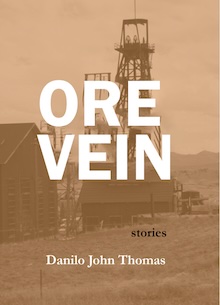
Danilo John Thomas’s story collection, Ore Vein, (Veliz Press) reminds me of a lenticular—one of those weird grooved pictures that shifts images—and I’m a kid jumping from one side of the room to another, watching the flowers bloom then wilt, or the skeleton grow flesh. In Ore Vein, it’s the land and community of Butte, Montana that morphs, with scenery that is beautiful and toxic, all at once. Imagery itself is in constant flux. So is structure. These stories are about mining, about copper, about magic—about characters fighting to survive in a place that is both poison and home.
Danilo and talked about all of that. But before getting into the various views of place, character, and the startling ways they intertwine, we started with the material object.
+
Danilo John Thomas: Someone I know took the physical book down into one of the mines and sent me a picture of it underneath a lamp down in the underground, which is pretty awesome.
Allison Wyss: That’s amazing! Your book is not just in the world. It’s in that world, the world you write about. What can you tell me about that place?
DT: Butte, Montana, and Southwestern Montana in general, are where these stories take place and where I grew up. I had the setting named Birch, Montana, for a long time, as a birch is a solid tree, but also a verb and instrument for punishment. However, I changed the name to Butte, after the actual place, because while most people writing about a specific, real place are concerned about accuracy, I embrace the inaccurate in the form of exaggeration, speculation, or guesswork—the things that make something legendary.
Butte is a legendary place. Like Captain Jack Sparrow, folks will say “That is the shittiest place I have ever heard of.” To which anyone from Butte will probably say, “Ay, but you have heard of it.” And if they haven’t, now they have.
AW: So how will the people of Butte will like the book?
DT: We’ll find out. It’s not a rosy picture, and it wasn’t ever intended to be. Butte has a big literary history, this bootstrapping sort of rosy picture, but it leaves out the harsher realities that I’m deliberately bringing to the surface.
In some ways, that’s metaphorical for small towns across America, but in Butte, it’s real. I don’t know if people will feel like they’re being put on blast for living a certain way.
AW: It makes me think of a question I often wrangle, which is how do you write in a way that’s respectful of the people but possibly critical of their circumstances.
DT: It’s the curating of chaos, right? And there’s so much left out in the fine details. It’s impossible to encapsulate the whole thing.
But it’s always a struggle about what makes place. Everybody’s talking about place-based writing or place as character. It’s this Möbius strip of place and people. A place is a people, but a people is a place too. We, the people, make Butte what it is. But so do the circumstances of Butte, make the people who they are. So being critical or celebratory of one or the other, is tantamount to being critical or celebratory of both.
A lot of these things are either factually accurate or happened to me or someone I know. But I’m fictionalizing. I get this degree of separation, and I’m able to talk about those things in a way that’s less personal.
But my experience with the place is… I don’t think I hate it, but the deepest hatreds are usually born out of love. The anger I’ve had toward the place—that diminished over time into where I could take it on objectively.
It’s also why I get into legendary folk taley, fantastical stuff. Holding up the warped mirror is a way to get at truth that accuracy can’t.
I’m not trying to skewer anything, but I’m trying to represent it, even through fantastical means, and in a way that seems accurate to my experience.
AW: Could you write about it if you still lived there?
DT: I did go back. There’s the Dear Butte residency, which is a great residency. I went back there for a novel I’m writing based on the physical nature of the place. A lot of the mine waste and the Berkeley pit is there so I didn’t have to go off memory but looked at it.
Butte’s done a great job as far as reclamation. There’s a big hill that was barren when I was there, but now it’s covered in trees. And Silver Bow Creek, which they used to call Shit Creek, is now a greenway that has a lively riparian zone that runs through the middle of the town where it used to be dead.
The mine is still open and there’s still a lot going on, but the overall shift is on the up and up and people have become more aware.
So I don’t know, if I still lived there, if I could write about it the same way.
AW: I love your idea of a Möbius strip of people and place. How does that play out in these stories?
DT: Butte has a history worth celebrating, but that is also filled with trouble. Butte copper electrified the nation—literally—once copper was discovered to be a conductor of electricity. It was one of the first electrified cities in the world. Copper in munitions litter the battlefields of World Wars. Butte was a successful testing ground for unionization and the rights of laborers. It’s also a story of corporate greed that sucked dry the Richest Hill on Earth and left ecological and psychological devastation in its wake, the reverberations of which are felt today in the pollution and the resulting cancers of the populace, the self-medicating practices handed down by overworked miners that result in the highest suicide rates in the country.
So, these stories have characters battling the acute tensions, but in many ways the whole of the town’s history.
AW: These stories observe a world that is polluted or corrupted at every turn. Toxins are everywhere.
DT: Mining offered prosperity in one hand, and doom in the other. I used to have weekend fires tucked into hills of mine waste, practiced football on mine tailings laced with arsenic, saw streets collapse into mine tunnels, had friends and family struggle with addictions and contract rare bone cancers, and many of my best friends die by suicide.
It was all normal when I was younger. It wasn’t until I left that I saw how these are not regular occurrences. After a long time, I was able to stop trying to drink it off and start writing about it.
AW: This aspect of good and bad, of a place bursting with beauty and doom—that comes through especially in the book’s imagery. What I expect to be ugly is made beautiful. What I expect to be beautiful is made putrid. In the opening of the first story, “Lug Hack,” moose “drift peacefully through the lake’s murky depths toward their final repose.” But then the moose rot and we flip to “stank soup.”
DT: At the microscopic level everything vibrates. At the macro, we hurl through the void at an unfathomable speed. Constant movement results in constant collision and this results in amazing amalgams or destructive weathering processes. Geologically speaking, writing allows you to apply pressure to your images so that you can find the heat in them. Sedimentary. Metamorphic. Igneous. The same matter in different states.
While I’m describing moose carrion stuck in a lake in these passages, I’m more concerned with the different stages of physical death. I have dealt with a lot of death. Solemnity and reverence, embodied by the dead moose in “Lug Hack,” accompanies the passing of a loved one on a psycho-spiritual level. But on the physical level, as demonstrated by our moose after sitting under water for a month or two, there are the processes that return us to compost. There is beauty in the latter, and there is often something ugly or awful in the former, in a physical way or in any number of performative or social ways.
There is also the reality that I have seen both things in real time.
AW: I love the gore. In other stories, we hear gristle rip and look at the tendons inside deep gashes.
DT: It goes back to just being familiar with dead things and injuries to the point that they don’t make me squirm. There were a lot of dead frogs, deer, rabbits, varmints, etc. around my cabin growing up. I gut fish all the time. My father worked as an RN for decades and has stories to tell.
I’m drawn, perplexed, inspired by the literal insides of things. The gore is natural and what sentient beings are made from. It’s not something we should be unfamiliar with.
AW: Here’s another example of the beautiful existing in the same space as toxicity and death, this time from “Grunt”:
It’s a strip mine that has slowly turned into a lake of acid, and it’s gorgeous when the sun rises. Today, thousands of avian corpses litter the shoreline. Lost and confused, a gaggle of geese landed in the pit water. A mix of arsenic, copper, cadmium, cobalt, iron, manganese, zinc, and sulfate, the pit water turned their guts out through their beaks and blistered their webbed feet. Their black feathers drift to the shoreline in lonely patches.
DT: While not in the exact fashion displayed in “Grunt,” a large flock of geese did land in the Berkely Pit in Butte, Montana, and I did work as a grunt on the roof of a concentrator right next to the Pit.
Looking over those polluted waters every day for a summer, as they changed from a milky lavender to ocher to brick, I began noticing other small details in the spiraling terraces of the mine—formations, shapes, colors, wildlife. I started to appreciate the beauty of the place, regardless of the fact that the Pit is the number one superfund site in the continental United States.
AW: In “Blast Furnace,” the sad and depressing is wondrous, perhaps, because I’m given kid goggles with the sentence: “Then, when he said those words, like a spell, we were kids, again.”
We couldn’t stop going, because the landscape was dotted with towering headframes; because a mile deep pit slowly filled with acidic run off; because historic buildings rotted around the edges of everything we knew; because the Buick engine rusted in the Shit Creek ditch, and the stolen shopping cart leered, stuck in the mud and filled with crushed Zima bottles; because the streetlights flickered and the trees had all died fifty years ago in their hardscrabble lots and the bar stools had been worn down to the springs; because all of it was everything in all of us, and we couldn’t stop without ceasing to exist.
DT: You have it exactly right. Children make the most of their environment. Trash gleams and castles are made of rusted steel. They are not one or the other, they are liminal. They are both. And that’s what these characters are going through. They are who they were, but they are somebody else, too. They’re in the process of shedding their youth and they’re not ready to be adults.
AW: This one is also from “Blast Furnace”:
Bel bayed at the moon, and I joined him. We lowed into an echo of a thing. Bel hung his head between the grooves of his pecs. The horseshoes he had for triceps flexed as he gripped the concrete.
DT: So, here, craft wise, my goal is to remove Bel from his humanity. He’s a wolf, then a vibration, then a chiseled mass fixed with horseshoes, which are lucky if hung correctly, bad luck if not. Thematically, he shifts because he’s lost. He doesn’t know who he is. Soon after, on the way to get into a fight and after being made to seem wolfish, he helps a family of quail across the road so they don’t get injured. So Bel is an amalgam. He is many things, but they don’t necessarily gel, he really is certain things, but also has to act certain ways to deal with inner turmoil.
It’s a volatile concoction that rhymes with the setting. Minerals and ores are necessary, but the damage done to the environment, which can be beautiful is also very real. You end up with nothing but sacrifice most of the time.
AW: We’re back to that Möbius strip of place and people.
That shape reminds me, actually, about the structural play in this collection—stories as triptych, or interworked with description of copper, or a list of screwdrivers.
DT: I like the challenge of fitting a narrative around a set of collected objects. The form and content edify each other in interesting ways. Sometimes the structures are absorbed as a thematic network of images. Other times, the network is so apparent that it becomes a deliberate framing structure.
Objectivity is a goal of Ore Vein, and I want to alter or expand people’s methods of decoding rhetorical structures in ways that make them uncomfortable. Having balance between the formal and the narrative is important, but these things exist on a spectrum. I want to offer the whole range.
AW: Can you talk more about objectivity? Do you think it’s an achievable goal?
DT: Something that stuck with me from a literature class is a Nietzsche quote about the more eyes we have on the subject, the more total our objectivity will be. It was the first time I understood what objectivity meant.
If you have two perspectives, you’re being objective to some degree, because it’s not just your own subjective view. But then if you have fifty considerations on one thing, or you have every possible consideration—where does that end? At some point, you have to say there is no possible take because there are so many takes that not one of them can be said to be correct. So at some point there’s diminishing returns on objectivity. But it’s hard to say that it’s not a good thing.
AW: So the stories in Ore Vein are all different takes on the same general subject? Through formal variations in the prose and characters’ perspectives, we get closer to truth.
DT: Right. We get a better understanding. And, you know, and sometimes those understandings are contradictory.
AW: You mentioned earlier that you get at truth through warping it, through a magical lens. The magical tales must be yet another view.
DT: So, Butte was a proverbial melting pot at its peak. Folks from all over the world were arriving by the thousands and bringing their cultural heritage. It’s why Butte folk are so keen to tell stories and to tell them in the most hyperbolic fashions. Our precursors were trying to outdo one another on a mythical-spiritual level, and it fuels the stories people tell with just a hint of magic.
The great Kevin Shannon used to sit at the M&M to tell the story of the Barnum and Bailey Circus coming to Butte in 1930 or thereabouts. There wasn’t anywhere to keep the elephants inside the city, so they put them just west of town. The keepers, not knowing the area, bed the herd down right near the train tracks. Wouldn’t you know but the night carts, full of ore for the smelter in Anaconda, came running down on them, and plowed into one of the elephants, killing it and derailing the train. When the Anaconda Co. went to negotiate a settlement with B&B, old Barnum let them know that they owed them for an entire herd of elephants. The Anaconda man said, “What? I thought just the one was hit.” And Barnum said, “Well, yes, but elephants stand in a line, trunk holding tail, and when your train hit the elephant in the rear it yanked the assholes out of the other eleven!”
That is not only a good story that I wanted to tell you, but the story of the storyteller is also a good story, and so on. The more it gets told, the more magical it becomes, literally and figuratively, until the tale and speaker of the tale are imbued with the magic of the legendary. Plus, I love mythology and Montana is full of it.
These tales are usually directly related to history, and history has magic in it that can make clean what might be horrid. In “Birdbone” and “Gift Horse,” magic literalizes history’s spell upon the present.
AW: What about the more grotesque sort of magic? A beaver bursts a truck’s oil pan with its teeth, but its carcass becomes a stopper for the oil, and the truck keeps running.
DT: So for “Lug Hack,” the beaver story, the occurrences and images are those convergences of form, character, and setting that I was harping on earlier.
The early fact of the beaver stuck in the oil pan is a literalization of the narrator’s dependence on dead things to keep him moving through his daily life. There are a number of dead or near dead things in that story that attack that notion in different ways to offer a bit of thematic objectivity.
That said, the beaver in the oil pan did happen to someone driving northern Montana. It was so odd when I read it in a newspaper that I wrote it in my book of commonplace and the note eventually made it into “Lug Hack.”
Now, “Birdbone” is a Faustian tale, or maybe more of a Robert Johnson tale, about the cost of magic. It’s about the dangers of certain stories, and how they might imprison us or set us free. So, I would say that it uses the idea of the Fae, Gods and tricksters, to question the “spell” certain stories cast over us, as a decoy. The Fae, are they real? Are they the whims of a mad man? The real dangerous magic is in the story itself and whether getting too thoroughly entrenched in a narrative about our past is ultimately damning. All good folk tales and yarns have a similar warning.
AW: Storytelling is powerful. And dangerous.
DT: On a larger scale, the whole book is collage work, but there’s some things that are more emotionally driven. They’re more lyric. Whereas the longer, more traditional stories are more character driven and get into motivation in ways that the others are not able to. It offers that good balance of emotional versus stylistic ingenuity because you can get things different ways, whether it’s the art form or the language or the content. I was trying to demonstrate a wide range of stories in offering that idea of objectivity.
AW: So these stories are all different takes on the same thing. Can you say what that thing is? I know it’s an impossible question.
DT: Maybe I’m trying to get out what that question is. It’s how can I consider the place, versus how history has considered the place. How it’s been discussed versus how it can be discussed. Everything has simultaneity, right? It is this, but it is also this, and it is also this, and it is also this, and it is all those things at the exact same time.
+++
Danilo John Thomas is the author of the short story collection, Ore Vein (Veliz Books, 2026) and two chapbooks, The Hand Implements (The Cupboard Pamphlet, 2017), and Murk (AB Gorham, 2012). A graduate of the PhD program in creative writing at Florida State University, he is recently the co-publisher at Octopus Books, managing and prose editor at Baobab Press, and assistant managing editor at The Kenyon Review. Born and raised in Southwestern Montana, he now lives in Omaha, Nebraska, with his wife, two daughters, and one toothsome staffy.
+
Allison Wyss is the author of the short story collection, Splendid Anatomies (Veliz Books), which was a finalist for the Shirley Jackson Awards. Her essays and interviews have appeared in Necessary Fiction, Split Lip, Lit Hub, The Rumpus, the Brooklyn Rail,and elsewhere. Her stories have appeared in Alaska Quarterly Review, Cincinnati Review, Wigleaf, and many other places. She lives in Minneapolis, where she teachs and writes a column about craft for the Loft Literary Center.